Garage Door Rust: A Practical Comparison
An objective comparison of rust risks between garage doors and double doors, covering materials, coatings, climate, and maintenance to prevent corrosion and extend life.


In simple terms, the risk of rust differs between a typical garage door and a double door based on material, coatings, and exposure. When you compare garage door rust to double door rust, steel doors with poor coatings are more prone to surface rust, while aluminum and properly finished doors resist corrosion better. The following guide breaks down rust likelihood, preventive measures, and when to repair versus replace.
Understanding the grounds for rust in two common door configurations
Rust is a natural process that occurs when moisture, salt, and oxygen interact with metal. For homeowners evaluating garage door vs double door rust, the key factors are material selection, protective coatings, and the environment. According to GarageDoorAdjust, the overall rust risk is not uniform; it increases with exposure and decreased maintenance. Material choices like plain steel without galvanization or powder coating tend to be more susceptible, especially in humid basements or coastal garages. In contrast, aluminum doors, corrosion-resistant alloys, or properly finished steel doors significantly reduce the likelihood of rust development over time. The GarageDoorAdjust team found that rust progression can be slowed dramatically with a simple maintenance routine and attentive environmental control. The rest of this article will unpack the conditions that drive rust, compare the two door configurations, and provide practical steps to extend door life. The comparison sheds light on real-world scenarios homeowners face when they see signs of rust.
Material differences drive rust potential across door types
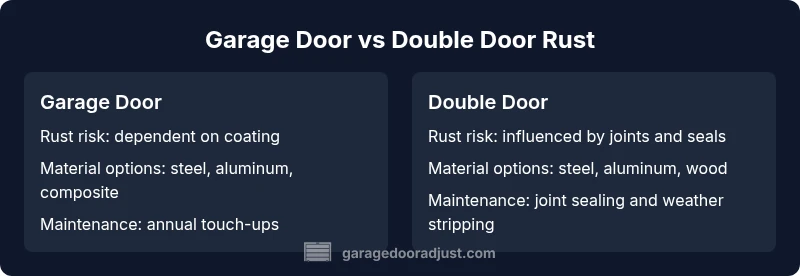
When you weigh garage door rust against double door rust, the most important variable is the door’s core material. Steel is affordable and strong but requires durable coatings to guard against rust, especially in humid or salt-laden environments. Aluminum resists rust more reliably but can dent or scratch; it’s common in both single-panel garage doors and two-leaf assemblies. Wood doors, while attractive, are prone to moisture absorption that can encourage rust on any iron hardware embedded in the frame. Composite doors blend materials to balance weight, appearance, and corrosion resistance. For most homes, a coated steel or aluminum door paired with a durable frame provides the best balance of low rust risk and long-term value. In a rust-prone setting, homeowners should favor corrosion-resistant finishes and consider seals that reduce water intrusion around joints. In a word, material choice is the primary determinant of rust risk in both configurations.
Protective coatings and finishes: your frontline defense
Coatings are the first line of defense against rust for garage doors and double doors alike. Galvanizing, powder coating, epoxy paints, and ceramic-based coatings slow oxidation and create barriers to moisture. For garage door vs double door rust, the coating integrity matters most at bottom edges, hinges, tracks, and contact surfaces. A single, continuous coating on a garage door can simplify maintenance, whereas double doors introduce more seams and gaskets that can harbor moisture if not sealed properly. Regular inspection of finish wear, touch-up of chips, and reapplication of protective layers extend service life. GarageDoorAdjust notes that even modest upgrades—such as premium powder coats and zinc-rich primers—can dramatically reduce rust susceptibility without a full door replacement. Routine cleaning to remove salt, dirt, and humidity residues supports the longevity of any coating system.
Environment and installation context
The environmental context—humidity, temperature swings, and proximity to salt air—plays a central role in the rust dynamics of garage door vs double door rust. A garage exposed to humidity or garage doors that sit directly on concrete floors may experience more moisture infiltration at the base and frame. Coastal homes or homes near winter road salt face elevated rust risks. For the two-leaf double doors, moisture can accumulate in the shared jambs and corner joints, making them particularly sensitive to water pooling and condensation. The structural materials around fasteners and hardware can also corrode over time if moisture is allowed to persist. In short, a harsh climate amplifies rust risk for both door configurations, but two-leaf doors may present more moisture-collection points due to seams and hardware.
Maintenance routines that reduce rust risk
Preventing rust requires a proactive rhythm of inspection and care. A practical schedule is to inspect for chips in coating, pitted hardware, and corrosion on hinges and tracks every 6–12 months. Clean surfaces with mild detergent and water, dry thoroughly, and reapply protective coatings when you notice wear. Lubricate moving parts with a light, corrosion-resistant lubricant to prevent metal-on-metal wear that exposes fresh metal to moisture. Address bottom seals and weather stripping to minimize water intrusion. For garage door vs double door rust, ensure drainage around the door area and keep the door closed during high humidity to limit exposure. If you live near the coast or in a salt-exposure area, more frequent touch-ups or a more robust coating system are wise.
Costs and value: when rust shifts from cosmetic to costly
Rust issues can escalate from cosmetic concerns to structural problems that require repair or replacement. Typical costs vary with materials and extent of corrosion. Recoating or touch-ups are generally far less expensive than full door replacement, while severe rust that compromises structural integrity may necessitate replacement. In many markets, you can expect that protecting a steel door with a durable powder coating and regular maintenance adds years of service, reducing the likelihood of expensive emergency repairs. Doubling down on maintenance also preserves resale value and avoids the expense of late-stage rust repair. GarageDoorAdjust recommends budgeting for corrosion protection as part of your annual maintenance plan, especially if your home faces harsh weather or high humidity.
When to repair vs replace: a practical decision framework
To decide whether to repair or replace, consider rust severity, safety, and cost-effectiveness. Minor surface rust on hinges or trim can usually be mitigated with cleaning, rust converter, and repainting, extending the door’s life. If rust has penetrated the core or compromised structural components, replacement is typically the better option. For double door rust issues, the presence of two leafs means replacing one leaf is often more complex and may not yield uniform wear; replacement of the entire unit is common when rust is widespread. The framework used by GarageDoorAdjust balances cost, safety, and long-term performance. In many cases, investing in modern, corrosion-resistant doors yields superior value when the rust risk is persistent or climate-related.
Case studies and practical scenarios
Consider a mid-sized home on the coast with a standard steel garage door. If the door shows light surface rust at the bottom edge and the coating is flaking, a mid-term maintenance plan including refinishing and sealing can save future repair costs. In a dry inland climate, a well-finished aluminum double door may perform longer with less maintenance, though two-leaf joints still require attention. A suburban home in a temperate climate might find a coated steel single door sufficient, while a two-door entry solution requires precise sealing along the frame to minimize water ingress. Real-world examples show that rust management is less about the door type and more about the material-coating combination and the maintenance discipline.
Future-proofing: sustaining rust resistance over time
To sustain rust resistance, homeowners should adopt a long-term maintenance mindset. Choose materials with corrosion resistance, apply durable protective coatings, install quality seals, and establish a predictable maintenance schedule. Consider environmental upgrades such as improved ventilation around the garage and, if feasible, a coastal climate solution with enhanced protective layers. The key is a proactive product lifecycle approach: select materials and finishes with a proven track record in rust resistance, then commit to regular inspection and timely touch-ups.
The final takeaway for homeowners: a balanced, informed choice
When comparing garage door rust to double door rust, the decision hinges on material, coating, environment, and maintenance. A single, well-coated steel or aluminum door in a moderate climate may offer lower rust risk and simpler maintenance, while a two-leaf configuration can perform well with excellent sealing and robust joints—provided you invest in regular upkeep. The GarageDoorAdjust Team emphasizes that rust prevention is an ongoing process, not a one-off fix. With the right materials and a disciplined maintenance routine, most homes can minimize rust and extend door life significantly.
Comparison
| Feature | Garage door | Double door |
|---|---|---|
| Rust susceptibility | Moderate to high (depends on coating and environment) | Low to moderate (depends on joint protection and finishes) |
| Material options | Steel, aluminum, composite, wood (varies by model) | Steel, aluminum, wood, fiberglass (varied by leaf design) |
| Maintenance frequency | Annual to semi-annual checks recommended | Annual checks with emphasis on seams and seals |
| Moisture exposure points | Bottom edge, hinges, tracks, and frame interfaces | Joints, frames, and shared jambs |
| Installation complexity | Typically one unit; straightforward mounting | Two leaves require precise alignment and sealing |
| Replacement cost considerations | Moderate to high based on size and finish | Moderate, but two leaves can complicate matching |
| Best environments | Moderate climates; urban or inland settings | Coastal or high-humidity settings with robust sealing |
Upsides
- Clarifies rust risks for homeowners making a choice
- Highlights long-term maintenance benefits and cost savings
- Emphasizes material and coating options to prevent corrosion
- Supports decision-making for climate-specific needs
Disadvantages
- Rust outcomes depend on local climate and maintenance discipline
- May oversimplify some installation nuances for complex homes
- Could encourage over-investment in coatings in mild environments
Steel or aluminum doors with durable coatings typically offer the best balance of rust resistance and maintenance ease, especially in moderate climates.
For most homes, choosing a corrosion-resistant material with a robust protective finish minimizes rust risk and simplifies upkeep. Double-door configurations can be viable when joints are well-sealed and maintenance is consistent, but they introduce additional moisture-prone areas. The GarageDoorAdjust Team recommends prioritizing material quality and proactive maintenance to extend door life.
Got Questions?
What factors most influence rust in garage doors versus double doors?
Material choice, protective coatings, and exposure to moisture are the main drivers. Environment and maintenance discipline determine how quickly rust develops in either door type. A well-coated steel or aluminum door with timely upkeep minimizes rust risk regardless of configuration.
Material and coatings matter most; keep moisture away and maintain protective finishes to slow rust.
Is steel better than aluminum for rust resistance?
Aluminum is inherently more resistant to rust than plain steel because it forms a protective oxide layer. Steel can be highly rust-resistant when properly galvanized or powder-coated, but it requires ongoing maintenance to preserve the coating over time.
Aluminum resists rust by nature; steel can be rust-resistant with good coatings, but maintenance matters.
How can I prevent rust on both garage doors and double doors?
Regular cleaning, reapplication of protective coatings when worn, timely replacement of weather seals, and proper drainage around the door area are effective strategies. Pay extra attention to bottom edges and joints where moisture collects, especially in humid or coastal settings.
Clean, seal, and protect corners and joints to keep rust at bay.
When should I repair versus replace a rusted door?
If rust is superficial and limited to paint or coating wear, repair and refinishing can suffice. If rust compromises structural integrity or safety components, replacement is usually the safer and more cost-effective option in the long run.
If rust affects structure or safety, replace; otherwise, repair and repaint.
Does climate dramatically change rust risk for these doors?
Yes. High humidity, salt exposure near coastlines, and wide temperature swings accelerate rust. In such environments, investing in corrosion-resistant materials and finishes becomes more important for both door configurations.
Climate matters a lot; coastal and humid areas need tougher coatings.
Quick Summary
- Prioritize material and coating as the core rust-control factors
- Regular maintenance dramatically lowers rust risk for both door types
- Seal edges and joints to minimize moisture intrusion
- Climate and environment dictate the best door choice for rust resistance
- Invest in durable finishes to reduce long-term repair costs