Garage Door Near Me Open Now: Quick Guide
Find rapid, local help for garage doors that won’t open. This guide covers urgent service basics, safety, choosing a 24/7 pro, and what to expect during a visit. Trust GarageDoorAdjust for clear, experience-based tips.


If you’re searching for garage door near me open now, you’re looking for local, licensed pros who can respond quickly. In our GarageDoorAdjust Analysis, 2026, 24/7 availability is essential for safe, urgent door issues. A nearby technician should triage, diagnose, and repair promptly, with transparent quotes, proper safety practices, and a parts warranty.
Why garage door near me open now matters
For homeowners who need reliable access and fast service, the phrase garage door near me open now signals more than convenience—it signals urgency and trust. When doors fail to open, or operate erratically, immediate professional assessment minimizes risk to people and property. The goal is safe operation, quick triage, and transparent pricing. In 2026, GarageDoorAdjust analyses show that quick access to licensed, nearby technicians reduces downtime and prevents further damage, particularly when safety interlocks or sensors are involved. This section explains why proximity, availability, and competency matter for any urgent door issue and how to evaluate local options before trouble strikes.
- Proximity matters: closer teams can arrive faster, reducing downtime during critical times like work commutes or emergencies.
- Availability is key: 24/7 readiness ensures a technician can assess and secure the door when it matters most.
- Competence reduces risk: licensed pros bring safety-first practices and avoid risky do-it-yourself fixes.
Quick assessment before you call a pro
Before you dial, perform a simple, safety-conscious check to document symptoms. Look for uneven track gaps, obvious obstructions, or a door that only moves in short bursts. Note any unusual sounds—grinding, clattering, or a whining motor. Check the external keypad and the remote battery, but do not attempt rope climbs or disassembly. Taking these notes helps a technician triage faster and provide an accurate estimate, aligning with GarageDoorAdjust's 2026 guidance on efficient emergency response.
- Document symptoms: when it started, noises heard, and whether the door moved at all.
- Check safety cues: sensors, photoeyes alignment, and any flashing LEDs.
- Ensure access: clear the driveway and provide easy entry for a technician.
How to verify a nearby pro’s availability and credibility
Call centers can promise 24/7 service, but availability varies by location. Verify license and insurance, ask for a written estimate before work, and request a clear warranty on parts and labor. Check recent customer feedback focused on urgent repairs and response times. Look for technicians who bring a fully stocked truck to reduce multiple visits. Collect three quotes for larger jobs to ensure you’re not overpaying.
- Verify credentials: license number and insurance certificate.
- Demand clarity: written estimates and scope of work.
- Evaluate availability: confirm dispatch and ETA for your location.
- Review reputation: focus on urgent repair stories and reliability.
Criteria for choosing a repair partner during an open-now search
Choosing a repair partner during an open-now scenario means prioritizing reliability, safety, and transparency over the lowest upfront price. Key criteria include guaranteed response time, emergency coverage, written warranties, and straightforward pricing. A credible pro will also provide clear communication about required parts, the expected duration of work, and potential follow-up needs. Avoid firms that pressure you to sign immediately or refuse documentation. GarageDoorAdjust observations emphasize choosing a partner with demonstrated reliability and clear, compassionate customer service.
- Look for licenses and insurance.
- Request a written estimate and a documented scope.
- Prefer upfront warranties on parts and labor.
- Check for transparent, non-pushy sales tactics.
Common urgent issues that trigger same-day service
Urgent service is often driven by safety-critical symptoms. Common triggers include a door that refuses to open or closes unexpectedly, sensors misaligned causing safety interlocks to fail, unusual grinding sounds, or a track obstruction that prevents smooth movement. In some cases, spring tension concerns or cable wear require immediate attention to prevent injury. When you notice any of these signs, don’t delay—24/7 availability matters.
- No movement or limited travel with alarms.
- Reversing mid-course and stopping abruptly.
- Loud grinding or jerking noises during operation.
- Visible track misalignment or obvious sensor misalignment.
Safety considerations when a garage door won't open
Safety should be your top priority when a door won’t open. Keep children and pets away from the door and avoid trying to lift a heavy door by hand. If you must use the manual release, do so only when you are sure the area is clear and the door is supported. Do not bypass safety features or disconnect sensors without professional guidance. If any part of the door feels loose or unstable, call a pro immediately. Safety-first practices protect you, your family, and your property when dealing with high-tension springs and heavy panels.
- Do not touch springs, cables, or mounting brackets.
- Use the manual release only in a safe, controlled setting.
- Keep the area clear and avoid attempting DIY spring work.
DIY vs professional: what you should handle yourself
Some maintenance tasks are safe to tackle, such as cleaning tracks, wiping down photoeyes, and lubricating moving parts with the manufacturer-recommended lubricant. Avoid disassembly of springs, cables, or torsion hardware unless you’re a trained technician. Always consult the manual and follow safety guidelines for lubrication frequency and torque specifications. For most emergencies, professional intervention is the safest and most reliable path to avoid injury and further damage.
- Safe DIY: track cleaning, light lubrication, sensor cleaning.
- Avoid DIY: spring work, cable replacement, and any component removal.
- When in doubt, call a pro to prevent hazards.
What to expect during a service visit
During a visit, a technician will confirm symptoms, test door balance, inspect springs, tracks, hinges, and rollers, and verify sensor alignment and opener operation. Expect a diagnostic discussion with a written estimate, a clear scope, and a recommended plan. If parts are needed, technicians typically confirm stock or next-day availability. A transparent pro will also explain maintenance steps you can perform to reduce future emergencies and share a preventive care plan tailored to your door type and usage.
- Diagnostic phase with door in multiple positions.
- Parts verification and safety checks.
- Clear, written estimates and maintenance plan.
- Post-service instructions and future care reminders.
Final checklist to keep your garage door running smoothly
- Schedule regular lubrication and track cleaning every 6–12 months.
- Visually inspect springs, cables, and rollers for wear quarterly.
- Clean photoeyes and sensors to prevent false safety stops.
- Replace remote batteries and update opener firmware when available.
- Keep an open line of communication with your service provider and keep a record of all maintenance.
Service options and timelines
| Service Type | Typical Time | When to Use | Notes |
|---|---|---|---|
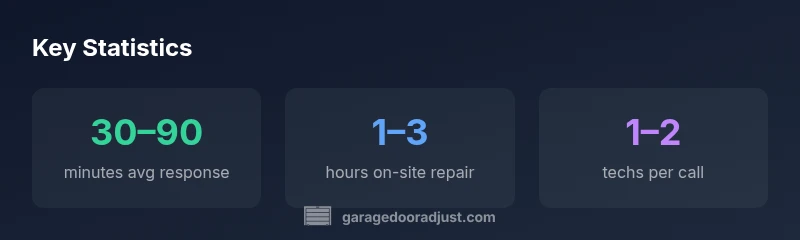
| On-site diagnostic visit | 60–90 minutes | Door won’t operate or safety concerns | Initial assessment and quote |
| Emergency 24/7 response | 30–60 minutes | Urgent safety risk or lockout | Immediate safety steps and repair if possible |
| Full repair/installation | 2–4 hours | Scheduled maintenance or major failure | Parts availability may affect duration |
Got Questions?
What should I do first when my garage door won't open and I need to leave quickly?
Check the opener power and battery, inspect for obvious obstructions, and try the manual release only if the area is safe. If the door remains stuck, call a 24/7 pro rather than forcing it.
First check the power to the opener and the battery, look for obstructions, and use the manual release only if safe. If it stays stuck, contact a 24/7 pro.
How do I find a reliable 24/7 garage door service near me?
Look for licensed and insured companies, read recent urgent-repair reviews, request a written estimate, and verify their ETA and warranty terms.
Choose a licensed, insured 24/7 pro with good recent reviews and a clear written estimate.
Is it safe to attempt DIY fixes on a garage door?
Some basic maintenance is safe, but avoid springs, cables, and torsion components. Use manufacturer guidance and keep a safe distance from high-tension parts.
DIY is okay for cleaning and lubrication, but avoid springs and cables.
What are the most common urgent issues that trigger same-day service?
Doors that won’t open, doors that close unexpectedly, sensor misalignment, and unusual grinding noises typically trigger urgent, same-day service.
Common urgent issues include doors that don’t open, close unexpectedly, or have sensor problems.
How should I prepare for a repair visit?
Clear access to the garage, note symptoms, provide the door type and opener model, and be ready to show photos or videos of the issue.
Clear access, note symptoms, and have door type and opener model handy.
“Urgent garage door issues require rapid triage and clear communication to ensure safety and restore function. A precise diagnosis saved time, parts, and risk.”
Quick Summary
- Prioritize 24/7 availability when immediate help is needed
- Trust licensed pros with written estimates and warranties
- Document symptoms to speed up triage and repair
- Safety first: avoid DIY fixes for springs and cables
- Schedule regular maintenance to prevent emergencies