Garage Door 2025: A Homeowner's Step-by-Step Guide
Learn to diagnose, repair, and maintain your garage door in 2025 with an expert, homeowner-friendly approach. This guide covers safety, tools, step-by-step fixes, opener programming, and seasonal maintenance for reliable operation.


According to GarageDoorAdjust, you will assess and safely repair common garage door issues in 2025, including balance testing, track alignment, and opener diagnostics, so your door opens smoothly without binding or noise. Before you start, unplug the opener, wear eye protection, and have a helper on hand. This guide covers tools, step-by-step actions, and safety warnings.
What changes in 2025 for garage doors
Across the home improvement landscape, garage doors have evolved notably by 2025. The newest models emphasize safety, energy efficiency, quiet operation, and smarter integration with home networks. The GarageDoorAdjust team notes that modern doors blend durable materials—galvanized steel, fiberglass, and high-strength aluminum—with improved weather seals that cut drafts and moisture intrusion. Tracks and rollers now feature lower friction coatings to reduce noise and extend life. Smart openers come with more reliable battery backups and broader compatibility with mobile apps, voice assistants, and automations.
Sensors that detect misalignment and obstructions have become more dependable, with auto-reverse functions that consistently meet safety standards. Insulation performance has improved, especially for attached garages, helping stabilize indoor temperatures and reduce energy loss. From a code perspective, 2025 updates strengthen pinch-resistance requirements and provide clearer DIY guidelines for safe installation. While the core principles stay the same, homeowners will notice smoother operation, fewer cold-weather jams, and simpler maintenance routines. GarageDoorAdjust Analysis, 2026, notes that these advances help homeowners avoid common failure modes and extend equipment life. When upgrading in 2025, prioritize door balance, sensor function, and a compatible opener with a solid backup power option.
The 2025 safety ecosystem: sensors, seals, and smarter openers
Modern safety ecosystems combine photoelectric sensors, edge detection, and smarter logic to prevent injuries. Door seals have tighter contact with door bottoms, improving weather resistance and energy efficiency. On the opener side, energy-efficient motors and battery backups minimize downtime during power outages. Homeowners who adopt smart features gain remote monitoring, maintenance alerts, and easier diagnostics, reducing unexpected failures across seasons.
Tools & Materials
- Safety glasses(ANSI Z87.1-rated for impact resistance.)
- Work gloves(Grip and hand protection; avoids pinching.)
- Stepladder(Stable, 6–8 feet for most residential doors.)
- Phillips screwdriver(PH2 head for common screws.)
- Flathead screwdriver(Small blade for prying or slot screws.)
- Wrench set(Open-end or socket wrenches for fasteners.)
- Lubricant spray(Synthetic garage-door lubricant; apply sparingly.)
- Rags/Shop towels(Clean up drips and wipe excess lubricant.)
- Voltage tester(Check for live circuits when working near the opener.)
- Masking tape (optional)(Mark sensor alignment or track reference points.)
Steps
Estimated time: 60-120 minutes
- 1
Prepare workspace and safety plan
Clear the area around the door and openers. Review the manual for your door model and establish a two-person workflow if possible. Put on eye protection, gloves, and ensure children and pets are away from the work zone.
Tip: Have a helper ready to hold or assist with door movement during tests. - 2
Disconnect power and secure the door
Unplug the ceiling-mounted opener and lock out the door’s moving parts to prevent accidental movement. If you have a manual-release handle, practice using it with the door supported by a prop or helper.
Tip: Never work on a door that is actively powered or can shift unexpectedly. - 3
Perform a balance test
With the door closed, disconnect the opener and pull the door up or down to feel resistance. A balanced door should stay at position if you briefly lift and let go; if it falls or sags, spring tension may be out of range and a pro should inspect it.
Tip: Keep one hand ready to stabilize the door if it starts to move. - 4
Inspect tracks, rollers, and hinges
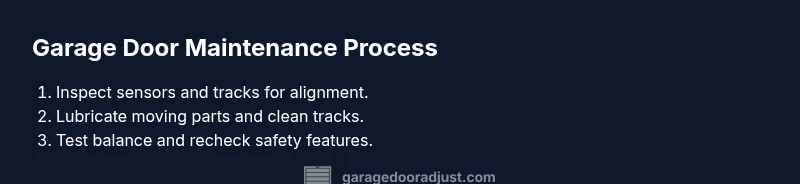
Look for dents, debris, or misalignment in the tracks. Clean, lubricate, and gently realign rollers and hinges. Check for wear on rollers, pins, and hardware and replace as needed.
Tip: Use a level to verify tracks are vertically aligned; slight misalignment can cause binding. - 5
Test safety sensors and opener limits
Reattach power and test that the sensors detect obstructions. Run the door through its full travel cycle and ensure the auto-reverse feature engages when blocked. If you have a smart opener, verify app notifications and remote updates.
Tip: If the opener’s LED indicators are blinking, consult the manual for the fault code. - 6
Lubricate moving parts and re-test
Apply a light coat of garage-door-specific lubricant to springs, hinges, rollers, and tracks. Wipe away any excess to prevent grit accumulation. Re-test door balance and opener operation after lubrication.
Tip: Avoid lubricating pulleys or the belt system inside the opener; use only exterior moving parts.
Got Questions?
What safety steps should I take before starting garage door repairs?
Unplug the opener and disconnect power before touching moving parts. Wear eye protection and gloves, and keep bystanders away. Do not work near springs unless you are trained.
Unplug the opener, wear protection, and keep others away before you start.
How can I tell if springs are damaged?
A door that won’t stay balanced, sags, or feels heavy to lift can indicate spring issues. Do not attempt to adjust torsion springs yourself—call a professional.
Look for sagging or hard manual lift and avoid DIY spring work.
Is it safe to lubricate tracks and hinges myself?
Yes, lubricate moving metal components with a garage-door-rated lubricant. Do not spray on sensors or the opener gears, and wipe off excess.
Lubricate the moving parts, but stay away from sensors and the opener's gears.
Can I program a new garage door opener myself?
Most openers can be programmed using the Learn button or wireless setup. Follow the manufacturer’s instructions and verify sensor alignment and limits after programming.
Yes, typically, but follow the manual and check safety sensors.
What determines the cost of professional repairs?
Costs vary by region and job scope. A professional will inspect, quote parts, and provide a written estimate before starting work.
Costs vary by job; always request a written estimate first.
Watch Video
Quick Summary
- Assess 2025 door features and safety upgrades before work.
- Balance tests prevent dangerous spring tension surprises.
- Keep tracks clean and lubricated for smooth operation.
- Program openers safely and verify sensor performance.
- Consult a pro for springs and major hardware replacements.