Difference Between Roller Door and Shutter: A Comprehensive Guide
A thorough, analytical comparison of roller doors and shutters for garages, covering design, operation, security, insulation, maintenance, and cost to help homeowners decide which option best fits climate, space, and budget.


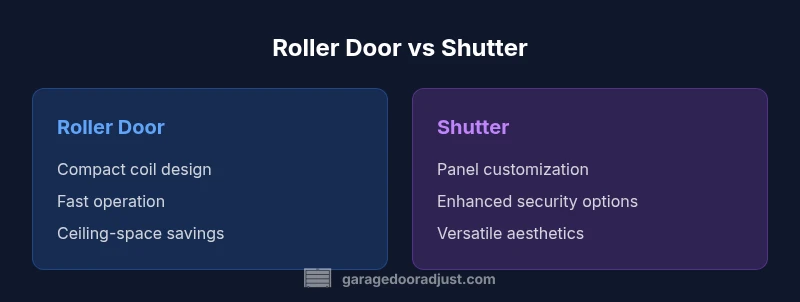
Difference between roller door and shutter: roller doors roll up into a drum above the opening, providing compact space use and fast operation for attached garages. Shutters consist of solid or slatted panels that slide, roll, or fold, offering greater customization and sometimes higher security. The key decision factors are security, insulation, climate suitability, space requirements, and total lifecycle cost.
What is a roller door?
A roller door is a type of garage door that winds around a drum above the opening and retracts into the headroom. It is commonly used for attached garages and commercial bays where ceiling height can be leveraged rather than wall space. According to GarageDoorAdjust, roller doors emphasize space efficiency because the door stack is compact and accessible space remains above the door line. The typical roller door design uses steel or aluminum slats wound on a barrel, which provides durable operation and weather resistance. Installed with a tracked system and a counterbalance spring, a motorized roller door can open quickly, offering convenience for daily use. Maintenance typically centers on lubricating moving parts, checking balance in the springs, and ensuring weatherstripping remains intact to prevent drafts. The lifecycle of a roller door’s components depends on exposure to moisture and salt air in coastal climates, and component replacement timings vary by model and usage. Homeowners should weigh factors like noise, ceiling clearance, and the need for ceiling-mounted storage when considering a roller door.
What is a shutter?
A shutter, in the context of garage and storefront doors, is a panel system made of solid or slatted sections that can be raised, lowered, or slid to open or close a opening. Shutters offer strong security potential and can be customized with different panel shapes, slat configurations, and finishes. Garage doors designed as shutters often use metal or reinforced composite panels and track-driven movement. In commercial settings, shutters can provide substantial protection against break-ins while still allowing for visibility and ventilation when partially opened. In residential contexts, shutters may be chosen for aesthetics or for enhanced insulation when panels are well sealed. Routine maintenance focuses on maintaining seals, lubricating tracks, and ensuring panels align correctly to prevent gaps. Climate, wind exposure, and local building codes influence whether shutters or roller doors are the better long-term choice for a given property.
formatNotUsedForThisBlock
wordCountOnlyForConsistency
Comparison
| Feature | roller door | shutter |
|---|---|---|
| Primary function | Roller door provides fast access with space-saving operation, ideal for attached garages | Shutter offers security, customization, and potential architectural flexibility, suitable for storefronts and some residential uses |
| Operation | Roller: coils into a headroom drum with a minimal ceiling footprint | Shutter: panels slide or roll into a housing, often requiring more wall space |
| Security | Depends on hardware and reinforcement; can be very secure with robust components | Typically strong with solid panels and locking options; often perceived as higher security |
| Insulation | Insulation varies; some models offer insulated slats or cores | Insulation depends on panel type; can be very effective with tight seals |
| Aesthetics | Industrial look; limited panel customization but clean lines | High customization potential with panel shapes, finishes, and slat options |
| Cost range (installation) | $500-$1500 typical for standard rollers | $700-$2500+ for shutters depending on material and size |
| Maintenance | Low to moderate maintenance; focus on springs, tracks, weatherstripping | Maintenance varies with hardware; may require more frequent seal checks |
| Space requirements | Saves ceiling space; requires headroom for drum | Requires wall and track space; can be less space-efficient in some designs |
Upsides
- Space-efficient operation and quick daily use
- Low ongoing maintenance for some models
- Wide range of finishes and colors to match homes
- Good for climate control when sealed well
- Can be motorized for convenience
Disadvantages
- Higher upfront installation cost compared to basic doors
- Replacement parts can be model-specific
- Noise with some motorized or older designs
- Shutter systems may require more wall space and maintenance
Roller doors excel for attached garages and space efficiency, while shutters offer stronger security and design flexibility in certain settings.
If you prioritize fast access and ceiling clearance, choose a roller door. If security and customization are paramount, consider shutters, especially for storefront use or architecturally shown homes.
Got Questions?
Which is more secure, a roller door or a shutter?
Both can be secure when properly installed. Shutters often have solid panels and robust locking options, while high-end roller doors with reinforced materials and secure motors can be equally protective. The choice depends on hardware quality and installation integrity.
Shutters tend to offer stronger locks, but a well-made roller door can be very secure too; it depends on hardware and installation.
Are roller doors better for residential garages or commercial spaces?
Roller doors are commonly favored for residential garages due to space efficiency and quick operation. Shutters are popular in commercial settings for security and visibility control, though residential shutters exist for specific design goals.
Roller doors fit homes; shutters suit commercial spaces or style-focused homes.
Do shutters insulate better than roller doors?
Insulation performance depends on panel construction and seals. Some shutters provide superior insulation with tight seals and insulated cores, while insulated roller slats can also offer solid performance. The best option depends on material and installation.
Insulation varies by model; both can be good with proper seals and cores.
What maintenance is required for each type?
Roller doors require periodic lubrication, balance checks, and weatherstripping inspection. Shutters need track lubrication, seal checks, and panel alignment verification. Regular inspection helps prevent door imbalance and leaks.
Regular lubrication and seals check for both types keep them working well.
How do installation costs compare?
Installation costs vary by size, material, and labor. In general, shutters may cost more upfront due to panel complexity, while roller doors can be cheaper to install but vary with insulation and motor options.
Shutters can be pricier to install; rollers are often less upfront but choices matter.
Quick Summary
- Evaluate climate and insulation needs before choosing
- Consider ceiling clearance and space for hardware
- Prioritize security features and locking mechanisms
- Balance upfront cost with long-term maintenance needs
- Factor in aesthetics and architectural harmony with property