Garage Door vs Roll-Up Door: A Practical Comparison
Compare garage door vs roll-up door on construction, insulation, security, cost, and maintenance. This analytical guide helps homeowners choose the right option for climate, space, and budget.


GarageDoor vs Roll-Up Door: In this comparison, the key differences you care about are insulation, security, space needs, and cost. According to GarageDoorAdjust, the traditional garage door generally delivers better energy performance and longevity, while roll-up doors tend to be cheaper upfront and easier to install in tight spaces. Align your choice with your climate, budget, and home layout.
Understanding garage door vs roll up door
When homeowners start evaluating options for their garage opening, the phrase garage door vs roll up door comes up frequently. A traditional garage door usually consists of sectional panels that glide along tracks and are powered by springs and a motor. A roll-up door, by contrast, uses a rolling mechanism or slats that stack compactly above the opening. The distinction matters for energy efficiency, security, and how much space you have to work with. According to GarageDoorAdjust, your decision should hinge on your climate, daily use, and long-term goals for the home. In practice, most households with a standard attached garage lean toward a sectional, insulated door for comfort and resale value, while smaller or budget-minded spaces may benefit from a simpler roll-up door. This article delves into the real-world implications of that choice, with practical steps you can take to measure, compare, and decide.
Quick context: why this comparison matters
Choosing between a garage door and a roll-up door affects more than the look of your home. It influences heat loss, noise, security, and even the way you live inside the space. For many homeowners, the garage is a primary entry point, a workshop, or a storage zone. The opening system you pick should balance daily convenience with long-term maintenance costs. Throughout this guide, we will reference broad industry observations and practical homeowner experiences to help you decide with confidence. GarageDoorAdjust's analysis for 2026 emphasizes that your climate zone and life in the home should drive the decision, not just aesthetics.
Key functional differences that drive performance
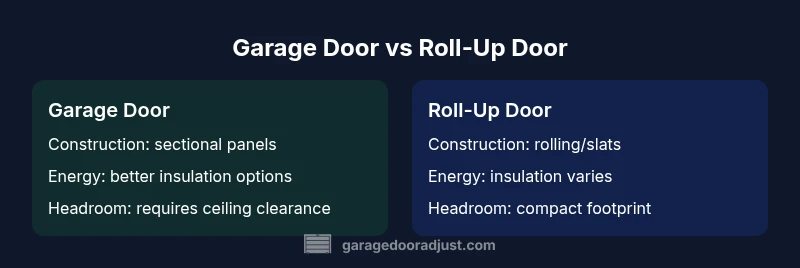
- Construction: Garage doors are typically sectional and panel-based, offering strong seals and variable insulation. Roll-up doors use rolling slats or a coil mechanism that can take up less headroom but may vary widely in insulation and rigidity. This fundamental difference affects energy efficiency and durability.
- Movement: A sectional door lifts vertically along tracks into a header space, while a roll-up door rolls into a compact housing, which can save ceiling clearance but may require more frequent track maintenance if exposed to debris.
- Appearance: A traditional garage door often contributes to curb appeal and appraisal value. Roll-up doors tend to appear more utilitarian, though modern designs can be decorative and compatible with various home styles.
Space and installation practicality
Space is a critical factor when choosing between the two options. A sectional garage door demands overhead clearance for the door to lift and stack, plus room for track hardware along the sides. In contrast, a roll-up door can be advantageous in garages with limited ceiling height or unusual interior layouts because it minimizes the vertical footprint of the moving components. Installation complexity varies by model, with insulated sectional doors requiring precise alignment and spring balancing, while roll-up doors emphasize reliable track guidance and weather-sealing features. Budget and local climate should shape your plan, as energy performance often governs long-term comfort and utility costs.
Insulation and energy efficiency considerations
The insulation value of a garage door is a major determinant of energy bills in climate-sensitive regions. A well-insulated sectional door reduces heat transfer during both winter and summer, contributing to lower HVAC loads and more stable indoor temperatures. Roll-up doors, while capable of being insulated, frequently come with thinner panels or less integrated sealing, making them more variable in energy performance. If you live in a hot or cold climate, the energy implications of each option can be substantial over the door’s lifespan. Always check R-value or U-value specifications and consider additional weather-stripping or thermal breaks where appropriate.
Security, safety, and reliability
Security is a critical concern for any garage entry. Both door types can be highly secure when installed with quality hardware, robust locking systems, and modern sensors. Insulated sectional doors often provide stronger structural integrity, which can deter forced entry, while roll-up doors offer simplicity and fewer moving parts that could fail. Safety features—such as auto-reverse sensors, manual override, and spring tension adjustments—are essential for both options. Reliability hinges on proper installation and regular maintenance; neglect can lead to misalignment, reduced sealing, and accelerated wear on tracks and springs. For most homeowners, a well-installed door with routine lubrication and balance checks remains the best guardrail against operational issues.
Maintenance, longevity, and service life
Maintenance needs differ between door styles. Sectional doors benefit from periodic lubrication of rollers, springs, and hinges, plus annual balance checks to ensure even weight distribution. Roll-up doors require track cleaning, lubrication of moving parts, and periodic inspection of the rolling mechanism and weather seals. Longevity is influenced by climate, moisture exposure, and usage patterns. In high-traffic garages or harsh climates, proactive maintenance can extend the life of either option. The key is to implement a simple routine that includes inspection after seasonal shifts and professional evaluation when you notice unusual noises or slower movement.
Cost considerations and long-term value
Cost is a major driver in the garage door vs roll up door decision. Insulated sectional doors typically carry higher upfront costs but offer benefits that can translate into energy savings, quieter operation, and improved resale value. Roll-up doors often come with lower initial price tags and faster installation, but their energy performance and noise reduction may be less favorable in some homes. When evaluating value, consider climate, usage, and the time horizon for ownership. GarageDoorAdjust Analysis, 2026 emphasizes weighing upfront costs against long-term savings and comfort, rather than choosing based solely on sticker price.
Sizing up your home: best-use scenarios
- Choose a traditional garage door if your priorities include energy efficiency, curb appeal, and long-term value. It is usually the better fit for attached garages, homes with standard setbacks, and climates with pronounced seasonal swings.
- Opt for a roll-up door when headroom is limited, you’re renovating on a tight budget, or you need a quick, space-saving solution. Roll-up models may be ideal for detached garages or conversion projects where insulation needs are moderate and cost containment is essential.
- In mixed climates or multi-use spaces, a hybrid approach—such as a well-insulated sectional door with a weather seal—can offer a compromise that satisfies both comfort and budget constraints.
Next steps: turning data into a decision
To move from analysis to action, measure your garage opening, assess the ceiling height, and determine climate-related priorities. Talk to a licensed installer about insulation options, door materials, and warranty coverage. Request quotes that explicitly separate labor, hardware, and any add-ons like extra weather-stripping. Use a decision framework that compares energy savings, noise levels, maintenance costs, and potential impact on home value. The GarageDoorAdjust team recommends documenting your priorities and obtaining at least three quotes before committing.
Final considerations: ensuring a confident choice
Remember that the best choice balances performance, price, and practicality. A well-chosen door aligns with how you use the space and your home’s architectural language. If you value energy efficiency and durability, a good-quality sectional garage door often wins. If your priority is cost containment and a straightforward installation, a reputable roll-up door can meet your needs without compromising basic function. In every case, pairing the door with proper installation, weather sealing, and routine maintenance yields the most satisfying long-term results.
Comparison
| Feature | garage door | roll-up door |
|---|---|---|
| Construction and operation | Sectional panels guided by tracks; lifts overhead | Slats or rolling mechanism that stack above opening |
| Insulation and energy efficiency | Often available with foam-core insulation and weather seals | Insulation varies; some models have limited insulation |
| Space requirements | Requires ceiling headroom and track space | Typically compact footprint; good for tight spaces |
| Security and durability | Rigid construction with strong locking options | Security depends on hardware; durability tied to material and track |
| Maintenance and lifespan | Periodic lubrication and balance checks; long service life | Track cleanliness and spring upkeep; lifespan varies by model |
| Cost and value | Higher upfront cost but potential energy savings | Lower upfront cost; long-term value depends on use and climate |
| Best use cases | Homes prioritizing insulation, curb appeal, resale value | Budget-conscious projects, limited headroom, quick install |
Upsides
- Better insulation and energy efficiency when selected with foam-core panels
- Stronger security options with quality hardware and locking
- Longer-term value through durability and reliability
- Wide design options to match home style
Disadvantages
- Higher upfront cost for insulated sectional doors
- Longer installation times and more complex maintenance for some models
- Roll-up doors can have variable insulation and sealing depending on model
- Potentially noisier operation if not properly installed
Traditional garage doors generally offer better energy performance and long-term value; roll-up doors are a practical, budget-friendly option for space-limited or renovation projects.
If energy efficiency and curb appeal are priorities, choose a well-insulated sectional garage door. If upfront cost and quick installation take precedence, a roll-up door may be the better fit, provided you select a quality model and ensure proper sealing.
Got Questions?
What is the main difference between a garage door and a roll-up door?
A garage door is typically sectional and lifts overhead on tracks, while a roll-up door uses folding slats or a rolling mechanism that stacks above the opening. The construction and movement impact insulation, space needs, and maintenance requirements.
The main difference is how they move: panels that lift versus slats that roll up.
Are roll-up doors suitable for most residential garages?
Roll-up doors can work in many homes, especially where headroom is limited or budgets are tight. However, sectional garage doors are often preferred for insulation, durability, and resale value.
Roll-up doors can fit many homes, but sectional doors are usually better for insulation and value.
Which is more secure?
Security depends on hardware and installation. Both door types can be highly secure when equipped with quality locks, sensors, and robust tracks.
Security depends on the hardware and installation; both can be secure with proper setup.
Do they require different maintenance?
Yes. Garage doors typically need lubrication and balance checks, while roll-up doors require track cleaning and periodic checks of the rolling mechanism.
Yes—lubrication and balance for doors; track and mechanism checks for roll-ups.
What factors should I consider before choosing?
Consider climate, space, insulation needs, budget, and how you use the garage. A door's performance in severe weather matters as much as its initial price.
Think about climate, space, insulation, budget, and garage usage.
What is the typical lifespan of these doors?
Lifespan varies by material, maintenance, and climate. With proper care, both door types can last many years, but performance and longevity differ by design and exposure.
With proper care, both can last many years; performance varies by design and exposure.
Quick Summary
- Assess climate to prioritize insulation vs. upfront cost
- Consider headroom and space constraints before choosing
- Security and maintenance affect long-term value
- Obtain multiple quotes to compare total cost of ownership
- A well-sealed, properly installed door reduces energy waste