Common Problems with Chamberlain Garage Door Opener: Troubleshooting and Fixes
Tackle the most common problems with Chamberlain garage door opener with our urgent, step-by-step troubleshooting guide. Learn quick fixes, safety checks, and when to call a pro to restore reliable operation.


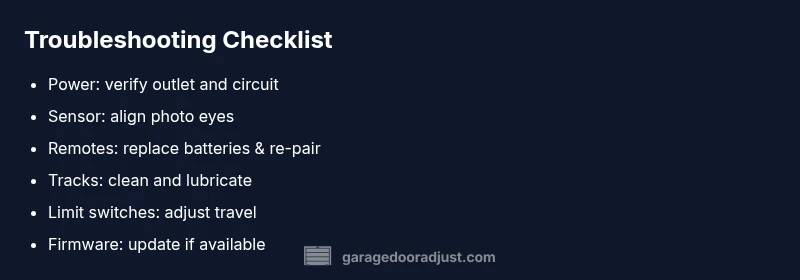
Steps: Start with the simplest checks—verify power, test safety sensors alignment, and ensure remotes/keypads have fresh batteries. For many homeowners, the most common problems with Chamberlain garage door opener come from power issues, misaligned sensors, or signal failures. If still stuck, perform a reset and run a test cycle to confirm the fix.
Understanding the scope of common problems with Chamberlain garage door opener
When people search for help with the keyword common problems with chamberlain garage door opener, they typically encounter three broad categories: power and electrical safety, sensor and safety-system alignment, and remote-to-opener communication. According to GarageDoorAdjust, these areas account for the majority of service calls and user frustrations. Doors may hesitate, stop mid-cycle, reverse unexpectedly, or fail to respond to the remote or wall control. This guide digs into those core issues and provides practical, step-by-step fixes you can perform safely at home. If any step feels risky or unclear, pause and call a professional. Your safety comes first, especially around live components and springs.
In many homes, the root cause can be traced back to a simple, fixable trigger—like a tripped circuit, dirty photo eyes, or a dead remote battery. By methodically testing each area, you can quickly rule out common culprits and restore reliable operation without replacing the entire opener. GarageDoorAdjust emphasizes a calm, organized approach to troubleshooting, so you can document what you tried and avoid repeating steps.
Power and electrical safety checks
Power issues are the most frequent source of garage door opener problems. Start by confirming the unit is plugged in securely and that the outlet is live. If the outlet shares a circuit with other devices, test for an overload or a tripped breaker. For GFCI outlets, press the reset button and re-test the opener. If you have access to a multimeter, verify that the outlet voltage matches typical household voltage (around 120V in the US). If power is stable but the opener remains unresponsive, proceed to sensor and signal checks. This stage is essential because a simple power fault can mimic more complex issues and mislead your troubleshooting path.
Safety sensors and photo eye alignment
Chamberlain openers rely on safety sensors to stop the door if an obstacle is detected. Misalignment, dirt on the lenses, or an object blocking the eyes can prevent the door from closing fully or cause it to reverse. Inspect both sensor eyes on either side of the doorway: they should face each other directly with a clear line of sight. Clean the lenses with a soft, dry cloth and ensure the mounting brackets are straight and secure. If the LED indicators show a fault, gently realign until both LEDs glow steadily. After alignment, perform a full cycle test using the wall control to verify the symptom has cleared.
Remote, keypad, and wall console signals
Low or failing signals from remotes and keypads are a common cause of unresolved opener behavior. Replace batteries in all remotes and the wall keypad; ensure the battery polarity is correct. Re-pair remotes to the opener using the learn or pairing button on the motor head, following your model’s manual. If a recent router or Wi‑Fi change introduces interference with any smart features, temporarily disable or reconfigure smart-home integrations to see if the issue improves. If pairing doesn’t restore control, the problem may lie with the receiver in the opener unit, which could require service.
Tip: Keep fresh batteries on hand and label which remotes belong to which user to simplify future troubleshooting.
Door balance, tracks, and driveline wear
A door that’s hard to lift by hand or drifts during operation can mimic an opener problem. Check door balance by disconnecting the door from the opener (usually a release handle for manual operation) and lifting it manually. If it feels heavy or binds, the torsion springs, tracks, hinges, or rollers may be worn or misadjusted. Clean the tracks to remove debris, and lubricate metal rollers and hinges with a silicone-based lubricant. Avoid oil-based lubricants on plastic components. If you notice grinding, squealing, or uneven movement, call a professional—these components carry high tension and can be dangerous to service yourself.
Limit switches and travel settings
Limit switches control how far the door travels. If the door closes too quickly or reverses mid-journey, the close travel limit may be misadjusted. Locate the limit screws on your opener (often near the back or side of the unit) and adjust in small increments, testing after each adjustment. If the door opens too high or too low, adjust the open travel limit accordingly. If you’re unsure about precise settings, resetting the opener to its factory defaults and reprogramming devices can restore proper travel. Always document changes to track what works.
Firmware, app compatibility, and smart features
Firmware mismatches or app integrations can cause unexpected behavior in modern Chamberlain setups. Verify your model supports firmware updates and check the official support site for updates and installation instructions. If you use a MyQ-based setup, ensure the app is current and re‑link devices after updating. Some older models operate best with basic mechanical fixes rather than smart features; in those cases, disable conflicting integrations temporarily to confirm stability.
A firmware update can resolve stubborn issues, but never apply updates while the door is in motion or the unit is exposed to moisture.
When to call a professional and safety reminders
If you encounter persistent issues after methodical troubleshooting, or you detect unusual noises, slipping components, or a door that feels unsafe, contact a licensed technician. Torsion springs, torsion bars, and internal gear mechanisms are hazardous when mishandled. Additionally, misalignment of tracks or structural damage requires professional inspection. Always unplug the opener before inspecting high-triction parts, and never loosen or adjust springs without training. Prioritize safety at every step.
Preventive maintenance to reduce future problems
Preventive maintenance keeps Chamberlain garage door openers performing reliably longer. Create a simple quarterly routine: inspect tracks for dents or loose fasteners, clean and lubricate rollers, hinges, and carriage components, replace batteries annually or as needed, and test auto-reverse safety features monthly. Wipe down the unit and enclosure to prevent dust buildup, and store spare parts like batteries in a cool, dry place. Maintaining a simple log of maintenance tasks helps you spot patterns and plan ahead.
Steps
Estimated time: 45-60 minutes
- 1
Verify basic power
Unplug and replug the opener or reset the circuit breaker. Confirm the outlet is live by plugging in a lamp. Observe any indicator LEDs on the opener for sign of power; if none, power is the first obstacle to address.
Tip: If the door is stuck mid-cycle, keep a hand nearby to guard against sudden movement when power is restored. - 2
Test safety sensors
Inspect both photo eyes for dirt and misalignment. Clean lenses, ensure the eyes face each other, and fix any bent brackets. Re-test by closing the door from the wall control to confirm the sensor fix helped.
Tip: If the LED on one eye is off, reseat the connection or replace the sensor unit if needed. - 3
Check remotes and keypad
Replace remote and keypad batteries. Re-pair remotes using the learn button on the opener; test each device individually to isolate the failing unit. Do not rely on memory—document which device is paired.
Tip: Keep spare batteries accessible and label remotes by room or user. - 4
Inspect balance and tracks
With the door closed, manually lift the door to check for smooth movement and balance. Clean the tracks and lubricate moving parts with a silicone-based lubricant. If the door binds, do not force it; call a professional if the issue persists.
Tip: Never lubricate the torsion springs directly; they store high-energy tension. - 5
Adjust limit switches
Follow your model’s manual to locate limit screws. Make small adjustments and test the open/close cycle. If the door closes too soon or reverses before contacting the floor, tweak the close limit in small increments.
Tip: Document each adjustment so you can revert if needed. - 6
Test firmware compatibility
Check for firmware updates for the opener and any connected MyQ app. Update if available and re-test remote functions afterward. Ensure any third‑party integrations are compatible.
Tip: Do updates with the door fully disengaged from movement; never update while the door is in motion. - 7
Call a professional if unresolved
If issues persist after the above steps, especially with springs, tracks, or internal electronics, contact a licensed technician. They can safely handle high-tension components and ensure code-compliant repairs.
Tip: Prepare notes about what you tried and any unusual symptoms to speed up diagnosis.
Diagnosis: Door Won't Respond to Remote/Wall Control or Opens Partially
Possible Causes
- highPower issue (outlet, circuit, or wiring)
- highSafety sensor misalignment/obstruction
- highRemote/keypad signal problem or dead batteries
- mediumLimit switch misadjustment or travel miscalibration
- lowDrivetrain wear or binding hardware
Fixes
- easyCheck outlet, circuit breaker, and reset power; test with a lamp on the same circuit
- easyRealign safety sensors and clear any obstruction; clean sensor lenses and test
- easyReplace remote/keypad batteries and re-pair remotes to the opener
- easyReset travel limits and reprogram devices per model manual
- mediumInspect tracks/rollers and call a pro for spring or major drivetrain work
Got Questions?
Why won't my Chamberlain garage door opener respond to the remote?
Dead batteries, failed pairing, or interference are the usual culprits. Replace batteries, re-pair the remote, and check for nearby signals that could cause interference. If it still doesn’t respond, inspect the opener’s receiver or consult a technician.
Most often it’s battery or pairing. Replace the batteries and re-pair the remote, and check for interference before seeking professional help.
How do I reset a Chamberlain garage door opener?
Locate the learn button on the motor head, press and hold for several seconds to reset. Then reprogram remotes and keypads according to the model’s manual. After resetting, test the full cycle to confirm normal operation.
To reset, press and hold the learn button until the LEDs flash, then reprogram your remotes and try a test cycle.
What causes the door to reverse after closing?
Typically a safety sensor misalignment or obstruction in the doorway. Realign sensors, clear the path, and re-test the closing cycle. If reversal persists, verify the door’s mechanical balance and re-check wiring.
Reversal usually means the safety sensors aren’t aligned or there’s an obstruction. Realign and test again.
Why is the door opening slowly or not reaching full height?
Possible causes include worn tracks, binding rollers, or misadjusted limit switches. Clean and lubricate moving parts, ensure tracks are straight, and adjust travel limits as needed. If symptoms persist, professional inspection may be required.
Slow opening usually points to tracks or limit settings. Clean, lubricate, and recheck the limits.
When should I replace Chamberlain remote batteries and sensors?
Batteries typically last 1-2 years; replace outdated batteries and test the remote’s range. If problems persist after battery change, consider checking the sensor and receiver components for faults.
Batteries usually last a couple of years—replace them and test the range.
Can I fix a noisy garage door opener myself?
Many noises come from lubrication or dirt; clean and lubricate tracks, allow clean movement, and tighten loose hardware. Do not attempt to adjust high-tension components like springs yourself; consult a pro for noisy or dangerous sounds.
Noise often comes from lubrication or loose parts; fix those, but leave springs to a pro.
Quick Summary
- Start with power and sensor checks before deeper fixes
- Re-pair remotes and reset travel limits as needed
- Avoid DIY springs—call a pro for safety-critical tasks
- Implement a preventive maintenance routine quarterly