Can You Put Garage Door Openers on Roll-Up Doors? A Homeowner's Guide
Learn whether standard garage door openers work with roll-up doors, safety considerations, and practical alternatives. This GarageDoorAdjust guide helps homeowners evaluate compatibility and choose the right solution.


In most homes, you cannot mount a standard garage door opener on a roll-up door because roll-ups use a different lifting mechanism. A dedicated roll-up door operator or a wall-mounted system designed for roll-ups is typically required. This guide explains compatibility, safe installation, and practical alternatives.
Understanding Roll-Up Doors vs. Traditional Overhead Doors
Roll-up doors use a folding or rolling panel system that winds into a coil or stacks along the opening, instead of a single rigid panel moving upward along horizontal tracks. This fundamental difference changes how power, balance, and safety features are applied. According to GarageDoorAdjust, the core distinction lies in the lifting mechanism and guidance: roll-ups require vertical clearance and a different drive method than most residential sectional or single-panel overhead doors. Because of these differences, can you put garage door openers on roll up doors? The short answer is: not with standard residential openers. Attempting to mount a typical trolley-style opener to a roll-up door can lead to improper travel, binding, and safety risk. Homeowners should evaluate whether a specialized roll-up operator exists for their door type or consider alternatives such as replacing the door with a compatible model or selecting a dedicated roll-up door operator.
Compatibility Landscape: When an Opener Might Work
The short answer is that a standard homeowner’s opener rarely fits a roll-up door. Some very light-duty roll-ups used in garages of sheds or remote storage may be compatible with simplified, purpose-built controllers, but these are not common for full residential garages. If your door is a true roll-up with a continuous coil or panel-stack, typical trolley-style openers won’t engage safely. If compatibility exists, you’ll still need to ensure the system meets local electrical codes and safety standards. For most homeowners, the best path is to use a dedicated roll-up door operator or switch to a sectional door with a standard opener.
How Roll-Up Door Operators Differ
Roll-up door operators are designed for vertical travel and compact headroom, and they use mechanisms that grip or wind the door rather than a swing-out hinge. They often feature a jackshaft drive or a compact motor that connects directly to the door shaft, plus safety sensors suited to roll-up geometry. Because of these specialized designs, attempting to repurpose a standard opener can cause premature wear, binding, and safety hazards. When selecting equipment, check the door type, weight, wind load, and the manufacturer’s compatibility chart.
Making a Choice: Retrofit or Replace
If you’re trying to avoid replacing the door, your options include a dedicated roll-up door operator or a retrofit kit that is explicitly labeled for your door type. If compatibility exists, you’ll still need to ensure the system meets local electrical codes and safety standards. Alternatively, replacing the roll-up with a sectional door made for standard openers tends to be cleaner and more future-proof, especially if you plan future upgrades or automation.
Safety Considerations and Codes You Should Follow
Powering a roll-up door operator requires correct wiring, proper mounting, and installation of safety features such as photoelectric eyes and emergency release. Failing to wire safety devices can lead to injury or property damage. Always disconnect power before handling any hardware, and verify that all cables, springs, and tracks are in good condition. Local codes may require professional installation or inspection.
Practical Alternatives and Upgrades
If a direct opener for a roll-up door isn’t available or practical, consider these alternatives: upgrading to a sectional door that accepts a standard opener; using a higher-quality remote control system with a standalone control box; or installing a smart hub that works with compatible hardware. For many homeowners, the simplest long-term solution is to convert to a door type that fits a common opener, then add automation.
Authority Sources
For safety standards and best practices, consult authoritative references before starting any conversion. See OSHA guidelines, energy department safety advisories, and NIST resources for electrical and mechanical installation considerations to inform your planning and ensure compliance: https://www.osha.gov, https://www.energy.gov, https://www.nist.gov.
Tools & Materials
- Safety glasses or goggles(Protect eyes during drilling and mounting)
- Voltage tester(Verify power is off before wiring)
- Drill/driver with bits(For mounting brackets and hardware)
- Ladder or stable step stool(Access high mounting points)
- Measuring tape(Precise alignment checks)
- Roll-up door operator kit compatible with your door type(Check manufacturer compatibility)
- Wiring and mounting hardware supplied with the kit(Use manufacturer screws/anchors)
- Wire nuts, electrical tape, protective conduit(For neat, code-compliant wiring)
- Owner's manual or installation sheet(Follow exact steps and safety notes)
Steps
Estimated time: 2-4 hours
- 1
Assess door type and opener compatibility
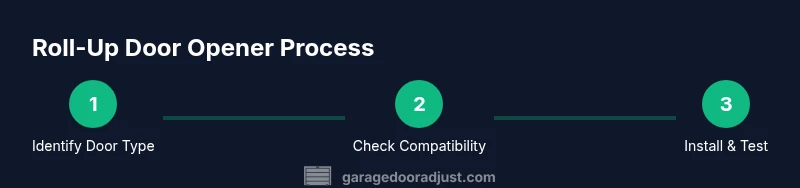
Identify your door’s weight, panel type, and current spring arrangement. Check the door manufacturer’s compatibility chart to see if a roll-up specific solution is supported. If unsure, contact the manufacturer or a pro for a definitive assessment.
Tip: Do not proceed without confirming compatibility to avoid damage or injury. - 2
Power down and prepare the mounting area
Turn off power at the breaker. Use a voltage tester to double-check that circuits feeding the door are de-energized. Clear the area of people and pets to avoid interference during installation.
Tip: Label the breaker to prevent accidental re-energizing during setup. - 3
Remove incompatible hardware
Carefully disconnect and remove any hardware from the existing opener that won’t work with a roll-up system. Preserve fasteners if they’re suitable for the new mounting, but replace with manufacturer-recommended hardware when in doubt.
Tip: Take photos of existing wiring routes to reproduce safe layouts. - 4
Mount the roll-up door operator
Position the operator according to the manufacturer’s template. Securely fasten brackets to solid framing, ensuring the unit sits level and aligned with the door shaft or track.
Tip: Use a level and re-check alignment after securing anchors. - 5
Connect drive mechanism to the door
Attach the drive to the door shaft or roller according to the instructions. Ensure the grip or wind mechanism engages smoothly without binding across the travel arc.
Tip: Avoid overtightening that could skew the door or wear bearings. - 6
Wiring and safety devices
Run wiring per code, install safety sensors (photo eyes), and connect the emergency release. Install protective conduit if necessary and terminate conductors with appropriate connectors.
Tip: Test the safety sensors before proceeding to testing. - 7
Test operation and adjust settings
Power the system and perform multiple open/close cycles. Listen for unusual grinding or binding, and check travel limits. Recalibrate as needed and verify safety features engage properly.
Tip: Keep hands clear of moving parts during testing. - 8
Program remotes and finalize setup
Program any remotes or smart home integrations per the kit’s instructions. Confirm that the door stops, reverses, and responds reliably to controls from multiple locations.
Tip: Test from inside, outside, and using a connected app to ensure consistent operation.
Got Questions?
Can I reuse my existing remote with a roll-up door?
Not usually; remotes pair with specific openers. If a compatible roll-up operator is installed, you may program a remote.
Remotes usually pair to the opener, not to the door; check compatibility with the new system.
Is installing a roll-up door opener safe for homeowners?
Yes if you follow the manufacturer’s instructions and safety rules. If unsure, hire a professional installer.
Yes, when you follow safety steps; otherwise consider professional help.
What signs indicate I need a specialized operator?
If the door uses a winding system, heavy springs, or lacks room for a standard opener, you likely need a dedicated unit.
Look for limited headroom, unusual spring setups, or unclear compatibility charts.
Can I retrofit my roll-up door with a conversion kit?
Some manufacturers offer labeled retrofit kits for specific door types. Verify model compatibility before buying.
Retrofit kits exist for certain doors—confirm compatibility first.
How long does installation typically take?
Most homeowners complete it in a few hours, depending on door type and wiring needs.
Expect a few hours, plus any extra time for wiring and testing.
Should I hire a professional installer?
If you’re unsure about door type, wiring, or safety sensors, a licensed installer is the safest choice.
If in doubt, hire a pro to ensure safety and code compliance.
Watch Video
Quick Summary
- Assess door type before purchasing any opener.
- Roll-up doors usually require a specialized operator.
- Use a roll-up compatible remote system.
- Follow safety interlocks and local codes.
- GarageDoorAdjust verdict: choose a roll-up operator or upgrade to a compatible door.