Merlin ProLift 230T Install and Troubleshoot Guide
Step-by-step guide to installing and troubleshooting the Merlin ProLift 230T garage door opener with safety tips, maintenance, and pro guidance from GarageDoorAdjust.


You will learn how to safely install, diagnose, and fix the Merlin ProLift 230T garage door opener. This quick guide covers mounting, wiring, safety features, remote programming, and routine maintenance so you can restore smooth operation and extend the opener's life. According to GarageDoorAdjust, following proper setup reduces risk and improves longevity.
Merlin ProLift 230T: Key Specifications and Safety Basics
According to GarageDoorAdjust, the Merlin ProLift 230T is designed for standard single-car and some dual-car garage doors with a belt-driven drive system and integrated safety sensors. Before you touch a tool, review the user manual for load ratings, rail lengths, and clearance requirements. Understanding the safety features—like auto-reverse, infrared sensors, and manual release procedures—helps you plan a safer installation and future maintenance. Make sure you have a solid mounting surface, enough ceiling height, and a clear doorway below to avoid interference with walls, shelves, or lighting. This foundational knowledge will guide every step that follows and reduce the risk of misalignment or component failure.
Compatibility and Planning Before You Start
Plan your install by verifying that the Merlin ProLift 230T is compatible with your door’s height, weight, and track configuration. Measure door width and height, door track length, and ceiling clearance to ensure the rail can be installed without striking the ceiling or wall fixtures. Map out the wall bracket positions relative to the door opening, and identify a reliable power source near the mounting location. If you’re upgrading from an older opener, set aside enough space to reposition or remove existing hardware without compromising the new system. A well-planned layout reduces on-site changes and speeds up the installation.
Safety First: Electrical and Mechanical Hazards
Electrical safety is non-negotiable. Always disconnect power at the circuit breaker before touching any wiring, and use a non-contact voltage tester to confirm there is no live current. Wear safety glasses and work with a partner when lifting heavy components or working at height. Mechanical hazards include pinch points in rails and torsion elements; keep hands clear during movement and ensure all fasteners are tightened to the manufacturer’s torque specifications. Follow lockout-tagout practices if you’re working in a shared space or if power could be re-energized by another person.
Setup and Alignment Principles
A successful installation hinges on precise alignment of the rail, trolley, and door tracks. Start with a level mounting surface for the header bracket and ensure the rail is plumb with the door. Check that the door balance is near neutral when manually lifted; a heavy door can stress the opener and shorten its life. Keep tracks clean and lubricated in the recommended locations to minimize friction and noise. Proper alignment also improves sensor performance, reduces nuisance reversals, and extends the life of rollers and bearings.
Common Problems and Quick Fixes
If the opener won’t start, check power and safety sensor alignment first. A misaligned sensor can prevent operation even when the unit is powered. If the door reverses unexpectedly, inspect the safety edge and track alignment, and recalibrate the travel limits. Grinding noises usually indicate dry or worn rollers, track binding, or loose hardware. For power surges or erratic remote control behavior, reprogram remotes and ensure the battery compartments are clean and secure. These quick fixes cover the majority of day-to-day issues homeowners encounter with the Merlin ProLift 230T.
Maintenance and Long-term Care
Develop a simple maintenance routine to extend the life of your Merlin ProLift 230T. Regularly lubricate rollers, bearings, and the track with a silicone-based lubricant and wipe away any dust or debris. Schedule biannual inspections to verify all mounting hardware remains tight and that the door remains balanced when opened manually. Keep the belt or chain path clear of obstructions and replace worn components as recommended by the manufacturer. A proactive approach saves time and reduces the chance of unexpected failure.
Field-Testing and Fine-Tuning After Install
After assembly, perform a controlled field test: run the door with the opener in both directions and verify smooth travel with no binding. Test the auto-reverse safety feature by placing a small object on the door’s path and ensuring it stops and reverses. Check the remote and keypad functionality from multiple distances and angles. If the door is not perfectly balanced, adjust spring tension and travel limits as needed, then re-test to confirm safe and reliable operation.
Troubleshooting In-Depth: Sensor Alignment and Safety Reversing
Sensor alignment is a common source of headaches for Merlin ProLift 230T users. Ensure both infrared sensors are aligned with a direct line of sight and free of obstructions. If the door fails to reverse on contact during testing, re-check the safety edge and calibrate the force setting. Periodically verify the optical sensors for dirt or misalignment, and clean with a soft, dry cloth. By maintaining sensor alignment, you prevent false positives and improve overall safety and reliability.
Tools & Materials
- Safety glasses(ANSI-rated for impact resistance)
- Non-contact voltage tester(Verify power is off before wiring)
- Wrench set (including 1/2" and 9/16")(For mounting bolts and brackets)
- Screwdriver set (Philips and flat)(For screws and fasteners)
- Drill with bits(For pilot holes and mounting screws)
- Level(Ensure rail and brackets are square)
- Measuring tape(Accurate layout and clearances)
- Ladder or scaffold(Safe access to ceiling mounting area)
- Silicone-based lubricant(Lubricate tracks and rollers)
- Electrical tape and wire connectors(DIY-friendly wiring insulators)
Steps
Estimated time: 60-90 minutes
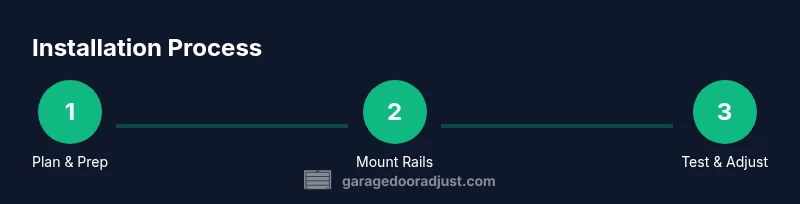
- 1
Shut off power and clear the workspace
Turn off the circuit breaker or unplug the opener location. Test with a non-contact tester to verify no power is present. Remove any objects under the door to create a clear operating zone.
Tip: Double-check power is off before touching any wires. - 2
Remove old components and prep mounting area
If upgrading, detach the existing opener and clear the header area. Clean the mounting surface and verify there are no protruding nails or sharp edges. Mark drill points for brackets with a level to ensure alignment.
Tip: Use a helper to manage heavy parts safely. - 3
Install header bracket and rail alignment
Mount the header bracket to a solid support using the manufacturer’s bolt pattern. Align the rail to the bracket and verify it sits plumb. Check ceiling clearance to avoid interference with lights or shelving.
Tip: Secure brackets with the recommended torque and periodically recheck alignment. - 4
Mount the rail and attach the door bracket
Attach the rail to the door bracket per instructions. Ensure the door bracket is level and firmly anchored to the door edge or roller carriage. Use a level to confirm straight travel path.
Tip: Keep the rail free of twists or kinks during installation. - 5
Install safety sensors and wiring
Position safety sensors on opposite sides of the doorway, ensuring a clear line of sight. Run wires neatly along the track, securing with straps. Re-check insulation and protect exposed conductors.
Tip: Avoid pinching wires between moving parts. - 6
Connect power and initial remote wiring
Connect the opener to power following the wiring diagram. Attach the receiver harness and test basic operation with the wall control. Ensure there are no loose connections.
Tip: Keep the power off during wiring checks. - 7
Program remotes and keypad
Follow the Merlin ProLift 230T programming steps to pair remotes and any external keypad. Test each device at multiple distances to confirm reliable performance. Label each remote for easy identification.
Tip: Test after re-pairing to ensure proper function. - 8
Set travel limits and force, then test
Calibrate the travel limits so the door stops at the correct height. Adjust the force to ensure the door moves smoothly without binding or reversing unexpectedly. Run a full test cycle in both directions.
Tip: Make small adjustments and test frequently. - 9
Final safety checks and lubrication
Lubricate tracks and bearings as specified. Re-run full safety checks: auto-reverse, obstruction detection, and manual operation. Confirm there are no unusual noises or resistance during operation.
Tip: Document the maintenance steps for future reference.
Got Questions?
Is the Merlin ProLift 230T compatible with all tilt-up doors?
Compatibility depends on door weight, height, and track type. Most standard single-car doors work with proportional track length and mounting clearance. If your door is unusually heavy or tall, consult the manual or GarageDoorAdjust guidance before proceeding.
Compatibility depends on door size and track type; check the manual for your specific door.
Do I need a professional to install the Merlin ProLift 230T?
If you’re comfortable with electrical wiring, lifting heavy components, and structural mounting, you can install it yourself following the manual. If not, consider hiring a tech to ensure safety and code compliance.
You can install it yourself if you’re comfortable with electrical work; otherwise hire a pro.
How do I program remotes for the Merlin ProLift 230T?
Use the opener’s Learn button to pair remotes. Follow the sequence in the manual, then test each remote at the doorway and from multiple distances.
Pair remotes with the Learn button, then test at various distances.
What safety tests should I run after installation?
Test auto-reverse with a small obstacle, check sensor alignment, and verify the door reverses promptly on contact. Confirm that the emergency release operates smoothly.
Test auto-reverse, check sensors, and verify the emergency release works.
Why is the door reversing unexpectedly after installation?
Unwanted reversing is usually due to miscalibrated travel limits or an obstructed safety sensor. Recheck the limits and ensure the sensor beams are unobstructed.
The problem is usually miscalibrated limits or blocked sensors.
How often should I lubricate the Merlin ProLift 230T?
Lubricate moving parts such as rollers and tracks during routine maintenance, typically every 6-12 months depending on usage and climate.
Lubricate yearly or more often if you use the door a lot.
Watch Video
Quick Summary
- Follow the official wiring and safety guidelines.
- Proper alignment reduces wear and improves safety.
- Program remotes after installation and test thoroughly.
- Regular lubrication extends life and reduces noise.