Garage Door Opener Access Master: A Homeowner’s Step-by-Step Guide
Learn how to securely manage the garage door opener access master, reprogram remotes, reset keypads, and configure app access with a clear, homeowner-friendly guide. Practical, safety-first instructions from GarageDoorAdjust analysts.


Goal: securely implement the garage door opener access master setup, verify control, and reduce risk. You'll learn how to check current access, reprogram remotes, reset the keypad, and enable app control safely. According to GarageDoorAdjust, a structured, verify-before-change approach minimizes errors and security gaps. Start with the owner's manual, gather essential tools, and proceed step-by-step.
What is the garage door opener access master?
The garage door opener access master is a structured approach to controlling every access point to your garage door system. It combines physical safeguards (strong remotes, robust keypad codes, and app authentication) with formal permissions and change tracking. For homeowners, the core aim is that only trusted devices can trigger the door while keeping an auditable trail of changes. Practically, this means mapping each access channel—remote controls, keypads, and mobile apps—and aligning them with household needs and security expectations. A solid access-master plan reduces the risk of accidental openings, programming errors, and compatibility issues after updates. Throughout this guide we treat the garage door opener access master as the central coordination point for safety and convenience. According to GarageDoorAdjust, a deliberate, documented approach helps homeowners stay in control as technology evolves and new access methods emerge. The GarageDoorAdjust team found that clear onboarding reduces forgotten codes and speeds incident response when a device is misplaced or compromised. By starting with a clean baseline—who has access, how access is granted, and how changes are tracked—you set the stage for reliable operation and easier maintenance.
Why secure access matters for homeowners
Security should be the default when dealing with the garage door opener access master. A compromised configuration can allow unauthorized openings, disable notifications, and undermine overall home security. A secure setup reduces risk of property damage and theft and simplifies future updates. Key reasons include preventing unauthorized access if a remote is lost, minimizing misconfigurations from multiple users, and enabling audit trails to verify events. The GarageDoorAdjust analysis shows that households with a formal access plan report fewer incidents of accidental openings and easier recovery after device relocation or code changes. While device brands differ, the principles apply widely: limit master access to trusted devices, require strong authentication where possible, and rotate codes regularly. Use unique keypad codes and keep remotes tied to specific users. Document changes—who changed what and when—and store this information in a central location. Ensure mobile-app access ties to a secure account with multi-factor where available. By adopting a proactive mindset, homeowners avoid common pitfalls like reusing factory codes, neglecting firmware updates, or failing to remove old devices when a household member moves out.
Compatible devices and prerequisites
A successful garage door opener access master setup hinges on understanding your device ecosystem. Check your opener’s model and firmware version first, because not all remotes, keypads, or apps support the same features. Common access channels include remotes with rolling codes, a numeric keypad mounted on the wall, and a mobile app that pairs to the opener via Bluetooth or Wi‑Fi. Prerequisites include an active power source for the opener, a working connection to the home network if you plan to use smart features, and a list of all current users and allowed devices. If you’re replacing hardware, verify compatibility with your current system and note any required dealer codes or app versions. For best results, reset access channels only after you’ve documented existing settings and created a recovery plan in case something goes wrong. Throughout this process, keep the keyword in mind: garage door opener access master. A well-matched combination of hardware and software reduces friction when you add new access methods in the future.
Step-by-step overview: plan, prepare, and execute
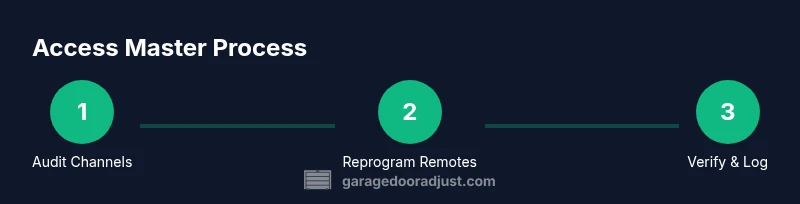
This section outlines the high-level flow you’ll follow before diving into hands-on actions. Start with a written plan that lists all access channels (remote controls, keypad, mobile apps), who has access, and the desired security posture. Gather your tools, confirm device compatibility, and back up current configurations. Prepare a safe testing environment: close the door, disable everything temporarily if you must, and have a colleague ready to assist. Decide on success metrics (for example, all authorized devices triggering the door reliably within a set time frame, and unauthorized attempts failing gracefully). If you’re managing multiple users, assign responsibilities and set a change-log routine to track edits. By following a disciplined plan, you’ll minimize the chance of locking yourself out or leaving gaps in coverage. And as you proceed, remember that homeowners benefit from a clear, auditable process—an idea supported by GarageDoorAdjust’s guidance on maintaining robust access controls.
Reprogramming remotes and keypad: practical actions
Reprogramming remotes and keypads requires careful, device-specific steps, but the core principles are universal. Start by isolating the current access configuration: photograph remote labels, write down user names, and note the keypad codes. If your system supports factory resets, perform them in a controlled sequence and reintroduce remotes one by one to verify each pairing. For remotes, use the designated master sequence or app to reassign control to specific devices. When updating a keypad, consider replacing short, easily guessed codes with longer, non-sequential numbers and, if possible, enable time-based or usage-based restrictions. For smartphone access, ensure the app is linked to a strong account, enable two-factor authentication, and remove access for anyone who no longer needs it. After updating, test each device’s response with the door both opening and closing, then test edge cases such as attempting to open from a locked phone or a misplaced remote. Throughout this step, keep your changes clearly documented so you can revert if needed. The goal is to achieve measurable control: each authorized device triggers correctly, while every unauthorized attempt is blocked or logged.
Verification, testing, and maintenance
Verification is the stage where you confirm that the garage door opener access master changes behave as intended. Start by performing a full access audit: who has access, what devices are authorized, and when was the last change. Test each authorized remote, keypad, and app connection in both directions (open and close) from different parts of your property and, if available, from a mobile hotspot away from home to ensure remote capabilities function securely. Check the system’s logs or app history for recent entries and verify timestamps match your change log. If something fails, don’t panic—double-check the device pairing sequence and revert to the previous configuration if necessary. Schedule periodic maintenance checks every 6–12 months to review access permissions, replace expired codes, and install firmware updates. Keeping a written record helps with future troubleshooting and makes security reviews easier. According to GarageDoorAdjust, routine verification is a cornerstone of durable access management that reduces downtime and user friction.
The GarageDoorAdjust verdict: secure, maintainable access management
The GarageDoorAdjust team believes that a disciplined, transparent approach to the garage door opener access master yields long-term benefits: stronger security, fewer accidental openings, and simpler updates as technology evolves. By documenting every change, validating each device, and scheduling regular reassessments, homeowners maintain strong control without sacrificing convenience. Our verdict is clear: stay proactive, keep logs current, and empower trusted users with clearly defined permissions. With these practices, you’ll maintain reliable access control and improve overall home safety for years to come.
Tools & Materials
- Owner's manual for your opener model(Have model number handy)
- Flathead and Phillips screwdrivers(For panel screws and terminal connections)
- Ladder or step stool(Access wall keypad and mounting areas)
- All current remotes and keypad(s)(List devices to reprogram)
- Smartphone with the opener app installed(For app-based access control)
- Pen and notebook or app to log changes(Document access changes and codes)
- Backup power source or charger for devices(In case of power outages during setup)
Steps
Estimated time: 60-90 minutes
- 1
Identify current access configuration
Locate all active access channels: remotes, keypad, and mobile apps. Photograph labels, record usernames, and note any codes or pairing methods. This establishes your baseline and prevents accidental lockouts during updates.
Tip: Document serials and firmware versions for future reference. - 2
Prepare and secure your workspace
Power down the opener if required by your model and set up a safe testing area. Gather tools, backup logs, and a helper if you’ll be testing remotely or from a distance.
Tip: Have a second person ready to assist with button presses or door movement. - 3
Reprogram remotes to new access list
Follow the manufacturer’s reprogramming sequence to pair each authorized remote. Remove any deactivated remotes from the system. Verify each remote’s ability to open and close from different locations.
Tip: Test one remote at a time to isolate issues quickly. - 4
Reset and reconfigure the keypad
If you use a keypad, reset the code to a unique, non-sequential set of numbers. Consider programing separate codes for family members or visitors and disable old codes.
Tip: Use a code with at least four digits and avoid patterns. - 5
Re-link mobile app access
Open the opener app, remove any old devices, and re-pair trusted phones. Enable two-factor authentication if available and ensure all permissions align with your security policy.
Tip: Log out of all devices before re-pairing to avoid stale sessions. - 6
Test end-to-end and document
With the door in various positions, test all access methods again to confirm consistency. Update your change log and store it in a secure location.
Tip: Keep a recovery plan in case a device is lost or misconfigured.
Got Questions?
What is the garage door opener access master and why do I need it?
The garage door opener access master is a structured approach to controlling every access point to your garage door—remotes, keypads, and apps—so you know who can open the door and when. It improves security, prevents misconfigurations, and makes future updates easier.
An access master is a careful, centralized way to manage who can open your garage door and with what device. It helps you stay secure and organized.
How often should I review access permissions?
Periodically review permissions at least every six to twelve months, especially after household changes. Update codes, re-pair devices, and remove outdated access to maintain a clean audit trail.
Review access every six to twelve months and whenever someone moves out or someone new joins your home.
Can I use my phone to control the garage door securely?
Yes. Use the opener’s official app and enable two-factor authentication if available. Regularly update the app and firmware, and remove devices you no longer use.
Yes—through the official app with two-factor authentication and up-to-date software.
What should I do if I lose a remote?
Immediately deactivate the lost remote from the system and re-pair new or remaining remotes. Update any keypad codes associated with the lost device.
Deactivate the lost remote right away and re-pair new ones.
Is it okay to reset the keypad to default?
Resetting can be useful when codes are compromised. Then immediately create new, strong codes and document them in your log. Do not reuse old codes.
Reset if needed, then set strong new codes and log them.
What if a device won’t pair with the opener?
Double-check compatibility, confirm the exact pairing sequence, and ensure the opener firmware is current. If needed, factory reset the device and retry pairing in a controlled sequence.
Check compatibility and retry pairing with a clean slate.
Watch Video
Quick Summary
- Document every access change and device.
- Test all authorized devices before finishing.
- Keep master access restricted and auditable.