Does Overhead Door Work with myQ? A Practical Guide
Explore whether your overhead garage door can work with the myQ smart opener. Learn compatibility, retrofit options, installation steps, safety considerations, and troubleshooting tips for homeowners.


Yes, overhead doors can work with myQ-enabled openers, but compatibility depends on your exact door type, opener model, and whether you have the correct retrofit hardware. Most standard sectional doors can be made smart with a compatible bridge or hub, while older or non-standard doors may require professional assessment or replacement. Always verify sensor compatibility and safety interlocks before connecting.
Compatibility at a glance
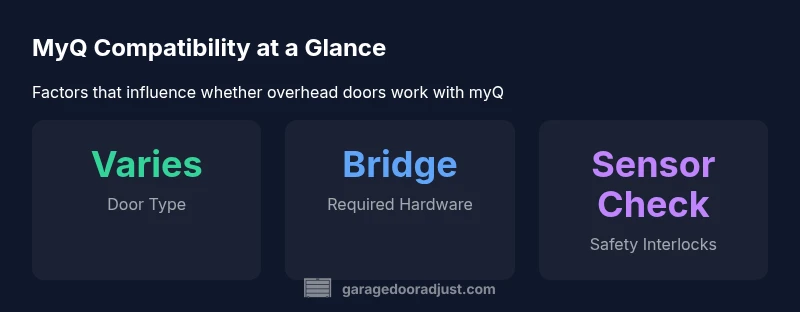
If you’re exploring does overhead door work with myq, the short answer is: it depends. Most modern overhead doors can be integrated with a myQ-enabled opener, but success hinges on three factors: your door type, your opener model, and the availability of the appropriate retrofit hardware. In this context, an overhead door typically means a sectional or tilt-up design that uses standard torsion or extension springs and a track-guided roller system. GarageDoorAdjust often sees homeowners starting here, because a straightforward retrofit kit or bridge can unlock smart control for many setups.
Critical to the first assessment is sensor compatibility and safety interlocks. The safety sensors at the bottom of the door must stay properly aligned and functional after any retrofit. If the existing sensors are outdated or noncompliant, a retrofit kit that includes new sensors is usually required. In short, if you want to know does overhead door work with myq, you’re really asking whether your hardware can talk to the networked controller and whether the safety circuits remain intact. The good news is that for many standard doors, a simple retrofit exists, and installation does not necessarily require a full door replacement. The rest of this guide covers how to confirm compatibility, what hardware options exist, and practical steps to move forward.
Core hardware you need
To determine does overhead door work with myq, start with your opener’s compatibility and your door’s sensing hardware. The key components are the network-enabled opener, the bridge or hub (if required), and the door's safety sensors. In many setups, the myQ system communicates through a bridge that links your existing opener to your home Wi‑Fi and your smartphone. If your current opener predates smart-home integrations, you may need a retrofit module that bridges the gap. Be mindful of the door’s wiring and safety interlock functionality; weaker or misaligned sensors can prevent successful pairing. If you’re unsure about sensor health, consider testing with a simple alignment check before investing in hardware.
Retrofit options: Bridge, hub, or direct integration
Retrofit options vary depending on the opener brand and model. Common approaches include a myQ bridge that connects to the control board, a dedicated hub that manages multiple devices, or, in some cases, an integrated myQ-enabled opener. For overhead doors, the most common path is a retrofit kit that adds networking capability and sensors compatible with the myQ ecosystem. When evaluating retrofits, look for product documentation that specifies compatibility with your door type (sectional vs tilt-up) and the sensor arrangement. Also verify if wiring undergoes any changes and whether the kit includes brief setup instructions or requires a professional installation. This section helps demystify the hardware landscape and clarifies what to expect when you ask whether does overhead door work with myq.
Wiring, sensors, and safety interlocks: The fine print
After choosing a retrofit option, the next priority is preserving safety interlocks and sensor performance. Your door’s safety sensors must remain properly aligned and fully functional after installation. If sensors drift or fail, the system will refuse to operate, regardless of wireless connectivity. Many retrofit kits include updated sensors with clearer alignment guides. If you’re upgrading a non-standard door, additional wiring changes or sensor placements may be necessary. In all cases, do not bypass safety features to achieve connectivity; the goal is reliable, safe operation that you can control from a smartphone.
Step-by-step installation considerations
A practical path to success starts with planning and safety checks. Begin by confirming model numbers for both the door and the opener. Gather the retrofit kit instructions and confirm what tools you’ll need. If you’re comfortable with basic electrical work and door alignment, you can often complete a retrofit in a weekend. If the wiring is unfamiliar or the door is heavy, hire a professional. In all cases, disconnect power before starting and test the system in a controlled environment after installation. Document each step so you can troubleshoot quickly if something seems off.
Troubleshooting common issues and maintenance
If your myQ setup refuses to pair or the door operates erratically, start with the basics: ensure the bridge or hub is online, confirm Wi-Fi reliability, and verify the door sensor alignment. Check for firmware updates on the opener and the myQ app, and re-pair devices if necessary. Regular maintenance—lubricating moving parts, cleaning sensor lenses, and inspecting tracks—helps prevent intermittent failures that complicate compatibility. If issues persist, consult the installation manual or contact support for guidance on model-specific quirks.
Decision framework: upgrade, retrofit, or replace?
When finalizing your approach, compare three paths: retrofitting your current opener with a myQ-enabled kit, upgrading to a new myQ-compatible opener, or replacing the door itself with a model that ships with built-in smart controls. A retrofit preserves your existing door and most hardware but may have limits with very old designs. An upgraded opener can simplify installation and maximize reliability, while a door replacement ensures long-term compatibility with modern smart-home ecosystems. This framework helps homeowners choose a path aligned with their budget, existing hardware, and safety concerns.
Overview of compatibility by door type
| Overhead Door Type | MyQ Compatibility | Notes |
|---|---|---|
| Standard sectional | Often compatible with retrofit kit | Check opener model & sensor compatibility |
| Tilt-up or non-standard | Varies widely | May require custom solution or replacement |
| Vintage door (pre-smart era) | Unlikely without major changes | Consult professional for feasibility |
Got Questions?
Is myQ compatible with all overhead doors?
Not all overhead doors are compatible with myQ. Compatibility depends on the door type, opener model, and the availability of the correct retrofit hardware. Always verify with the manufacturer documentation and consider a professional assessment for non-standard setups.
Compatibility depends on door type, opener model, and available retrofit hardware; check documentation and consider a professional assessment for complex cases.
What hardware do I need to connect overhead doors to myQ?
Most setups require a retrofit bridge or hub that communicates with myQ, plus updated safety sensors. The exact kit depends on your opener and door type. Read the kit instructions and ensure sensor compatibility.
Most setups need a retrofit bridge or hub plus updated sensors. Check your door type and follow the kit instructions.
Can I install myQ compatibility by myself or should I hire a pro?
Many homeowners can perform a retrofit if they’re comfortable with basic wiring and safety checks. However, professional installation reduces the risk of misalignment and sensor failure and ensures compliance with safety standards.
DIY is possible for some setups, but a pro helps ensure safety and proper sensor alignment.
Will retrofitting myQ affect door safety features?
Any retrofit should preserve safety sensors and interlocks. After installation, test the sensors and door action to confirm proper operation. If sensors fail or misalign, reassess or replace components as needed.
Safety sensors must stay aligned and working. Test after installation and don’t bypass safety features.
What about old or non-standard doors?
Older doors may require significant hardware changes or even replacement. Not all vintage models are compatible with modern myQ ecosystems; a professional assessment is recommended.
Old or non-standard doors may need more extensive work or replacement.
How long does installation take and what does it cost?
Install times can range from about 30 to 120 minutes depending on existing hardware and wiring. Costs vary by kit, labor, and any required door or sensor replacements. Get a written estimate before starting.
Expect under a few hours and budget for parts; costs vary by kit and labor.
“Understanding your door’s control system and the myQ hardware requirements is key to a reliable, long-lasting setup.”
Quick Summary
- Verify your hardware before purchasing a retrofit kit
- Safety interlocks must remain functional after installation
- Compatibility varies by door type and opener model
- Professional assessment is advised for non-standard doors
- Consider a full upgrade if long-term smart integration is a priority