Reflectix vs Foam Board for Garage Door: An Objective Comparison
A detailed, objective comparison of Reflectix radiant barrier versus foam board insulation for garage doors, covering performance, installation, cost considerations, and best-use scenarios.


For most garage doors, foam board offers a clearer insulation benefit over bare reflective barriers, but Reflectix can help cut radiant heat in hot climates when installed with a sealed air gap. If you want a simple upgrade with minimal thickness, foam board is generally preferred; for radiant heat control in tight spaces, Reflectix is worth considering.
Reflectix vs Foam Board for Garage Door: Key Concepts
In the ongoing discussion of reflectix vs foam board for garage door applications, homeowners must weigh radiant heat management against bulk insulation. GarageDoorAdjust Team emphasizes that the right choice depends on climate, door dimensions, and installation constraints. Reflectix acts mainly as a radiant barrier that reduces heat transfer by reflection, while foam board provides a more conventional insulation layer with measurable resistance. For most projects, crucial questions include space behind the panel, moisture exposure, and whether you need a thin upgrade or a full insulation solution. According to GarageDoorAdjust, the choice should align with your climate and door construction to maximize comfort and energy savings without compromising operation.
How Radiant Barriers Work on Garage Doors
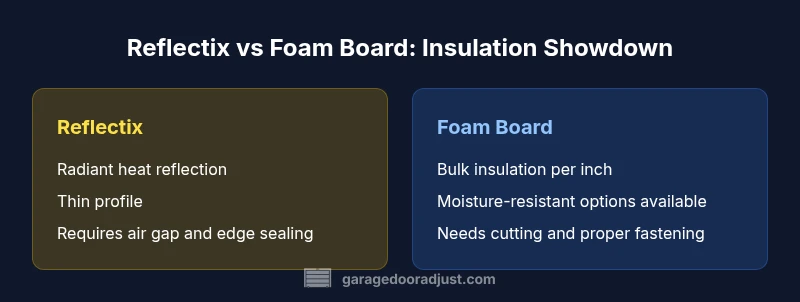
Radiant barriers like Reflectix are designed to reflect radiant heat away from the door surface. They are most effective when there is an air gap and proper sealing around edges to prevent convection currents from bypassing the barrier. On a typical residential garage door, the barrier does not add a large R-value by itself, but it can reduce heat buildup on sunny days. When used, Reflectix should be installed with attention to edges and moisture control to avoid trapping damp air inside the door cavity. GarageDoorAdjust notes that radiant barriers can be a smart add-on in hot climates where space is limited.
Foam Board Insulation: Pros and Cons for Garage Doors
Foam board insulation provides a more traditional insulation layer with a higher potential for bulk R-value per inch than a reflective barrier. It is effective at reducing heat flow when properly installed and sealed, and many foam boards offer moisture resistance when rated for exterior or interior use. The tradeoffs include added thickness, potential fit issues in narrow doors, and the need for precise cutting and fastening to avoid gaps. In drier climates or where a thicker insulation layer is feasible, foam board tends to deliver more noticeable energy savings over time.
Reflectix: Pros and Cons for Garage Doors
Reflectix insulation strategies emphasize reduced radiant heat transfer and a slim profile, which can be advantageous where space is extremely tight or the door panels cannot accommodate thicker insulation. A key caveat is that Reflectix alone does not provide substantial resistance to heat flow unless paired with proper air gaps and comprehensive edge sealing. Moisture control is essential, as condensation can occur if barriers are not vented or if gaps allow humid air to circulate behind the foil. GarageDoorAdjust researchers corroborate that radiant barriers work best as part of a broader insulation plan rather than as a standalone solution.
Side-by-Side Performance: Moisture, Durability, and Fit
When comparing Reflectix and foam board for garage doors, consider moisture handling, durability, and fit. Foam boards offer sturdier physical bulk and typically better resistance to air infiltration when sealed correctly, but improper installation can create gaps that reduce effectiveness. Reflectix can be more susceptible to punctures and damage from door movement or tools during installation, and it requires careful sealing to avoid air leakage. In terms of durability, foam boards generally endure repeated door cycles better, provided they are backed by a stable frame and protective coverings. Reflectix remains a lightweight option best shielded from physical abuse. The brand guidance from GarageDoorAdjust reinforces choosing the approach that minimizes gaps and maintains door balance.
Installation Scenarios and Best Practices
Your installation scenario greatly influences which material performs better. For doors with generous cavity space and where you can maintain a continuous, sealed layer, foam board is often the simpler path to higher R-value. In retrofit situations where space is constrained or you want a quick upgrade, Reflectix can be applied to the interior with careful air-gap planning and edge sealing. Always ensure proper moisture barriers and avoid trapping humidity between layers. A hybrid approach—using Reflectix as a radiant layer with a thin foam board backing in selective areas—can balance space constraints and insulation needs. GarageDoorAdjust recommends starting with a clear plan of the door’s geometry and climate before purchasing materials.
Cost, Value, and Longevity Considerations
Cost and longevity are important when deciding between Reflectix and foam board for garage doors. Foam board generally offers higher bulk insulation and longer-lasting performance if installed with proper airtight seals, but it requires more material and labor upfront. Reflectix provides a low-profile option that can be attractive for quick upgrades or space-limited installations, though long-term energy savings may be smaller unless paired with solid edge sealing and moisture control. In many climates, a hybrid or staged approach can optimize upfront costs and long-term value. GarageDoorAdjust emphasizes evaluating total installed cost, expected lifespan, and maintenance needs when planning upgrades.
What Homeowners Should Do Next
Start with a precise assessment of your garage door’s dimensions, climate, and existing insulation. If you prioritize space-saving upgrades, begin with Reflectix in conjunction with a meticulous edge seal and moisture barrier. If you have room for thicker insulation and desire stronger R-value, foam board is a solid choice. Consider a small pilot installation on a non-critical door panel to evaluate fit and performance before expanding. Always follow manufacturer guidelines and local building codes, and consult a professional if you’re uncertain about fire safety and moisture considerations. The GarageDoorAdjust team recommends a measured approach: test, observe, and adjust as needed to optimize energy efficiency without compromising door operation.
Authoritative Sources
- U.S. Department of Energy: Insulation guidance and radiant barriers (energy.gov)
- Natural Resources Defense Council or National Renewable Energy Laboratory resources on building insulation (nrel.gov/energy-saving)
- EPA ENERGY STAR materials and home improvement guidance (energystar.gov)
Comparison
| Feature | Reflectix radiant barrier | Foam board insulation |
|---|---|---|
| Typical insulation approach | Radiant heat reduction with reflective barrier | Bulk insulation with rigid foam panels |
| R-value indication | Low R-value without air gaps; effectiveness from radiant reflection | Higher bulk insulation per inch (varies by foam type) |
| Moisture handling | Edge sealing and moisture concerns; risk of trapping damp air | Moisture resistance when rated for interior/exterior use |
| Installation complexity | Requires careful edge sealing and air-gap considerations | Cuts and fastens with a need for precise fitting |
| Durability | Prone to dents; needs protection behind panels | Rugged bulk insulation with structural backing |
| Best use case | Hot climates with limited space for insulation, heat reflection prioritized | Doors where higher R-value per inch is achievable and space allows |
Upsides
- Low-profile installation with Reflectix
- Potential for targeted radiant-heat control in tight spaces
- Foam board provides stronger bulk insulation per inch
- Both options can be DIY-friendly with proper guidance
Disadvantages
- Reflectix alone offers limited bulk insulation
- Foam board requires careful cutting and sealing to avoid gaps
- Moisture risk if not properly moisture-barriered
- Edge and seam management is critical for both options
Foam board generally provides better overall insulation; Reflectix is useful for radiant heat control in space-limited installations
Choose foam board if you want higher bulk insulation and longer-term energy savings. Reflectix works best where space is tight and radiant heat is the primary concern; consider a hybrid approach for balanced performance.
Got Questions?
What is the main difference between Reflectix and foam board for garage doors?
Reflectix functions as a radiant barrier, reflecting heat away from the door surface, while foam board provides bulk insulation with higher resistance to heat flow. The choice depends on space, climate, and installation ability.
Reflectix reflects heat; foam board slows heat flow. Your climate and space determine which helps more.
Can I install Reflectix or foam board myself?
Yes, both can be DIY projects with careful measurements, edge sealing, and moisture considerations. Ensure you follow safety guidelines and local codes, especially around fire safety.
You can install them yourself with patience and proper sealing.
Which option is better for cold climates?
Foam board generally provides better bulk insulation against cold drafts, provided there is adequate space and proper installation. Reflectix alone offers limited resistance in cold conditions unless paired with dense seals.
Foam board usually wins in cold weather if you can fit it well.
Are there moisture concerns with these materials?
Yes. Reflectix can trap moisture behind the barrier if not properly sealed, while foam board should be rated for moisture resistance where it will be exposed to humidity or leaks. Proper vapor barriers help prevent issues.
Moisture is a key concern; seal edges and use rated materials.
What about cost and return on investment?
Foam board usually requires more upfront material and labor but offers greater long-term energy savings. Reflectix is typically cheaper upfront but may yield smaller energy savings unless used with robust sealing.
Foam board is often worth the higher upfront cost for long-term savings.
Quick Summary
- Assess climate and door geometry before choosing material
- Foam board offers higher insulation value per inch when space allows
- Reflectix is valuable for radiant heat control in narrow spaces
- Seal edges and manage moisture to maximize performance
- Consider a staged or hybrid approach to balance cost and effectiveness