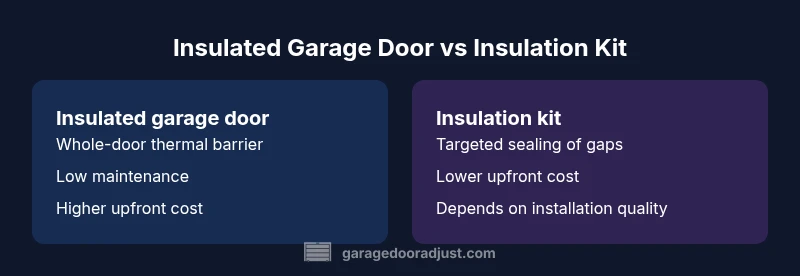
Insulated Garage Door vs Insulation Kit: A Practical Comparison
Compare insulated garage doors and insulation kits to decide which upgrade best boosts energy efficiency, comfort, and value. This analytical guide covers performance, cost, installation, and real-world scenarios for homeowners.


The choice between an insulated garage door and an insulation kit hinges on climate, budget, and how you use your garage. An insulated garage door delivers a complete thermal barrier with fewer gaps, usually improving energy bills and comfort over time. An insulation kit offers a lower upfront cost and more flexibility for specific trouble spots. Overall, the insulated door often provides more consistent performance.
Key Differentiators: when to choose which approach
Choosing between an insulated garage door and an insulation kit starts with a clear view of how your garage is used and what you want to achieve. For many homeowners, the insulated garage door represents a comprehensive upgrade that minimizes heat transfer from every panel, frame, and seam. This all-in-one solution reduces drafty corners and helps regulate temperature more evenly, which can translate into tangible energy savings over the long term. By contrast, an insulation kit is a modular, DIY option that targets specific weak points—such as gaps around the door edges, the header, or the bottom seal—without replacing the entire door. According to GarageDoorAdjust, many households find that a kit is sufficient for improving comfort in milder climates or as a transitional upgrade before committing to a full door replacement. In short, choose the insulated garage door for a total-package improvement and easier upkeep; opt for an insulation kit when budget or project scope dictates a more targeted fix.
-1
Comparison
| Feature | Insulated garage door | Insulation kit |
|---|---|---|
| Thermal performance (overall) | High, integrated barrier across the whole door | Moderate to high, depends on seal quality and installation |
| Installation effort | Low to moderate if replacing the door; work may involve framing and track alignment | Moderate to high, requires careful cutting, sealing, and potential door alignment |
| Cost range | Medium to high upfront (door cost plus installation) | Low to medium upfront (kit cost and basic tools) |
| Flexibility | Fixed, integrated system with minimal gaps | Adjustable, can target specific leaks and gaps |
| Maintenance | Low maintenance; occasional seal checks | Moderate maintenance; seals may need reapplication or replacement over time |
| Durability | High durability; withstands seasonal changes | Dependent on kit materials and seal integrity |
| Best for | Whole-door energy efficiency and long-term value | Budget-conscious upgrades and targeted sealing |
Upsides
- Comprehensive energy improvement with fewer heat leaks
- Low maintenance after installation
- Increased door durability and strength
- Improved curb appeal and potentially higher home value
Disadvantages
- Higher upfront cost and professional installation may be required
- Longer lead times for door replacement
- Less flexibility for addressing only small problem areas
- Potential for overkill in mild climates
Insulated garage door generally provides better long-term value for most homes, while an insulation kit is ideal for tight budgets or targeted fixes.
If you want broad, consistent energy gains and a simpler maintenance path, the insulated garage door is the stronger choice. Use an insulation kit when you need a cost-conscious upgrade that fixes specific drafts or gaps. The right decision depends on climate, usage, and financial comfort.
Got Questions?
What is the fundamental difference between an insulated garage door and an insulation kit?
An insulated garage door is a complete, integrated barrier that reduces heat transfer across the entire door, while an insulation kit is a DIY add-on designed to seal specific gaps and improve insulation at select points. The kit is typically cheaper upfront but may require more maintenance and precise installation to be effective.
The door is one full insulation system; the kit targets only gaps. If you want broad protection, go with the door; if you’re fixing a specific draft, a kit can work.
Can I install an insulation kit myself, and is it worth it?
Yes, many homeowners install insulation kits themselves, especially in temperate climates. The payoff depends on how well you seal gaps and whether you also address weatherstripping. If you’re comfortable with basic caulking, sealing, and measuring, a kit can be a sensible first upgrade.
If you’re handy with basic home projects, a kit is doable and can reduce drafts.
How long does installation typically take for each option?
A typical insulation kit installation may take a few hours to a day depending on the number of gaps and the complexity of the weather seals. Replacing or upgrading to an insulated garage door generally requires a professional and can take a day or two, including removal of the old door and track alignment.
Kits are faster for small projects; doors take longer and may need a contractor.
Will adding an insulation kit affect the garage door opener’s performance?
If installed properly, an insulation kit should not interfere with opener operation. Poorly sealed gaps or added bulk can affect balance or track alignment, so ensure seals and weatherstripping are compatible with the door's movement and the opener's clearance.
Make sure seals don’t obstruct the door’s travel or interfere with tracks.
Are there weather-stripping or seal considerations I should know about?
Yes. Weather-stripping is crucial for both options. For doors, replace worn bottom seals and add edge seals as needed. For kits, ensure the added insulation doesn’t create friction against the frame or tracks. Regular checks help maintain a tight seal over time.
Good seals matter; check them regularly.
Is an insulated door always better than a kit in every climate?
Not always. In very cold climates, an insulated door typically delivers stronger energy savings and comfort. In milder climates or for existing structural limitations, a high-quality insulation kit can provide meaningful improvements without the cost of a door replacement.
Climate plays a big role; door upgrades shine in harsher weather.
What maintenance should I plan after installation?
Inspect seals seasonally, clean and replace weatherstripping as needed, and check for door alignment. Keep tracks free of debris and ensure insulation materials remain intact to avoid creating new air leaks.
Keep seals in good shape and check alignment yearly.
Quick Summary
- Choose the insulated garage door for complete, long-term energy efficiency
- Use an insulation kit to fix targeted leaks without replacing the door
- Factor climate and usage; kits may suffice in milder environments
- Plan for installation costs and potential professional help
- Reassess after a season to confirm energy and comfort gains