Single Garage Door vs Double: Which Fits Your Garage?
An analytical comparison of single vs double garage doors, covering dimensions, costs, insulation, installation, and maintenance to help homeowners decide which door size best fits their garage.


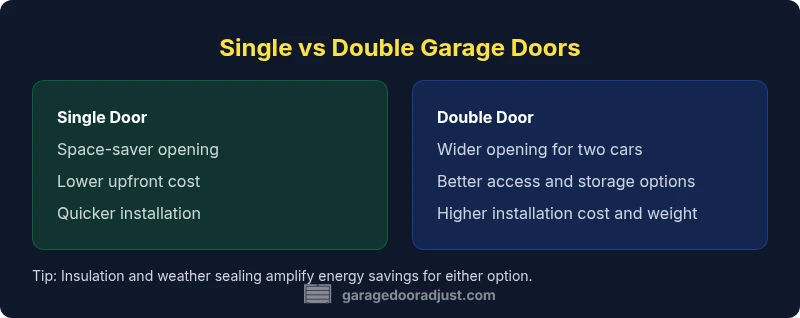
TL;DR: A single garage door is narrower, usually cheaper to install, and fits tight spaces, making it ideal for a single-car garage. A double door spans a wider opening, makes parking two cars easier, and can simplify future expansion, but comes with higher upfront cost and potentially more complex installation. Choose based on current space, parking needs, and long-term plans.
Understanding the core difference: single garage door vs double
A single garage door vs double—these terms refer to the width and opening size of your garage door, not just the number of panels. In practical terms, a single-door configuration is narrower and designed for a single-car bay, while a double-door setup spans a wider opening, typically accommodating two cars side by side. This distinction affects the opening's geometry, the framing requirements, and how you move vehicles in and out. According to GarageDoorAdjust, the choice often hinges on how you use the space today and whether you expect changes in your parking needs in the next few years. The opening width determines not only how many vehicles can fit but also how much overhead clearance you have for storage or shelving above the door. In many homes, the decision also influences your insulation strategy and energy efficiency, especially in climates with extreme temperatures.
Structural implications of door size
When you compare single vs double doors, the most immediate structural difference is the opening width and the header span. A wider opening requires a longer track section, a heavier door panel, and often a more robust counterbalance system. In some homes, converting a single opening to a double later can require reinforcing the wall framing, adjusting the ceiling-mounted tracks, and possibly upgrading the opener to handle the added weight and travel. This means retrofit costs may be higher than simply installing a new, appropriately sized single-door unit if you plan to stay in the home for many years. If you anticipate future changes, plan for a modular approach: ensure the structure can support either configuration without major renovation. Planning ahead can save time and reduce the risk of misalignment or binding during operation.
Costs and value proposition
Cost considerations are a major driver in this decision. Generally, single-door installations tend to be less expensive upfront than double-door installations, because fewer materials, lighter weight, and simpler hardware are needed. However, long-term value isn't just about upfront price; you should also weigh maintenance intervals, longevity of components, and potential energy savings from better insulation. For homeowners who frequently park two cars, a double-door setup can offer convenience that offsets higher initial costs over time. In practice, the price gap varies by materials, insulation level, and regional labor rates. GarageDoorAdjust analysis shows that the total cost of ownership can be more favorable for the option that reduces daily friction and repair visits over many years.
Space and footprint considerations
The footprint of a single door versus a double door translates into how much garage concrete you lose or gain. A single door generally leaves more wall space for storage, work benches, and wall-mounted shelving, while a double door often requires more ceiling height and possibly deeper footprint within the doorway opening. If you rely on wall-mounted storage or overhead storage systems, a narrower opening may maximize usable space. Conversely, if your floor plan accommodates a larger opening, a double door can eliminate a central jamb and reduce the risk of misaligned weather seals across two panels. Think through how you move large items in and out of the garage, and check that your driveway and approach won't conflict with the door's arc during operation.
Insulation, energy efficiency, and weather sealing
Insulation performance varies with door design and panel construction, not simply with width. Double doors can be built with multiple insulation layers and stiffer frames that minimize thermal bridging, but single doors can achieve similar performance with high-quality cores and weather seals. The key is to compare overall U-values and gasket quality, not just the number of panels. For climate resilience, look for doors with robust weather-stripping, sash-style seals around the perimeter, and good door-to-floor alignment. If you park in an attached garage, the door's thermal performance contributes to indoor comfort and energy bills. Work with an installer who can tailor insulation choices to your local climate and the door size you choose.
Maintenance and durability considerations
Both single and double doors share core maintenance needs: balancing, track lubrication, roller replacement, and spring inspection. The larger mass of a double-door system can magnify wear on the springs, cables, and tracks, potentially increasing maintenance frequency. Regular safety checks—testing auto-reverse, inspecting weather seals, and ensuring torsion spring tension is within safe parameters—are essential for both configurations. If you notice uneven door movement, creaking, or slow operation, address it promptly to prevent bigger problems. Establish a seasonal maintenance rhythm and keep a simple log for parts replacement and service intervals.
Security and safety considerations
Door size can influence home security and safety practices. A wider opening may require more robust locking strategies and reinforced sections to resist forced entry. Ensure remote openers have rolling-code or modern encryption, and install sensors that detect misalignment or obstruction. For families with children or pets, implement clear safety boundaries around the door's travel zone and keep remote controls out of reach. Proper installation reduces pinch points and uneven door movement, which can otherwise create injury risks or accidental damage when raising or lowering a large, heavy panel.
Installation and retrofitting challenges
Installing a single door is typically quicker and simpler than installing a double door because fewer components must align perfectly. A double-door installation may involve more precise alignment of two door panels, more powerful torsion springs, and careful calibration of the opener to handle the wider load. If you're replacing an old setup, you may also need to adjust header height, wall framing, and the ceiling track. In some cases, a retrofit to single- or double-door sizing requires structural modifications or a new opener with higher lifting capacity. Working with a qualified installer reduces the risk of misalignment and ensures code compliance.
Real-world scenarios: choosing for a single-car vs two-car garage
In a typical single-car garage, most homeowners begin with a single-door design to minimize space and cost, while preserving full vehicle clearance. A two-car garage presents a trade-off: either a single double-width door or two separate single doors. A single extra wide panel can simplify operation and heating; however, two narrower doors offer redundancy in case one panel needs servicing and can provide more flexible storage options along the sides. Your decision should reflect your current garage layout, whether you foresee converting to a workshop, and how much driveway space you want to reserve for opening doors. Finally, consider local HOA guidelines and storm resilience; some regions prefer doors with extra reinforcement.
Step-by-step decision framework
Use this framework to choose confidently: 1) Measure the opening and check header support. 2) List parking needs for today and the near future. 3) Compare upfront costs, maintenance, and energy performance. 4) Evaluate installation complexity and contractor availability. 5) Review insulation, weather sealing, and security features. 6) Decide on a door system that aligns with your home’s aesthetics and resale value. 7) Request written quotes and seek warranty details from multiple installers. A thorough comparison reduces the risk of regret and helps you plan for future garage use.
Maintenance checklist and troubleshooting tips
Create a simple seasonal checklist to keep your door running smoothly: visually inspect panels for dents or corrosion, test balance by pulling the door halfway down and letting go (the door should hold), lubricate tracks and rollers, and inspect weather seals for wear. If the opener stutters, check the safety sensors and recalibrate limits as needed. For noisy operation, identify squeaks by listening along the track, then oil the rollers and hinges. Document any fixes and monitor for recurring issues, which may signal the need for professional service or part replacements.
Final considerations before purchasing
Before you buy, define your garage’s layout, parking demands, and climate considerations. Seek quotes that itemize each component: door panels, springs, tracks, insulation, and installation labor. Ensure that the warranty covers both parts and labor and that the opener’s capacity matches the door weight. Consider resale value and curb appeal; a well-chosen door can boost property value and reduce future energy costs. Finally, partner with a reputable installer who can guide you toward the most reliable configuration for your home.
Comparison
| Feature | Single door | Double door |
|---|---|---|
| Width | Narrow opening for a single-car bay | Wide opening for two-car bays |
| Installation time | Typically quicker | Typically longer due to dual panels and heavier hardware |
| Cost range | Lower upfront cost | Higher upfront cost |
| Best for | Single-car garages or space-constrained layouts | Two-car garages or need for easier access |
| Maintenance and durability | Similar maintenance needs per component | Heavier system may demand more frequent inspection of springs/tracks |
| Insulation and energy | Can achieve strong insulation with quality cores | Can achieve very strong insulation with multi-layer cores |
Upsides
- Lower upfront cost and simpler installation for singles
- More wall space for storage with singles
- Sufficient for single-car households with balanced storage
- Two-car setups benefit from wider access and parking flexibility
- Potential resale value improvement with appropriately sized doors
Disadvantages
- Single doors may require upgrading later if two cars are parked inside
- Double doors involve higher installation costs and heavier components
- Wider doors can complicate retrofit or alignment if existing framing is limited
Depends on space and parking needs; single doors for tight spaces, double doors for two cars and future flexibility
The GarageDoorAdjust Team recommends assessing current layout and future parking plans. If you park one car and value space efficiency, a single door is typically the best fit. If you regularly park two cars or anticipate expanding storage, a double door offers greater convenience and resilience.
Got Questions?
What is the main difference between a single garage door and a double garage door?
The main difference is width and opening size. A single door fits a narrow, single-car bay, while a double door covers a wider opening suitable for two cars. Both require proper framing and an appropriately rated opener.
The key difference is width: single for one car, double for two cars. Both need solid framing and a capable opener.
Are double doors more expensive to install than singles?
Yes, doubles generally cost more upfront due to heavier panels, longer tracks, and stronger springs. The total cost depends on materials and insulation, as well as installation complexity.
Yes, double doors usually cost more upfront because they’re heavier and require stronger hardware.
Can I convert a single-door opening into a double-door opening later?
Conversion is possible but often involves structural work, header reinforcement, and potentially a new opener. It’s typically more complex and expensive than keeping the current size.
Converting later is possible but may require structural changes and a bigger investment.
What are typical width ranges for single vs double doors?
Single doors are designed for narrower openings, while double doors require wider openings. Exact widths vary by garage and manufacturer, so measure precisely and verify with your installer.
Widths vary; measure your opening and confirm with the installer.
Which door is better for insulation and energy efficiency?
Insulation depends on core construction and seals rather than width alone. Both can achieve excellent energy performance with quality cores, multi-layer panels, and tight weather seals.
Insulation quality depends on the core and seals, not door width.
Do single doors require more maintenance than double doors?
Maintenance needs are similar in principle, focusing on balance, tracks, rollers, and springs. A larger double-door system can have more wear in components, but proactive service keeps both in good shape.
Maintenance is similar, but doubles may have more wear due to weight.
Quick Summary
- Measure your opening accurately before selecting a door size
- Balance current parking needs with potential future changes
- Weigh upfront costs against long-term maintenance and energy efficiency
- Consider insulation and weather sealing for climate comfort
- Consult a professional installer to ensure proper fit and safety