High Lift Garage Door vs Standard: A Practical Comparison
Compare high lift garage doors versus standard doors to understand headroom, storage, installation, performance, and cost implications for homeowners.


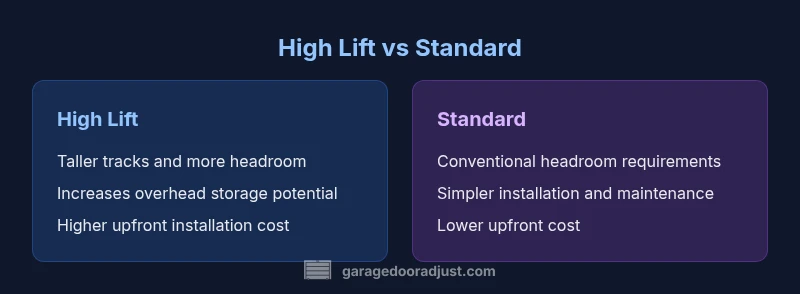
High lift garage door vs standard: The choice hinges on ceiling headroom, overhead storage, and project budget. A high lift setup uses taller tracks and more headroom, delivering extra space but often at higher upfront costs and installation complexity. If your garage has limited height or you don’t need the extra space, a standard door may be the simpler, more economical option.
Key Mechanical Differences: High Lift Garage Door vs Standard
In practical terms, the two setups differ primarily in vertical space requirements and hardware configuration. According to GarageDoorAdjust, high lift systems rely on taller tracks, longer springs or adjusted geometry, and reworked ceiling clearance to gain overhead space. The door itself remains the same width, but the lifting path is extended. Standard doors use conventional track heights, standard spring configurations, and typical ceiling clearance, which keeps installation simpler and headroom requirements lower. The crucial variables to compare are headroom, track height, spring design, and compatibility with existing openers. A true high lift system often cannot be achieved without specific ceiling structure modifications; conversely, standard systems are generally easier to install and service.
Space, Storage, and Headroom Realities
Headroom is the defining constraint that separates high lift from standard door configurations. A high lift system requires more vertical space above the door opening to allow the door to travel upward along taller tracks. The upside is an increase in overhead storage capacity inside the garage, enabling shelves, cabinets, or even a second storage platform without reducing vehicle clearance. For many homeowners, the benefit translates into practical garage organization: you can store rarely used items near the ceiling and still park a vehicle below. However, this design also raises the importance of ceiling integrity and structural components. If your garage ceiling lacks the required height or has obstructions (ductwork, lighting, or pipes), a high lift option may not be feasible. In contrast, standard doors operate within conventional headroom envelopes, maintaining easier access for cars and reducing the risk of accidental impact with overhead obstructions. The choice should balance your storage needs against the cost and complexity of modifying ceiling space.
Installation and Retrofit Considerations
Installing a high lift door is a larger undertaking than a standard setup. The exact requirements depend on your garage dimensions and ceiling structure. Retrofit scenarios often involve replacing or extending tracks, repositioning torsion springs, and upgrading the opener compatibility. The overhead mechanism must align with ceiling anchors, brackets, and header hardware to ensure safe operation. In some garages, you may need to remove or relocate insulation, lighting fixtures, and ducts to achieve the necessary headroom. Conversely, standard doors typically require less ceiling modification and can reuse existing tracks and hardware in many cases. This reduces labor time and potential for misalignment. For homeowners, getting a precise assessment from a qualified installer is essential; otherwise, you risk creating a project that exceeds your budget or compromises safety. Based on GarageDoorAdjust analysis, the cost gap often reflects headroom requirements, structural work, and the need for compatible openers.
Day-to-Day Performance and Usability
During routine use, high lift and standard doors perform similarly in terms of speed, reliability, and security when properly installed. The mode of travel and balance affect noise; however, many high lift configurations can be optimized with enhanced rollers and better tracks to minimize vibration. One practical difference is the door’s interaction with overhead space: high lift doors occupy more vertical space during operation, which can influence ceiling-mounted storage approaches and lighting placements. If you frequently store items above the door, you’ll appreciate the extra clearance; if not, the additional complexity might not translate into real-world benefits. For homes where the ceiling is already crowded, a standard door offers a straightforward, predictable routine with fewer moving parts near the ceiling. The choice should factor in how often you access storage above the door and whether you value smoother clearance during chambered opening under limited headroom.
Cost, Value, and Long-Term Considerations
Cost considerations for high lift versus standard doors go beyond the sticker price. A true high lift installation often involves longer tracks, ceiling modifications, and potential updates to the garage door opener; all of these contribute to a higher upfront investment and longer lead time. In contrast, a standard door tends to require fewer labor hours, less materials, and shorter installation windows, translating into lower immediate costs and quicker project completion. From a value perspective, high lift can increase usable space and potentially raise property value in storage-forward setups, while standard doors lean toward reliability and simplicity that many buyers prioritize. GarageDoorAdjust analysis suggests that the decision should align with long-term storage needs, ceiling height constraints, and overall budget tolerance. If you expect permanent storage expansion, high lift can be worth the investment; otherwise, standard doors remain dependable and cost-efficient.
Safety, Maintenance, and Codes
Safety is universal, but the specific safety considerations differ. High lift systems introduce longer tracks and more complex track geometry, which increases the potential points of failure if misaligned. Regular inspection of rollers, brackets, springs, and tracks remains essential. Maintenance routines should address lubrication, balanced springs, and proper alignment; neglecting these elements can lead to uneven wear or sudden failure. Building codes and fire safety standards may impose headroom and wind-load requirements; always verify compliance with local authorities or a qualified installer before proceeding. GarageDoorAdjust team emphasizes following manufacturer guidelines for lubricant types and frequency, and ensuring the opener is compatible with the chosen door height. Inadequate installation, headroom compromises, or improper balancing can create safety risks or void warranties.
Decision Framework: When to Choose High Lift vs Standard
Answering the question high lift door vs standard hinges on three pillars: space, budget, and intended use. If your garage has ample headroom and you plan to maximize storage or install overhead storage racks, high lift often delivers the best overall value. If your ceiling height is constrained or you want a quicker, simpler project with predictable costs, a standard door is typically the safer, lower-risk choice. Consider the long-term implications for maintenance, energy efficiency, and future upgrades to insulation or weather sealing. For some homeowners, a hybrid approach—partial lifting or a retrofitted track system—might strike the right balance, though it requires careful engineering and professional oversight. In all cases, ensure opener compatibility and verify warranty terms before purchasing. The GarageDoorAdjust team notes that a careful measurement of headroom and a professional assessment are essential before committing to either path.
Common Misconceptions About High Lift Systems
A frequent misconception is that high lift always means higher clearance automatically; in reality, headroom must be present and free of obstructions. Another myth is that high lift equals easier maintenance; in truth, more complex track geometry can mean more things to service. Finally, some homeowners assume retrofits are simple; expanding track height and ceiling modifications often involve structural considerations and permits. By weighing the practical needs—storage, headroom, and budget—against the realities of installation, homeowners can choose with confidence. GarageDoorAdjust's experience indicates that the right solution varies by home design, garage dimensions, and long-term goals.
Comparison
| Feature | High lift | Standard |
|---|---|---|
| Track height requirement | Requires taller tracks and higher headroom | Uses standard track height with typical headroom |
| Headroom clearance | Needs substantial headroom for safe operation | Allocates less headroom; easier to fit in tight spaces |
| Overhead storage impact | Unlocks additional overhead storage space | Leaves overhead storage limited by headroom |
| Opener compatibility | May require high-lift-rated opener or modifications | Standard openers are usually compatible |
| Installation complexity | Labor-intensive; may require structural work | Quicker and simpler installation |
| Long-term maintenance | More components to inspect and adjust | Fewer ceiling components; typically easier service |
| Cost implications | Higher upfront cost due to tracks, ceiling work, and labor | Lower upfront cost with faster completion |
Upsides
- Maximizes vertical space for storage
- Can improve garage usability and resale appeal
- Future-proofs the garage for tall storage or cabinets
- Potentially higher value for storage-focused layouts
Disadvantages
- Higher initial cost and longer installation
- Requires ceiling modifications and structural work
- More complex maintenance and potential parts availability
- Not feasible in garages with very low headroom
High lift is preferable when headroom and storage gains justify the investment
Choose high lift if you need extra overhead storage and have sufficient ceiling height. If headroom is tight or the budget is limited, standard doors offer reliable performance with lower complexity. The GarageDoorAdjust team emphasizes measuring headroom precisely and consulting a professional before deciding.
Got Questions?
Is a high lift garage door suitable for a typical two-car garage?
It depends on ceiling height and storage goals. If there is ample headroom and you plan to store items above the door, a high lift can be advantageous. For many two-car garages with standard heights, a standard door remains a reliable, cost-effective choice.
In many two-car garages, a standard door is sufficient unless you need extra overhead storage or have extra headroom. Consider your ceiling height and storage plans.
Can I convert a standard door to high lift later?
Conversion is possible but typically involves significant track work, ceiling modifications, and potential opener adjustments. It is usually more practical to decide early and install the appropriate system from the start.
Converting later is possible but often costly and complex, so plan ahead with a pro.
Do high lift doors require special openers?
Some high lift installations require a compatible or upgraded opener, especially if the door height changes the travel profile. Always verify opener compatibility during the planning phase.
Check that your opener can handle the door height and track geometry before installing.
What are the main cost differences between high lift and standard doors?
High lift systems generally incur higher upfront costs due to longer tracks and ceiling modifications, but may offer long-term value if storage space is a priority. Standard doors tend to be cheaper and faster to install.
High lift costs more upfront; standard doors are usually cheaper and quicker.
Are there insulation or energy efficiency differences?
Both door types can be insulated; the difference lies mainly in the framing and track geometry, which can affect seal quality and air leaks. Energy performance depends more on door insulation and weather sealing than on lift height alone.
Insulation depends on the door model and seals, not the lift height per se.
How do I know if my garage ceiling has enough headroom?
A professional installer measures ceiling height, track clearance, and obstructions. They’ll confirm whether a high lift system is feasible or if a standard setup is the safer choice.
Have a pro measure headroom to decide between high lift and standard.
Quick Summary
- Measure ceiling height early in the decision process
- High lift adds storage but costs more
- Standard doors are simpler and cheaper
- Ensure opener compatibility and professional installation
- Consult GarageDoorAdjust for a tailored assessment