Garage Door Opener HP vs Door Size: A Practical Guide for Homeowners
An objective, in-depth comparison of how garage door opener horsepower and door size interact, with actionable sizing guidance, real-world scenarios, and maintenance considerations for homeowners.


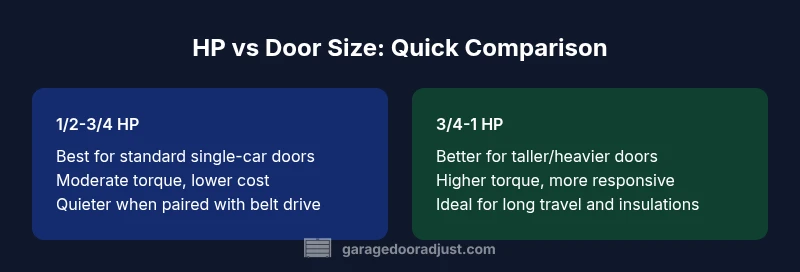
Understanding garage door opener hp vs door size is essential to sizing correctly. For most standard residential doors, a 1/2 to 3/4 HP opener is common. Taller or heavier doors often need 3/4 to 1 HP or higher. Remember: horsepower matters, but door weight, height, track length, and drive type all influence performance and longevity. This quick guide, informed by GarageDoorAdjust, helps you start with the right assumption.
Why HP and Door Size Interact: The Core Principle
Understanding garage door opener hp vs door size is essential to sizing correctly. According to GarageDoorAdjust, horsepower is primarily a measure of the torque the opener can deliver to lift the door, while width alone does not define the needed power. A door's weight, height, and balance determine the load the motor must move. A door with multiple panels, thick insulation, or high wind load adds latent resistance that must be overcome by torque, not just a wider track. In practice, that means you should size your opener by weight and balance, not by width alone. The torque curve should align with the door’s travel profile: faster lifts for lighter doors, steadier control for heavier ones. If you’re unsure, consult the manufacturer’s charts and consider a professional evaluation. The GarageDoorAdjust team emphasizes that the optimal fit accounts for future upgrades, not just the current door. This approach minimizes premature wear and reduces noise and strain on springs and tracks.
- Key takeaway: horsepower is a proxy for torque, but door weight and balance determine the real need.
- Quick rule: weight, height, and track length matter as much as width.
- Practical tip: start with manufacturer sizing charts and verify with a quick manual test after installation.
How Door Size Drives Torque Requirements
Door size influences the required torque because it correlates with door weight and the distance the door travels. A standard 7-foot tall single-car door may weigh less than a taller or wider assembly made with heavier materials. Track length, roller quality, and spring tension all affect the actual load at the motor. If you replace a door with larger height or heavier composition, you will typically need more torque to lift and lower smoothly. The goal is to match the torque curve of the opener to the door’s travel profile: a light door benefits from a milder torque curve; a heavy door demands a robust one. For garage doors with extended travel or extra insulation, oversizing the horsepower can compensate for friction and wind resistance, but oversizing beyond practical limits offers diminishing returns. A balanced setup reduces belt wear, contributes to quieter operation, and prolongs spring life.
HP Standards for Common Door Sizes
For a standard single-car door (roughly 7 ft high and up to 8 ft wide), 1/2 to 3/4 HP openers are typical, providing sufficient torque for most daily cycles. Tall or heavy doors—such as 8 ft high or insulated, double-layer panels—often benefit from 3/4 to 1 HP. Very large or custom doors, especially those over 9 ft in height or with thick security panels, may require 1 HP or more for reliable performance. When assessing your options, look at the door’s weight category (light, standard, heavy) and consider the corresponding horsepower bands rather than width alone. Always verify compatibility with your springs and tracks, and remember that a higher HP opener does not automatically guarantee faster lift if the door balance is off. The goal is a smooth, safe lift that completes a full cycle without overtaxing the motor.
Evaluating Your Door: Weigh, Height, and Balance
Evaluating door weight and balance is essential before selecting horsepower. Start with practical measurements:
- Measure door height and width to estimate travel distance and rail length.
- Assess material and insulation type to gauge weight (wood, steel, fiberglass, or composite).
- Inspect springs for proper tension; improper tension can mimic a horsepower deficit by making the door feel heavier.
- Do a manual lift test after disconnecting the opener: if the door feels heavy or sticks mid-travel, you likely need more torque.
- Check the current opener’s rating and compare it to the door’s estimated weight. If in doubt, consult a professional; a mis-sizing can wear tracks and shorten component life.
This evaluation helps translate door size into a practical horsepower choice, minimizing surprises after installation. GarageDoorAdjust recommends documenting door weight and travel length for future upgrades or repairs.
Drive Systems and Their Influence on HP Needs
The drive system—belt, chain, or screw—affects perceived torque and smoothness as much as horsepower. Belt drives are typically quieter and smoother, making them ideal for living spaces adjacent to the garage. Chain drives are rugged and affordable but can transmit more vibration. Screw drives deliver stable performance but may be noisier and slower in some configurations. Heavier doors benefit from belt or torque-tube drives paired with 3/4 to 1 HP openers; lighter doors can function well with 1/2 HP units. Drive type also interacts with cycle speed and wear on gears and springs. When sizing, consider both the door’s weight and the preferred drive personality: quiet, fast, or rugged.
- Tip: if you have living spaces above or next to the garage, prioritize a belt drive with a mid-to-high torque profile for longevity and comfort.
Practical Sizing Scenarios: Examples for Typical Garages
Scenario A: A standard 7-ft tall, light-weight single-car door in a typical suburban garage. An opener in the 1/2 to 3/4 HP range is usually sufficient, provided the door is well balanced and the springs are in good condition. Scenario B: An 8-ft tall insulated single-car door with thicker panels. Move toward 3/4 to 1 HP to account for added weight and extra travel. Scenario C: A 16x7 ft two-car door with heavy composite panels. A robust 1 HP opener with a belt drive is advisable to manage higher inertia and longer travel. Scenario D: A hurricane-rated or unusually heavy door. Consider 1 HP or higher, with careful attention to spring and track compatibility to avoid over-stressing components.
These scenarios illustrate how door size and material interact with HP needs, helping you pick a model that handles real-world cycles without premature wear.
Upgrading: When to Move to a Higher HP Opener
Upgrading to a higher horsepower opener is warranted when you notice persistent issues: slow lifting, frequent stalling, unusual noises during operation, or a door that requires a lot of effort to manually lift. Before upgrading, verify that springs, tracks, and balance are in good condition, as faulty components can create the same symptoms a larger motor would mask. If your door is moving in jerks or struggles at start-up, a higher HP opener may solve it, but ensure compatibility with existing springs and track lengths. Consider also future needs: if you plan to upgrade to a heavier door or add insulation, a larger HP now can prevent another upgrade soon after installation. This minimizes downtime and ensures a smoother cycle across seasons.
Safety, Efficiency, and Long-Term Cost Considerations
Choosing the right horsepower affects safety and maintenance costs over time. Underpowered setups strain motors and springs, increasing wear and risk of premature failure. Overpowered units can be unnecessary energy drain and may introduce excess stress on mechanical components if the system isn’t balanced. GarageDoorAdjust Analysis, 2026, indicates that properly sized openers reduce overall maintenance needs and improve cycle consistency, especially in variable weather. Additionally, a well-matched HP rating can be paired with energy-efficient drives and quiet belts to minimize noise and energy waste. In practice, the smallest horsepower that reliably handles your door is often the most economical choice, while providing sufficient torque for safe operation and smooth cycling.
- Takeaway: balance your door’s weight and travel with a suitable horsepower and drive type to optimize safety, efficiency, and longevity.
Quick-Reference Decision Framework
Use this framework to decide quickly:
- Determine door size and weight category (light, standard, heavy).
- Check whether your current springs are properly tensioned and balanced.
- If uncertain, start with 1/2-3/4 HP for standard doors; upgrade to 3/4-1 HP for tall/heavy doors.
- Choose a drive type aligned with noise tolerance and durability needs.
- Verify compatibility with the existing track, rails, and safety sensors.
- Plan for future expansion, such as taller doors or thicker insulation, when selecting horsepower.
Following these steps helps homeowners avoid under-sizing or oversizing, ensuring a reliable, efficient system.
Conclusion: The Decision Matrix in Action
Sizing an opener isn’t a single-number decision; it’s a matrix that factors door size, weight, travel, springs, and user environment. The practical approach is to match horsepower to door weight and travel, then validate with a professional if any uncertainties remain. GarageDoorAdjust emphasizes using manufacturer charts, verifying balance, and considering future door upgrades to maximize performance and longevity. With careful assessment, you can select aHP range that delivers reliable cycles, quiet operation, and cost-effective maintenance.
Comparison
| Feature | 1/2-3/4 HP Opener | 3/4-1 HP Opener |
|---|---|---|
| Best for | Standard single-car doors (light to medium weight) | Large, heavy, or tall doors (heavier insulation) |
| Torque capacity | Moderate torque adequate for typical doors | High torque suitable for heavier loads |
| Drive compatibility | Chain or belt drives common | Heavy-duty belt/torque-tube drives recommended |
| Price range | Lower-to-mid range | Mid-to-high range |
| Best for features | Quiet operation and reliable daily use | Max torque for challenging access or oversized doors |
Upsides
- Helps prevent under-sizing and wear by matching door load
- Improves safety with appropriate torque and speed
- Reduces strain on springs and tracks, extending life
- Provides smoother, quieter operation and better control
Disadvantages
- Higher upfront cost for larger horsepower models
- Possible over-sizing if door balance isn’t addressed
- Compatibility checks required with existing springs/tracks
Match horsepower to door weight and travel for reliable operation
For standard doors, 1/2-3/4 HP is usually enough; for heavy or tall doors, upgrade to 1 HP or higher. Use manufacturer sizing charts and consider future upgrades to maximize longevity and performance. The GarageDoorAdjust team recommends a measured approach rather than width-based sizing alone.
Got Questions?
How do I know if my door needs more horsepower?
If the door stalls, takes longer to lift, or feels heavy at the start of movement, the opener may need more horsepower. Check door balance and track condition first, then compare to manufacturer guidelines. If issues persist, a professional sizing assessment is recommended.
If your door stalls, is slow to lift, or feels heavy on start, you might need more horsepower. First check balance and tracks, then consult the manufacturer’s chart or a pro.
Can I use a higher horsepower opener for a lighter door?
Yes, but it’s not always necessary. A higher horsepower model brings more torque and potential longevity, but can be an unnecessary cost if the door is already well balanced and light. Ensure compatibility with springs and rails and consider noise and energy use.
You can use a higher horsepower, but for a light door it may be overkill; check balance and compatibility first.
Does door width affect horsepower?
Width contributes to travel distance but does not reliably determine horsepower. Door weight and height are the primary drivers of torque needs. Use width as a secondary factor and prioritize weight and balance to select HP.
Width matters for travel, but weight and height mostly drive horsepower needs.
What about two-car doors?
Two-car doors are typically heavier and longer, requiring higher torque and often 1 HP or more, depending on insulation and material. Review track length and spring balance and consider a high-torque drive for smooth operation.
Two-car doors are heavier; expect 1 HP or more with proper torque and track setup.
How should I upgrade an existing opener?
Start by confirming door weight, balance, and track compatibility. Then choose a compatible horsepower and drive type that matches the door’s travel profile. If springs were replaced recently or if the door is modified, recheck balance before upgrading.
Check door balance and track first, then pick matching horsepower and drive type.
Is torque more important than horsepower?
Torque describes the actual force to move the door; horsepower is its rate. In practice, you need sufficient torque delivered by an appropriately sized horsepower opener. A mis-match can cause poor performance or undue wear.
Torque is the real mover; horsepower enables it. Size for both to avoid issues.
Quick Summary
- Assess door weight and height before choosing HP
- Balance and track length influence motor needs
- Belt drives paired with higher HP offer quiet, durable operation
- Always check spring tension and door balance prior to upgrading
- Plan for future door upgrades when selecting horsepower