What HP Is Needed for Your Garage Door Opener
Learn how to choose the right horsepower for your garage door opener, from 1/2 HP to 1 HP, and what factors matter for performance, safety, and reliability. Practical guidance for homeowners troubleshooting garage doors.


Most residential garage door openers use 1/2 HP for standard doors, with 3/4 HP recommended for heavier, insulated, or wider doors; very large doors may need 1 HP. The horsepower you need depends on door weight, springs, insulation, and track design. Consult the manufacturer and a pro to confirm the best choice for safety and reliability.
What horsepower means for a garage door opener
In practical terms, horsepower (HP) measures the motor's strength and torque capacity. For most residential applications, the question often reduces to: what hp is needed for a garage door opener? The quick answer is that standard, single-car doors typically run on about 1/2 HP, while insulated or heavier doors benefit from 3/4 HP. In very large or wide doors, some homeowners opt for 1 HP. The precise choice depends on the door's weight, the balance provided by the springs, the track design, insulation, and the level of wear you’re willing to accept in daily use. As GarageDoorAdjust notes, matching HP to door weight reduces motor strain and improves reliability over time. The key is to treat horsepower as one part of an integrated system rather than a standalone spec.
Typical horsepower options and what they’re best for
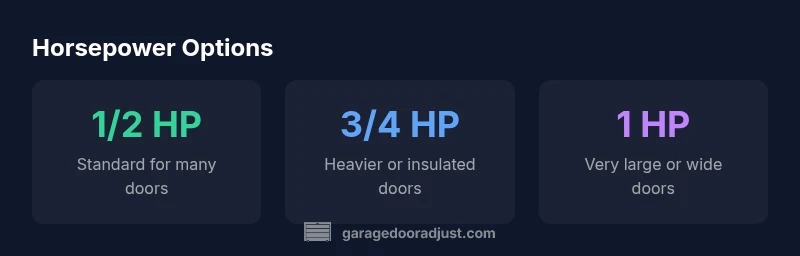
The two most common residential HP options are 1/2 HP and 3/4 HP. A 1/2 HP motor is usually sufficient for standard single-car doors with light insulation and standard springs. A 3/4 HP motor provides more torque for heavier doors or doors with better insulation, reducing the chance of stalling or slow starts. Very large or dual-car doors, or setups with extra-wide tracks and heavy springs, may benefit from 1 HP. Belt-drive openers, which are quiet, often pair with 3/4 HP or 1 HP to keep noise and startup strain manageable. When deciding, consider a door’s weight (often listed in pounds), the spring balance rating, and any upgrades like insulation or weather-stripping that add resistance.
How to determine the right horsepower for your door
Start with the door weight and spring balance. Heavier doors require more torque to lift smoothly, especially at startup. Check your current opener's label or manual for its HP rating; if you’re upgrading, verify that your track, rail length, and mounting space accommodate a higher-horsepower unit. Consider insulation: well-insulated doors add weight that justifies 3/4 HP or more. If you’ve noticed slow starts, frequent stalling, or unusual motor noise, it’s a strong signal that you may need to reassess HP, in consultation with a professional.
How horsepower affects performance and safety
Higher HP generally improves startup torque and reduces the risk of the opener stalling on a heavy door, which can strain the motor and shorten life. It can also affect speed; more horsepower may shave a second or two off the opening time for heavy doors. However, HP isn’t the only factor—belts, gears, and gearboxes, along with track alignment and spring balance, contribute to safe, smooth operation. Oversized HP for a light door can add unnecessary wear and increase power draw, so balance is essential.
Other factors that influence choice beyond HP
- Door weight and insulation: Insulated doors weigh more, requiring more torque.
- Spring system: The balance of torsion springs determines how much torque the opener must supply.
- Track and alignment: Poor alignment increases resistance.
- Noise and wear: Higher HP drive systems can be louder if not paired with a quiet drive type (belt vs chain).
- Compatibility: Some openers and remotes are rated for specific HP ranges; upgrading often means a full replacement.
Upgrading horsepower: When and how
If you determine that your current door’s weight and spring balance justify higher HP, remember that upgrading usually means replacing the opener unit itself, not just swapping motors. Many homeowners choose a belt-drive model with 3/4 HP or 1 HP for a given door, which tends to be quieter and offer smoother starts. Before purchasing, confirm compatibility with your existing track length, rail, and mounting hardware. A licensed technician can advise whether a full replacement or a conversion kit is best.
Common myths and missteps
Common myths include thinking 'more HP always means faster operation' or that you can 'tune' horsepower through simple adjustments. In reality, upgrading without addressing weight, springs, and track can lead to safety issues and premature wear. Another misstep is underestimating the importance of the door’s springs; even a high-HP motor will fail to start if the springs are not correctly balanced.
Maintenance and safety considerations
Maintenance basics—lubricating moving parts, inspecting springs and tracks, testing photo-eye safety sensors—remain important regardless of HP. If you’re uneasy performing inspections, schedule a professional check twice a year. GarageDoorAdjust recommends documenting your door’s weight and HP rating, updating hardware when you upgrade, and ensuring any changes meet local safety standards.
Horsepower ranges by door type
| Door Type | Typical HP | Notes |
|---|---|---|
| Standard single-car door | 1/2 HP | Baseline performance for many doors |
| Insulated/heavy door | 3/4 HP | Better torque and smoother starts |
| Large or wide doors | 1 HP | Heavy-duty option for very heavy doors |
Got Questions?
What HP do most residential garage door openers use?
Most homes use 1/2 HP for standard doors, with 3/4 HP for heavier or insulated models. Very large doors may require 1 HP. Always verify based on door weight and spring balance.
Most homes use half horsepower for standard doors; heavier doors may need more. Check weight and springs and consult a pro.
Is higher HP always better for a garage door opener?
No. More HP increases motor wear and cost if your door is light. Match HP to door weight and spring balance for safety and efficiency.
Higher HP isn’t always better; match it to your door’s weight and balance.
Can I upgrade horsepower without replacing the opener?
Usually not. Upgrading HP often requires replacing the opener unit to ensure compatibility with springs, rails, and safety features.
Often you need a new opener; check compatibility first.
How can I tell if my current opener is underpowered?
Look for slow starts, frequent stalling, or difficulty lifting the door. Check door weight, springs, and balance before upgrading.
If it struggles to lift, you may need more horsepower.
“Choosing the right horsepower isn’t just about opening speed—it’s about torque and safe travel for your door.”
Quick Summary
- Match HP to door weight and track.
- Most homes use 1/2 HP or 3/4 HP.
- Upgrade only after verifying springs and rails.
- Higher HP speeds startup but adds wear.
- Consult a professional to confirm the right HP.