Garage Door vs Sliding Door: An In-Depth Comparison for Homeowners
A practical, in-depth comparison of garage doors and sliding doors, focusing on insulation, security, maintenance, and space requirements to help homeowners choose the right door for their garage.


When deciding between a garage door versus a sliding door for a typical home, a garage door generally provides better security, insulation, and reliability, with more installer options and compatible openers. Sliding doors often save space but can cost more to maintain and repair. This comparison guides homeowners toward a practical choice.
Why homeowners consider a garage door instead of sliding door
If you're weighing a garage door instead of sliding door for your attached or detached garage, you're weighing how a door opens, seals, and protects your space. The phrase garage door instead of sliding door captures a common homeowner question in many climates and home styles. According to GarageDoorAdjust, the team found that most residential garages benefit from a door that can be fully insulated, offers strong weather sealing, and integrates with standard openers. A traditional garage door—whether sectional or one-piece—offers rapid operation, reliable weather resistance, and broad installer support. In contrast, sliding doors can free wall space and create a clean, modern aesthetic, but they often require more careful sizing, more frequent maintenance, and specialized hardware to ensure airtight operation. For many households, the practical choice remains a standard garage door with quality insulation, serviceable tracks, and a compatible opener.
-23
Design, mechanisms, and how they work
Garage doors typically rely on a sectional or one-piece design that rolls up along tracks and uses torsion or extension springs to counterweight weight. Sliding doors, by contrast, move horizontally on rollers along a track and depend on precise alignment and weather seals. The reliability of a garage door is often tied to the condition of the opener, tracks, and springs, while sliding doors depend on track integrity and roller wear. In either case, choosing high-quality hardware and regular inspections reduces the risk of jams, misalignment, and seal failure. For homeowners, understanding the fundamental operating principles helps set realistic expectations about maintenance, cost, and lifecycle.
-32
Space considerations and architectural impact
The space you have around the opening heavily influences which option makes sense. A standard garage door requires overhead clearance for the door to rise, which affects ceiling height and stored items above the doorway. Sliding doors, meanwhile, need wall space along the opening to accommodate the door as it slides; this can reduce storage or furniture layout options. In tight driveways or narrow garages, a sliding door might seem attractive because it avoids the overhead requirement, but it often introduces other constraints, such as weather sealing and wind resistance. When evaluating space, map out opening dimensions, wall thickness, and available headroom to determine feasibility for each option.
-35
Insulation, energy efficiency, and comfort
Insulation is a primary factor when comparing doors that close off a garage used as a living space or workshop. A well-insulated garage door minimizes heat loss, reduces condensation, and lowers heating or cooling loads for adjacent living spaces. Sliding doors often perform differently depending on the material and glazing; some high-end sliding systems include multi-point weather seals and energy-efficient glazing, but they may still underperform compared with a properly chosen insulated sectional garage door. If energy efficiency is a priority, prioritize doors engineered with high R-values, tight seals, and consideration for wind resistance in your climate.
-36
Security and safety implications
Security is a key differentiator. Garage doors typically offer robust locking mechanisms integrated with the opener, perimeter seals, and anti-ram features when installed with modern hardware. Sliding doors can be secure but may rely on specialized multipoint locks and weather seals that can degrade over time. Safety concerns include pinch points, spring tension, and the potential for doors to derail from tracks. Regular inspection of springs, cables, tracks, and sensors helps prevent accidents and break-ins. For households with pets or children, the safety features of automatic reversal, overload protection, and door balance are especially important.
-34
Durability, maintenance, and lifecycle costs
Durability varies by material and build quality. A typical sectional garage door uses steel, aluminum, or composite panels with a durable coating to resist corrosion and denting. Maintenance often centers on lubricating moving parts, cleaning tracks, and replacing weather seals. Sliding doors require ongoing attention to rollers, tracks, and weather seals to ensure smooth operation and weather tightness. While garage doors may appear more complex initially, their long-term maintenance cycles are generally predictable, with replacement parts readily available from most manufacturers. The lifecycle cost depends on climate, usage patterns, and the availability of qualified technicians in your area.
-37
Aesthetics and curb appeal
Garage doors offer a broad spectrum of designs, materials, colors, and window inserts that can complement various architectural styles. From traditional raised panels to contemporary glass options, manufacturers provide customization that can boost curb appeal and home value. Sliding doors provide a sleek, minimalist look that suits modern exteriors, especially when paired with slim frames and large glass panes. Your choice should balance architectural harmony with practical considerations like insulation, security, and maintenance accessibility.
-39
Installation timelines and contractor considerations
Installing a garage door typically involves structural considerations, door track mounting, spring calibration, and opener integration, often requiring 1–2 days of skilled labor, depending on the system and climate. Sliding doors may demand precise frame preparation and track installation, with potential modifications to wall studs or header supports. The complexity of installation can influence project duration and cost. Always hire licensed professionals with proven track records for your door type to ensure safety, warranty coverage, and proper alignment.
-40
When a sliding door makes sense in a garage
There are scenarios where a sliding door could be advantageous, such as when wall space is fully utilized or when the garage serves as a flexible living area that benefits from seamless transitions and unobstructed views. However, sliding doors often require more precise weather sealing and can present challenges with locking mechanisms and security. If your garage experiences extreme weather, a properly sized, well-insulated garage door may still offer superior performance and value over time.
-34
Quick decision checklist
- Assess climate, energy goals, and interior use of the space
- Compare insulation levels, seals, and glazing options
- Examine track alignment and spring or roller wear
- Check opener compatibility and smart-home integration
- Consider resale value and curb appeal impact
- Get multiple quotes from licensed installers to compare timelines and warranties.
-39
Practical steps to move forward
Gather the opening measurements, choose a door style (sectional versus sliding), and request on-site evaluations from at least three installers. Ask for energy ratings, warranty terms, and service plans. Before committing, test sample seals and ask about maintenance routines and replacement intervals. This approach helps ensure you select the right door type for your home and budget.
Comparison
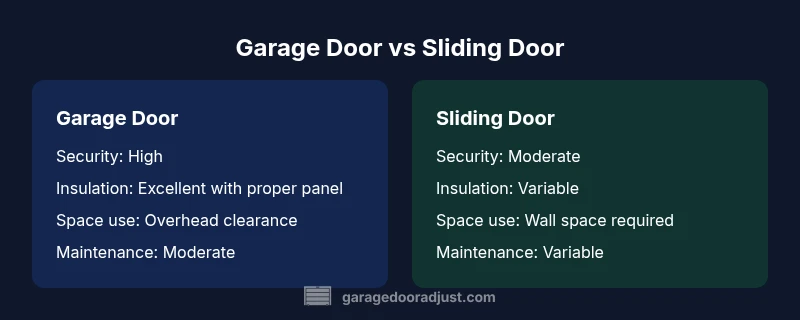
| Feature | Garage Door | Sliding Door |
|---|---|---|
| Security | High-grade locking and sensor integration typical of modern garage doors | Requires dedicated locks and optional security upgrades; may be less robust without specialized hardware |
| Insulation/Energy Efficiency | Typically better when paired with an insulated panel and proper weather seals | Can vary widely; insulation is often less uniform due to glazing and frame design |
| Space Requirements | Overhead space needed; ceiling clearance affects headroom and storage | Wall space needed along opening; floor space is generally not a constraint |
| Maintenance/Repairs | Generally straightforward with regular spring and track checks; widely available parts | Rollers and tracks may wear unevenly; seals and hardware can require more frequent servicing |
| Opener/Automation Compatibility | Broad compatibility with standard openers; widely supported by smart-home ecosystems | Opener options exist but may require specialized hardware for full automation |
| Aesthetics/Customization | Many panel styles and windows; strong curb appeal options | Sleeker appearance possible with glass and minimal framing but fewer insulation choices |
| Longevity/Total Cost of Ownership | Durable with periodic maintenance; long service life when maintained | Lifespan depends on usage and maintenance; can incur higher replacement costs for hardware |
Upsides
- Better insulation and weather sealing
- Stronger security against intrusion
- Extensive opener compatibility and automation options
- More design and material choices
- Longer expected lifespan with regular maintenance
Disadvantages
- Higher initial installation cost in some cases
- Requires overhead space and precise alignment
- Potentially louder operation on older models
- Professional installation recommended for best results
Garage doors generally offer better overall value for most homes; sliding doors may fit space-constrained entries.
Choose a garage door for energy efficiency, security, and long-term reliability. Opt for a sliding door only if space savings and a modern aesthetic are top priorities and you can invest in careful maintenance and specialized hardware.
Got Questions?
Can I replace a sliding door with a garage door in an existing opening?
Replacement feasibility depends on structural framing, wall supports, and the doorway dimensions. A licensed contractor can assess whether the opening can accommodate a sectional or one-piece garage door without compromising structural integrity. In some cases, widening or reinforcing the opening is necessary.
Replacement is possible in many cases, but an on-site assessment is essential to confirm structure and opening size.
What factors influence the cost difference between garage doors and sliding doors?
Costs depend on door material, insulation level, window features, hardware quality, and installation complexity. Labor, permits, and whether you need structural modifications also influence the total. Request detailed quotes to understand value and warranty terms.
Costs vary with material, insulation, and installation complexity; get multiple quotes to compare value.
Are garage doors compatible with existing openers and smart-home systems?
Most modern garage doors are compatible with standard openers and many smart-home platforms. If you have an older opener, you may need an adapter or a new opener kit to ensure full functionality and safety features.
Check your current opener’s model and compatibility before selecting a new door.
Is insulation always better with a garage door than a sliding door?
Insulation can be superior with a well-chosen garage door, especially when paired with sectional construction and weather seals. Sliding doors vary by material and glazing; some perform well, others don’t seal as tightly.
In most cases, insulated garage doors outperform basic sliding doors in energy efficiency.
What maintenance routines are common for each door type?
Regular lubrication of moving parts, track alignment checks, weather-seal inspection, and seasonal opener testing are common. Garage doors may require spring tension checks; sliding doors focus more on track and roller wear.
Maintenance is essential for both; schedule periodic checks and address issues promptly.
Quick Summary
- Prioritize insulation and security for long-term comfort
- Evaluate overhead space vs wall space when choosing the door type
- Consider maintenance requirements and existing opener compatibility
- Choose a door design that aligns with your climate and home style
- Obtain multiple quotes to compare warranties and timelines