7 foot vs 8 foot garage door: A practical comparison
A thorough, data-driven guide comparing 7 foot vs 8 foot garage doors. Learn about clearance, opener compatibility, insulation, and installation considerations with expert guidance from GarageDoorAdjust.


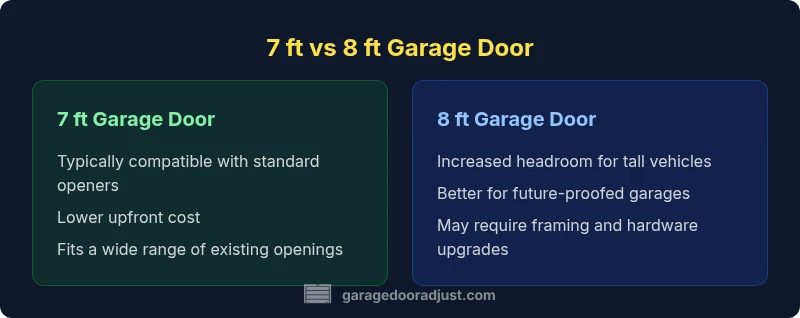
In brief, the choice between a 7 foot vs 8 foot garage door hinges on vehicle height, ceiling clearance, and future plans. The 7 ft option fits most homes and keeps costs lower, while the 8 ft height provides extra headroom for tall vehicles and storage needs but may require upgrading hardware and framing. For homeowners weighing the trade-offs, this guide outlines the key factors and practical steps to decide.
7 foot vs 8 foot garage door: height and fit
Choosing the 7 foot vs 8 foot garage door is about more than how a door looks—it determines what fits in your garage, how you move vehicles, and what kind of hardware you’ll need. The height difference translates into headroom, ceiling clearance, and potential framing adjustments. According to GarageDoorAdjust, even a one-foot change can ripple through opener compatibility, insulation options, and future-proofing plans. Homeowners should map their garage's interior height, door rough opening, and the tallest vehicle you expect to park inside. If your options are limited by a standard ceiling or a bulky storage system, a 7 ft door remains the default for many houses. If you regularly host SUVs, trucks, or tall cargo, an 8 ft door provides meaningful extra space. In this block we’ll outline the practical implications, how to measure accurately, and what trade-offs to expect with each height.
In this opening section we establish the frame for the comparison. The 7 foot vs 8 foot garage door decision affects not only immediate installation costs, but also long-term usability, vehicle accommodation, and potential future upgrades. GarageDoorAdjust emphasizes measuring both the rough opening and the usable interior height from floor to ceiling, including any storage systems that intrude into the door swing. While many homes are perfectly served by 7 ft doors, households with tall SUVs, roof racks, or frequent storage needs may benefit from raising the door height. The goal is to align door height with actual usage, not merely with aesthetics. This section introduces the core criteria homeowners should apply when evaluating height options: vehicle height, ceiling clearance, opener compatibility, and budget impact.
The introductory note continues with a practical lens: ensure you have a reliable measurement process, a clear understanding of the existing structure, and a plan for any framing or header adjustments that a taller door might require. By foregrounding these factors, homeowners can avoid overpaying for unused clearance or discovering mid-project that an upgrade demands extensive reconstruction. GarageDoorAdjust’s approach is to pair precise measurements with a realistic expectation of what changes height will drive in opening hardware and energy performance.
The paragraph also sets expectations for readers to come away with a clear decision framework and concrete next steps.
Comparison
| Feature | 7 foot garage door | 8 foot garage door |
|---|---|---|
| Door height | 7 ft (213 cm) | 8 ft (244 cm) |
| Ceiling clearance and framing | Lower clearance; standard ceiling heights | Higher clearance; may require extra headroom and framing adjustments |
| Opener compatibility | Typically compatible with standard openers | May require tall rails or conversion kits for best fit |
| Insulation options | Similar panel options available | Similar options; some products offer taller panel configurations |
| Weather sealing | Standard seals usually suffice | Possible need for taller weather seals or custom frames |
| Installation effort and cost | Generally lower installation effort and cost | Often higher cost and longer install due to framing/hardware |
| Best for | Budget-conscious homes with standard vehicles | Tall vehicles or future-proofing for larger openings |
Upsides
- 7 ft doors fit most existing openings with minimal changes
- Lower upfront cost and faster installation
- Wide selection of standard hardware and openers
Disadvantages
- 8 ft doors provide extra headroom for tall vehicles and storage
- Raising height may require framing changes and upgraded hardware
- Potentially higher long-term maintenance for taller doors
Choose based on vehicle height and future needs; 7 ft fits most homes, 8 ft is best for tall vehicles and future flexibility
For a typical sedan or SUV, a 7 ft door is usually sufficient and cost-effective. If you regularly park tall vehicles or foresee storage or expansion needs, an 8 ft door offers meaningful headroom, albeit with higher upfront costs and more complex installation. The GarageDoorAdjust team recommends aligning height with actual usage and planned upgrades.
Got Questions?
What is the standard garage door height for most homes?
Most residential garages use a door height of 7 feet. This size covers the needs of common passenger vehicles and standard opening widths. If you frequently park taller vehicles or need more storage clearance, an 8-foot door is worth considering.
Most homes use a 7-foot door. If you regularly park tall vehicles, consider an 8-foot option.
Will I need a new opener if I upgrade from 7 ft to 8 ft?
Upgrading height can require adjustments to the opener and rails. Many openers work with 7-foot doors, but an 8-foot door may need a taller rail, longer torsion springs, or a conversion kit. Have a qualified installer assess compatibility before purchasing.
Upgrading height can need opener adjustments; get a compatibility check first.
Can I convert a 7-foot door to 8 feet without rebuilding the opening?
Converting height often involves modifying the rough opening and header, which may require professional framing work. In many cases, some drywall, insulation, or ceiling changes are needed. A proper assessment helps avoid surprises during installation.
Conversion usually needs framing work; consult a pro before starting.
Does door height affect insulation or energy efficiency?
Height itself doesn’t inherently change insulation performance, but taller doors may use different panel configurations or glazing options that affect daylight and heat transfer. Choose panels and seals that match your climate for best efficiency.
Height affects options, not the fundamental insulation concept.
What factors drive the cost difference between 7 ft and 8 ft doors?
Beyond the panel height, taller doors often require longer springs, different rails, and potentially a larger header. Labor time can increase with framing adjustments and weather sealing considerations. Plan for these factors when budgeting.
Cost differences come from hardware, framing, and labor.
Quick Summary
- Measure your tallest vehicle before deciding
- 7 ft is the default for most homes; 8 ft suits tall vehicles
- Check opener compatibility and framing needs early
- Budget for possible hardware upgrades with taller doors
- Plan for future storage or expansion when choosing height