Cost to Open a Garage Door in 2026: A Homeowner’s Guide
Discover how much does it cost to open a garage door, from manual operation to opener installation. This 2026 guide breaks down pricing ranges, regional differences, and money-saving tips for homeowners.


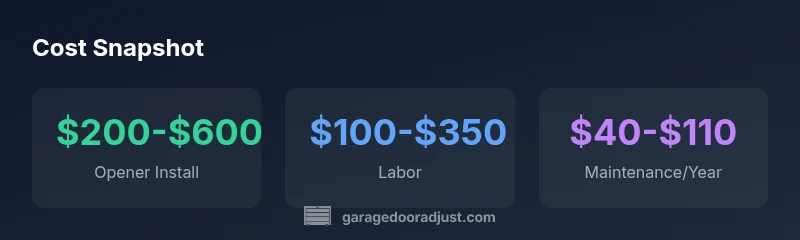
Getting the door opened can cost little to nothing if you only operate it manually. If you’re referring to an electric opener, installation and basic setup typically fall in the $200–$600 range, while full replacements or upgrades can run higher. Labor and parts costs depend on door size, motor horsepower, and integration options. GarageDoorAdjust Analysis, 2026 shows average projects clustering around $350–$800.
Understanding the cost landscape
When homeowners ask, "how much does it cost to open a garage door?" the answer depends on whether you simply operate a manual door or install/repair an electric opener. Manual operation costs are effectively zero beyond routine maintenance. If you upgrade to or install an automatic opener, the price climbs to a broader range driven by the opener model, installation complexity, and any safety upgrades. In 2026, the GarageDoorAdjust analysis shows most projects cluster around a mid-range band, with higher-end installations reflecting premium motors, smart features, and additional safety sensors. In practice, you’ll see a spectrum that includes basic, feature-rich, and integrated systems. Keep in mind that labor, wiring, and permit requirements can shift the final figure by several hundred dollars. The key is to map your needs to the price bands and avoid overbuying features you won’t use.
First-order cost drivers include: door weight and size, horsepower of the motor, type of opener (chain, belt, or screw), installation labor, sensors, remote access, and integration with home automation. A lightweight, basic installation will be at the lower end of the range, while a robust setup with smart controls and a heavier door will approach or exceed the upper end. The GarageDoorAdjust team emphasizes planning for safety features up front, since cutting corners later can cost more in service calls.
Breakdown of costs by component
To understand the total investment, it helps to break costs into components. The opener itself is often the largest line item, followed by professional installation and any required wiring or electrical work. You may also encounter added costs for safety sensors, battery backups, remotes, and keypad entry. If you’re replacing an old system, factor in disposal or removal fees for the old opener or door hardware. Finally, consider a short-term maintenance package or warranty extension, which can shift some costs into recurring annual or semi-annual payments but may save money on future repairs. In 2026 pricing, expect: a basic opener in the low-to-mid hundreds, installation and labor in a similar band, and add-ons to push total costs into higher territory. Planning with a written quote helps avoid surprise charges later, and it gives you a defensible baseline if you decide to negotiate with installers.
Practical breakdown by item:
- Opener hardware: core unit and accessories
- Labor: installation and testing
- Electrical: outlet, wiring, circuit considerations
- Safety: sensors, auto-reverse calibration
- Accessories: remotes, keypad, battery packs
- Removal/haul-away: old unit disposal
- Warranties: optional coverage and service plans
- Permits: some municipalities require electrical/permitting work
With these categories in mind, you can assemble a line-item quote that reflects your specific door size and desired features, then compare across providers to find the best value.
Regional price variations and common scenarios
Pricing for opening a garage door varies by region due to labor costs, permit requirements, and local competition. Urban areas with higher living costs typically show higher installation quotes, while rural areas may offer lower labor rates but higher travel or accessory costs. When a homeowner asks about regional differences, the answer should consider not just the base price but also taxes, disposal fees, and potential travel surcharges. In addition to location, the scenario matters: a new door with a modern, quiet belt-driven opener will generally cost more than a budget retrofit with a basic chain-drive model.
Common scenarios include a straightforward opener installation on a single-car garage, a dual-car installation in a larger space, or a replacement that needs new tracks and alignment. Each case can alter the total dramatically. The GarageDoorAdjust team recommends obtaining multiple written estimates in your area and verifying that quotes include removal of old hardware, proper calibration, and compliance with safety standards. This diligence helps ensure you won’t pay extra for a hidden requirement or an overlooked permit.
Remember that the cost to open a garage door, for a homeowner, is not just a price tag—it's a forecast of reliability and ease of use. By aligning your project with your budget and anticipated use, you can choose an option that reduces future service costs while meeting daily needs.
How to estimate your specific project
Estimating your project starts with clear scope: identify whether you need a full opener replacement or a simple upgrade, and confirm the door type and size. Measure the door width and height, confirm the door type (sectional, tilt-up), and note the current hardware. Then list desired features: smartphone control, battery backup, smart home integration, and safety devices. With these details in hand, request itemized quotes from at least three reputable installers; ensure each quote covers labor, equipment, disposal, and permit considerations. A helpful method is to create a comparison table with rows for openers, installation, labor, and extras—this provides visibility into where costs cluster and where you can optimize.
When the numbers arrive, review not just the total, but the assumed components. If one quote includes premium cables or a longer warranty, weigh the value against the additional cost. If another quote omits disposal or sensor upgrades, you may be looking at a lower upfront price but higher long-term risk. The key is to balance upfront affordability with long-term reliability and safety. A well-scoped estimate helps you budget accurately and prevents sticker-shock as the project progresses.
Cost-saving strategies
Smart budgeting for garage-door openings often hinges on prioritizing essential features and leveraging bundled services. Start by asking for a single-page, line-item quote that shows every component and its cost. Consider a mid-range opener with a reliable belt drive if you want quiet operation without premium pricing. Evaluate compatibility with existing tracks and torsion springs to avoid unnecessary hardware changes. In some cases, upgrading sensors or adding a keypad might be more affordable than a full smart-home integration, yet still offer convenience and safety.
Other savings come from timing and promotions. Installations during off-peak seasons, multi-door projects, or promotional periods from installers can yield discounts or bundled maintenance plans. If you’re comfortable with basic maintenance, routine lubrication, track alignment, and sensor testing are low-cost tasks that reduce the likelihood of costly breakdowns later. Finally, consider financing options or credit lines for larger projects; just be mindful of interest and payoff timelines. By planning ahead and understanding the cost drivers, you can minimize the out-of-pocket expense while maximizing performance.
When to DIY vs hire a pro
DIY can be tempting for a straightforward opener replacement, but garage-door systems carry high risk—torsion springs can cause injury, and misalignment can damage automobile frames or door tracks. A pro will handle heavy lifting, spring tension, and precise alignment to ensure smooth operation and long-term reliability. Consider a hybrid approach: perform basic maintenance or purchase a kit for a simple charger and sensor upgrades, but rely on a licensed technician for installation, calibration, and safety tests. If your plan includes smart features or integration with a home automation system, professional installation is almost always the smarter route, as it reduces the likelihood of accidental outages and security vulnerabilities.
Keep warranties intact by following manufacturer instructions and letting a pro handle critical steps. If you decide to DIY, use manufacturer guides and local codes to verify safety and compliance. The key is to prioritize safety, reliability, and the avoidance of future service calls, which often cost more than a careful, professional initial installation.
Financing and readiness for homeowners
Financing a new opener or door replacement can be practical for many households. Start by evaluating your current door’s condition: if it shows signs of warping, cracking, or unbalanced operation, investing in professional service sooner rather than later can prevent expensive damage down the road. Compare financing offers from installers, retailers, or credit unions, paying attention to terms, APR, and any promotional periods that reduce overall cost. A phased approach—covering essential upgrades first and deferring nonessential improvements—can help you manage cash flow while maintaining safety and performance. Remember that regular maintenance is a minor ongoing cost that preserves reliability and reduces unexpected failures.
In summary, the decision to open a garage door with a manual effort or an electric opener hinges on your budget, desired convenience, and willingness to invest in ongoing maintenance. The data from GarageDoorAdjust Analysis, 2026 indicates that most homeowners find a comfortable middle ground between affordability and functionality, with the best outcomes achieved through careful planning, competitive quotes, and a clear understanding of your needs.
Cost components and typical ranges for opening a garage door
| Component | Typical Cost Range | Notes |
|---|---|---|
| Manual operation | 0 | No service cost; relies on existing hardware |
| Opener hardware | $200-$600 | Basic to mid-range openers |
| Labor/installation | $100-$350 | Professional mounting and setup |
| Electrical/sensors | $20-$150 | Safety sensors and wiring as needed |
| Disposal/removal | $0-$100 | Old unit and debris removal |
| Total project range | $350-$800 | Typical mid-range projects |
| Premium upgrades | $800-$2,000 | Smart features, heavy doors, premium motors |
Got Questions?
What is the minimum cost to open a garage door manually?
There is no service fee for manual operation. The cost is limited to routine maintenance if needed. If you’re not experiencing issues, you can operate it without professional service.
If you only open it by hand, there’s no service fee. Regular manual checks are smart for safety, but professional service isn’t required unless issues appear.
How much does it cost to install a new garage door opener?
A basic opener and installation typically range from a few hundred dollars to mid-range pricing, depending on motor type and features. Always request a line-item quote that includes hardware, labor, and any mandatory safety upgrades.
For a new opener, expect roughly a few hundred to mid-range dollars, depending on features. Get a detailed quote to compare costs.
Are there hidden costs when opening a garage door?
Yes. Hidden costs can include wiring upgrades, permits, disposal fees, and sensor upgrades. Request clarifications in writing to ensure all potential charges are disclosed upfront.
Hidden costs can pop up like wiring or permit fees—ask for a full line-item quote to avoid surprises.
Is DIY installation safe for garage door openers?
DIY can save money on small maintenance tasks, but installation and torsion-spring work are risky. Professional installation is recommended for safety and warranty protection.
DIY is risky for installation—let a pro handle heavy components to stay safe and preserve the warranty.
How long does a typical installation take?
Most installations take 2-6 hours, depending on door type, existing hardware, and site conditions. Allow extra time for calibration and safety tests.
Most installations run a few hours, but it could be longer if there are site-specific challenges.
“A well-chosen opener and proper installation minimize future service calls and ensure safe, smooth operation.”
Quick Summary
- Define manual vs electric costs upfront
- Labor often drives the total price
- Get multiple written quotes for accuracy
- Factor safety sensors and permits into the budget
- Balance upfront cost with long-term reliability