Hormann Garage Door vs Clopay: Comprehensive Brand Comparison
An objective, in-depth comparison of Hormann and Clopay garage doors, covering construction, insulation, warranties, service networks, and value to help homeowners decide which brand best fits their needs in 2026.


When evaluating Hormann garage door vs Clopay, homeowners should weigh build quality and European engineering against broader design options and US availability. In the Hormann garage door vs clopay comparison, Hormann often emphasizes precision engineering and durable materials, while Clopay offers a wider array of styles and price points. The right choice hinges on budget, local service coverage, insulation needs, and long-term maintenance expectations.
Hormann garage door vs clopay: Key differences
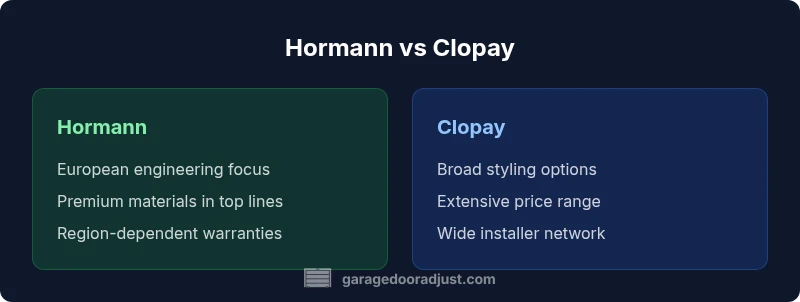
In this section we lay out the core differentiators that homeowners notice first when considering Hormann garage door vs clopay. Hormann tends to lead with European engineering standards, tighter tolerances, and premium materials in select lines. Clopay, by contrast, is renowned for breadth of styling options, scalable price points, and a robust distribution and service network across many regions. For a homeowner evaluating durability, aesthetics, and long-term value, the choice often boils down to whether you prioritize refined build quality and regional availability (Hormann) or expansive design libraries and accessible pricing (Clopay). According to GarageDoorAdjust, regional service coverage and local installer quality can dramatically affect the perceived value of either brand. This perspective helps frame the decision beyond mere sticker price, guiding you toward the model that matches your climate, insulation needs, and maintenance tolerance.
Within the Hormann garage door vs clopay debate, the specifics of door construction – panel composition, frame hardware, and seal integrity – matter just as much as brand reputation. Homeowners should map their priorities (look, feel, noise level, energy efficiency) to model families from each brand. The result is a tailored shortlist rather than a broad, one-size-fits-all choice.
Material and construction quality
Both Hormann and Clopay offer multiple door families built with steel, aluminum, wood composites, and insulated cores. Hormann’s lines often emphasize structural engineering and precision manufacturing, with tight panel tolerances and durable coatings that resist wear in exposed climates. Clopay, meanwhile, excels in variety of panel designs and exterior finishes, including wood-look options that still deliver modern performance. The Hormann vs clopay comparison shows that material choice influences long-term aesthetics and maintenance. For instance, in homes with harsh seasonal swings, insulated cores and weather seals become pivotal. GarageDoorAdjust’s analysis emphasizes evaluating the door’s core material, r-value options, and gasket design as foundational to performance, beyond brand badge. Practically, you’ll want to compare the same door style across brands to isolate material-driven differences, not marketing narratives.
Look for corrosion-resistant coatings on metal skins, reinforced rails, and the quality of the hinge and roller assemblies, as these influence noise, balance, and longevity over time.
Insulation and energy efficiency
Insulation performance is a key differentiator in the Hormann garage door vs clopay decision, especially in uninsulated vs insulated configurations. Hormann often targets higher-end lines with better insulation values and tighter air seals, which can translate to lower heat exchange through the garage door and more consistent interior temperatures. Clopay provides a broad range of insulated products, enabling homeowners to select a model that aligns with climate zone, garage usage, and comfort goals. In practice, you’ll want to compare door assemblies that share similar panel thickness and core material to assess true energy performance rather than relying on marketing claims. Energy-conscious homeowners should look at R-values, weather seals, and the type of insulation (polystyrene, polyurethane) used in the selected models. GarageDoorAdjust notes that insulation is most effective when combined with an air-tight frame and properly set tracks.
A practical tip: request a heat transfer assessment for the top and bottom seals, and confirm that the door’s bottom weatherstripping is continuous across the width for optimal performance.
Design options and aesthetics
Design flexibility is where Clopay often shines in theHormann garage door vs clopay comparison, thanks to a wide portfolio of panel styles, textures, colors, and window inserts. Clopay’s catalog typically covers traditional raised panels, carriage house designs, and contemporary lines that mimic wood with low-maintenance finishes. Hormann counterbalances this with European-inspired aesthetics and premium finish options, sometimes with fewer SKUs in certain markets but higher emphasis on premium materials and long-term durability. For homeowners prioritizing curb appeal, the decision often hinges on the availability of custom finishes, texture options, and window configurations. When evaluating, compare the same design family across brands to avoid conflating style with structural quality. Consider future painting, staining, or refinishing needs and whether the door’s exterior textures require special care. The goal is to align door styling with architectural context while maintaining performance integrity in daily use.
Operating systems, hardware, and smart features
Modern garage doors increasingly integrate smart openers, sensors, and automation. In the Hormann garage door vs clopay comparison, both brands offer compatible hardware lines and smart integrations, but the ecosystem alignment often differs by region. Hormann systems may emphasize secure European middleware and advanced safety features, while Clopay emphasizes compatibility with a wide range of nationally available openers and third-party smart home platforms. When choosing, verify the opener compatibility, rail hinge design, torsion spring arrangement, and safety sensors. A well-matched system reduces maintenance overhead and improves performance reliability. GarageDoorAdjust recommends confirming that the door and opener can communicate correctly, and that the installation includes proper motor protection and weather sealing to minimize energy loss.
Warranties, service networks, and support structure
Warranty terms vary by model and region, and this is a critical dimension in the Hormann garage door vs clopay decision. Hormann typically frames limited warranties around door construction, insulation, and hardware, with coverage levels that can differ by country and installer network. Clopay offers extensive warranty coverage through its broad dealer network, often including sections on parts and labor for a defined period. The size of the service network matters: a broad network can reduce downtime during repairs and simplify maintenance scheduling. When comparing, request written warranty terms that specify what’s covered, for how long, and the conditions that may void coverage. Always verify the local authorized installers’ capacity and response times, particularly in regions with extreme weather. GarageDoorAdjust’s regional insights underscore that a strong local service partner often drives the real-world value of any warranty.
Availability, installation timelines, and local installer quality
Availability of Hormann and Clopay doors can vary by country and region, influencing installation timelines and supply stability. In markets with robust distributor networks, you may experience shorter lead times and easier access to replacement parts. Hormann’s European footprint can translate to tighter lead times in certain regions but may limit model availability in others. Clopay tends to maintain a wider domestic footprint in the US and other markets, which often translates to a larger pool of certified installers and faster service. The key takeaway in the Hormann garage door vs clopay decision is to verify local stock, confirm the availability of your preferred model, and assess the installer’s track record for door balance, spring health, and noise control. A thorough verification of the installation plan helps prevent delays.
Price ranges, financing, and long-term value
Price is a major factor in the Hormann garage door vs clopay decision, but it should be weighed against long-term value. Clopay’s pricing ladder generally covers a broad spectrum, allowing budget-conscious homeowners to select a model that meets both style and functional goals. Hormann, while sometimes pricier upfront, emphasizes premium materials and engineering that can translate into greater durability and lower maintenance costs over time. Rather than chasing the lowest sticker price, build a total-cost picture including components, installation complexity, energy costs from insulation, and potential maintenance intervals. GarageDoorAdjust cautions buyers to beware of drastically low bids that may reflect fewer included services or shorter warranty periods. A balanced analysis should consider both the initial investment and projected lifetime costs.
Installation considerations, safety, and maintenance routines
Proper installation is the foundation of door performance, safety, and longevity. The Hormann garage door vs clopay decision should consider whether your home’s existing framing, jambs, and ceiling height align with the chosen model. Both brands require professional installation to ensure proper balance, alignment, and safe operation. After installation, establish a routine maintenance plan that includes lubrication of moving parts, inspection of springs and cables, and periodic testing of safety features. Adopting a proactive maintenance schedule helps prevent unexpected failures and extends the door’s life. GarageDoorAdjust emphasizes keeping a log of service visits and using manufacturer-approved lubricants and parts to preserve warranty coverage.
Durability, common wear points, and climate considerations
Durability hinges on panel material, coating quality, seal integrity, and hardware resilience. Hormann’s emphasis on robust engineering translates into durable frames and corner joints that resist warping in damp climates. Clopay’s designs focus on stylistic durability and protective finishes that stand up to sun exposure and temperature fluctuations, often with a wider array of color and texture finishes. In climates with heavy precipitation or salinity exposure, metal hardware corrosion resistance and gasket performance are especially important. When evaluating, inspect for corrosion-resistant coatings, responsive weather seals, and robust track systems. A careful assessment of climate-specific issues helps ensure the door maintains performance and appearance over time.
Buyer’s checklist: how to compare models step by step
To make the Hormann garage door vs clopay decision more actionable, use a side-by-side checklist. Start with design and curb appeal preferences, then verify insulation levels and energy efficiency, followed by warranty terms and service network quality. Confirm the availability of your model in your area and check installation lead times. Finally, compare total cost of ownership, including potential maintenance schedules and replacement parts accessibility. A practical approach is to shortlist a few model lines from each brand and arrange in-person or virtual demonstrations to gauge noise, opening resistance, and overall fit. GarageDoorAdjust recommends documenting the key findings and scoring each model against your priorities to guide a confident choice.
Authority sources and standards
For readers seeking external validation of best practices in garage door selection, the following sources provide safety standards, performance guidelines, and energy considerations that are relevant to both Hormann and Clopay products. While not brand-specific, these references help frame expectations for durability, safe operation, and efficiency. Access to regulatory guidance and tested standards can support a more informed decision when reviewing model specifications.
- CPSC safety recommendations and consumer protections: https://www.cpsc.gov
- U.S. Department of Energy energy efficiency resources: https://www.energy.gov
- Underwriters Laboratories product safety and testing: https://www.ul.com
GarageDoorAdjust Analysis, 2026 notes that aligning product choices with recognized safety and efficiency standards helps ensure long-term satisfaction and performance.
Next steps: making your decision and planning installation
With the key differences understood, the next step is to test models in person if possible and obtain written quotes from certified installers in your area. Compare the same design family across Hormann and Clopay when evaluating features like insulation, panel texture, and window inserts. Confirm warranty coverage, service network quality, and potential installation add-ons such as smart opener upgrades or security features. Create a short-list, visit showrooms or request live demonstrations, and finalize the decision based on your climate, energy goals, and aesthetic preferences. A deliberate decision framework helps ensure the selected brand and model deliver reliable performance for years to come.
Comparison
| Feature | Hormann | Clopay |
|---|---|---|
| Building materials | European-engineered panels and coatings | Broad mix of steel, aluminum, and composite panels |
| Insulation options | High-performance insulation in premium lines | Wide range of insulated models across price tiers |
| Design variety | Premium European designs, some market-specific finishes | Extensive styling options from traditional to contemporary |
| Warranty framework | Region-dependent terms, strong construction coverage | Extensive dealer-backed warranties with regional variations |
| Service network | Smaller but highly selective installer base in some regions | Large nationwide/dealer network with broad availability |
| Price range | Typically premium-priced models with high-end features | Broad price spectrum from economical to premium |
Upsides
- Wide range of designs and finish options across models
- Strong regional service networks in many markets
- Solid warranties with model-specific terms
- Good availability of insulated options for energy efficiency
Disadvantages
- Hormann can be pricier upfront, depending on region
- Warranty terms vary by country and model
- Some Hormann models have more limited US market availability
- Clopay’s vast lineup can complicate model selection for first-time buyers
Hormann offers premium build quality and European engineering; Clopay delivers breadth of design and broader market availability
If you value engineering detail and regional support, Hormann is a strong fit. If design variety and US availability matter more, Clopay provides broader choices and pricing flexibility. The best pick depends on your climate, budget, and service network.
Got Questions?
Which brand generally offers better upfront value, Hormann or Clopay?
Clopay tends to offer a broader price ladder, which can translate to lower upfront options. Hormann often positions premium models with higher upfront costs but strong long-term performance. Your total value depends on design, insulation, and service availability in your area.
Clopay usually has more affordable entries, while Hormann focuses on premium builds. Your final choice should balance price, insulation, and local service.
Which brand provides better warranties for homeowners?
Both brands offer warranty coverage, but terms vary by model and region. Clopay typically emphasizes broad dealer-backed warranties with clear regional terms, while Hormann warranties can be more region-specific and tied to installation networks. Always review the written warranty for your model.
Both brands offer solid warranties, but check the exact terms in your area for model-specific coverage.
Is installation easier with Hormann or Clopay doors?
Installation ease largely depends on your home’s framing and the installer's expertise. Clopay’s extensive installer network can simplify scheduling, while Hormann’s systems may require region-specific technicians. Seek certified installers with proven track records in your area.
It depends on your local installers—both brands need qualified professionals for best results.
Which brand has better insulation options for energy savings?
Both brands offer insulated doors, with Clopay providing a broad spectrum across price points. Hormann often emphasizes high-performance insulation in its premium lines. Match insulation R-values and seal quality to your climate for real energy savings.
Clopay has a wider insulation option range, Hormann focuses on premium insulation in select lines.
How should I approach choosing between Hormann and Clopay?
Start by listing priorities (design, energy efficiency, warranty, service area). Compare equivalent models across brands, verify local availability, and request written quotes. A side-by-side checklist helps visualize which brand aligns with your home, climate, and budget.
Make a priorities list, compare equivalent models, and choose based on local availability and total value.
Quick Summary
- Compare same-design models across brands to isolate material effects
- Prioritize insulation options for energy efficiency needs
- Verify local installer availability and service quality
- Read warranty terms carefully before purchasing
- Account for total cost of ownership, not just upfront price