Raynor vs Clopay: A Comprehensive Brand Comparison for Homeowners
An objective, in-depth comparison of Raynor vs Clopay garage doors, covering design, insulation, warranty, price ranges, installation, and service to help homeowners choose wisely.


Raynor garage door vs Clopay is a brand-level decision that affects curb appeal, long-term maintenance, and overall value. This comparison helps homeowners weigh construction quality, insulation options, warranties, and price ranges so you can choose the right door for your home. According to GarageDoorAdjust, brand reputation and service availability often tilt the scale in favor of installers' preferred options.
Raynor garage door vs Clopay: Brand Positioning and Market Presence
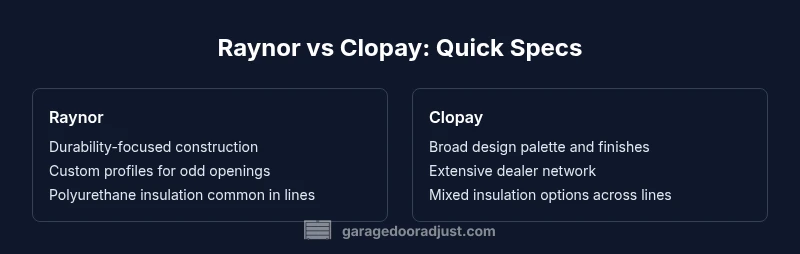
Choosing between Raynor and Clopay goes beyond a single model number. Both brands have cultivated distinct identities in the residential market, with Raynor often emphasizing durability, structural customization, and local installer partnerships, while Clopay has built broad distribution, extensive designer options, and a perception of value across a range of architectural styles. For homeowners, that means understanding how each brand aligns with your home’s aesthetics, your maintenance preferences, and your long-term ownership plans. The GarageDoorAdjust team notes that availability of trained dealers and technicians in your area can have a material impact on service responsiveness, warranty handling, and the ease with which you can source replacement parts. When you start your evaluation, map out your priorities: how important is curb appeal, how much customization do you want, and how critical is a seamless warranty transfer if you move. A practical approach is to list your top three needs and compare how each brand meets them, rather than chasing the newest trend or a glossy brochure. Overall, Raynor’s approach tends to reward homeowners who want rugged durability and tailored fit, while Clopay’s breadth of color, panel options, and dealer coverage can benefit those seeking quick availability and expansive design choices. The message is clear: your home’s style and your service expectations should guide the choice as much as the door’s appearance.
Construction and Materials: Panel Styles, Coatings, and Durability
From a construction standpoint, Raynor and Clopay offer a spectrum of panel configurations, materials, and exterior coatings. Raynor often emphasizes heavy-gauge steel and insulated cores designed for lasting performance in varied climates, plus options for custom panel profiles that mimic traditional carriage-house aesthetics. Clopay tends to present a broader gallery of panel styles and finishes, including designer textures and color-shaded coatings, which can simplify coordinating with exterior siding and roofing. When evaluating materials, homeowners should consider wind load ratings, impact resistance for high-traffic garages, and the ease of maintenance—steel panels typically require less daily upkeep than aluminum in coastal environments. For many properties, the choice between Raynor and Clopay hinges on getting the look you want while ensuring the door can withstand seasonal shifts. It’s worth noting that while both brands offer steel and aluminum constructions, the available insulation strategies and finish warranties may vary by model line, so confirm the exact product line’s specification before purchase.
Insulation and Energy Efficiency: What Matters for Home Comfort
Insulation plays a pivotal role in reducing drafts, stabilizing garage temperatures, and moderating adjacent living spaces. Raynor and Clopay each provide insulated door options, but the composition and performance characteristics can differ. Raynor often features polyurethane foam cores in many of its higher-end lines, delivering a compact core with strong structural rigidity. Clopay, meanwhile, offers a mix of polyurethane and polystyrene cores across its range, giving homeowners flexibility to balance price with thermal performance. The key is to assess the door’s overall assembly, including the seal perimeter, weatherstripping, and the track and roller system, which contribute to thermal efficiency just as much as the underlying core. For energy-conscious homes, prioritize models with tight seals around the header, sides, and bottom, and verify the compatibility of the door with insulation upgrades in the garage ceiling or adjacent spaces. In practice, a well-insulated Raynor or Clopay door can noticeably reduce heating and cooling loads over the course of a year, especially for attached garages where temperature fluctuations transfer into the home. Remember that installation quality affects energy performance just as much as the door’s material composition, so partner with an experienced installer who follows manufacturer guidelines.
Warranty and Service: Coverage, Duration, and Transferability
Warranty is a crucial signal of confidence and long-term support. Both Raynor and Clopay offer warranties, but terms often depend on the product line, door construction, and the installing dealer. General trends show longer warranties for steel doors with insulated cores, reflecting confidence in both corrosion resistance and structural rigidity. Transferability—how easily a warranty remains valid when ownership changes—can vary by region and by installer network. Homeowners should document the warranty terms in writing, understand what is covered (including hardware, springs, and tracks), and learn the process for submitting a claim. The installer’s role is also important: a knowledgeable technician can interpret warranty language, ensure proper door balance, and provide prompt service for necessary repairs. When comparing Raynor vs Clopay in this area, ask about post-purchase support, availability of replacement parts, and the expected response times for service calls in your ZIP code. In many cases, the difference in warranty handling reflects the local dealer network more than the brand name itself.
Installation, Availability, and Customization: Sourcing and Setup
Availability and customization options can be a deciding factor when choosing between Raynor and Clopay. Clopay’s portfolio typically delivers broad color palettes, texture options, and faux-wood finishes intended to replicate high-end materials without the maintenance. That breadth helps homeowners coordinate with broader exterior design schemes and can shorten lead times since multiple dealers carry the same lines. Raynor’s approach often emphasizes elite customization for customers who want a door that perfectly matches unique architecture or unusual garage dimensions. This can translate to longer lead times in some markets but yields a door with a tailored silhouette and optimized insulation properties. Consider your priorities: if you want a quick, uniform installation across multiple homes, Clopay’s dealer network may be advantageous; if you need a highly bespoke solution that perfectly matches an architectural vernacular, Raynor might be the better partner. The logistics of ordering, lead times for custom panels, and the availability of in-stock options in your area are all part of the decision framework.
Decision Guide: Which Brand Fits Your Home and Budget
To decide effectively, start with your home’s style and your primary goals. If curb appeal with extensive designer options is paramount, Clopay’s expansive palette and finishes can be compelling. If durability, customization for odd dimensions, and long-term performance in challenging climates are your priorities, Raynor’s engineering emphasis is worth prioritizing. Always verify the specific product line’s features rather than assuming a brand-wide stance. Create a simple matrix of three scenarios: budget-conscious projects, design-forward renovations, and retrofits for older structures. In each scenario, map your top three needs—price, aesthetics, and service coverage—and score Raynor and Clopay against those criteria. Finally, consult with a local installer to confirm availability, after-sales support, and the expected lifecycle of components like springs and rollers. By balancing aesthetics, performance, and serviceability, homeowners can confidently select the brand that best aligns with their home and lifestyle.
Comparison
| Feature | Raynor | Clopay |
|---|---|---|
| Panel options | Strong emphasis on durability, customizable profiles | Broad designer palette with many finishes and textures |
| Insulation options | Popular polyurethane cores in many lines | Mix of polyurethane and polystyrene across range |
| Warranty and transferability | Warranty terms vary by product line and local dealer | Dealer-driven warranty with regional differences |
| Installation availability | Strong focus on bespoke installs in some markets | Extensive dealer network with quicker availability in many areas |
| Price range (installation) | Moderate to premium depending on customization | Budget-friendly to mid-range depending on line and finish |
| Best for | Homeowners seeking rugged durability and fit-for-purpose customization | Homeowners prioritizing design variety and quick availability |
Upsides
- Provides a clear, side-by-side view of two major brands
- Helps homeowners weigh priorities like design vs. durability
- Guides readers toward the most suitable option based on lifestyle and climate
Disadvantages
- Brand-specific claims may not reflect regional dealer realities
- Warranty terms can vary by installer and local regulations
- Outliers exist in pricing due to customization and lead times
Choose based on your priorities: Clopay for design variety and quick sourcing; Raynor for durability and bespoke fit.
Neither brand dominates all categories. Prioritize aesthetics and dealer availability for Clopay, or durability and customization for Raynor. Use this guide to align your choice with your home's design and your service expectations.
Got Questions?
Which brand offers more customization options for doors?
Clopay generally presents a wider range of finishes and panel styles, which helps with unique architectural matches. Raynor focuses more on bespoke panel profiles and fit-for-purpose customization for unusual dimensions.
Clopay tends to offer more finishes and panel styles, while Raynor emphasizes bespoke options for unusual sizes.
Is one brand consistently cheaper to install than the other?
Prices vary by model line and finish, but Clopay often provides broader mid-range options with quicker availability, while Raynor can be more cost-effective when customization is limited.
Clopay usually has more mid-range options; Raynor can be cheaper when you don't need customization.
Which brand has better dealer support in rural areas?
Dealer networks vary by region. Clopay typically benefits from a larger national footprint, while Raynor's strength can depend on local master installers and regional partnerships.
Clopay often has a wider national dealer network; Raynor's strength lies with local installers.
Do Raynor and Clopay warranties transfer if you move?
Warranty transfer rules depend on the specific product line and the installer. Always confirm transferrable terms before purchase and document terms in writing.
Warranty transfer depends on the line and installer; confirm terms in writing.
Which brand is better for energy efficiency?
Both brands offer insulated door options, with Raynor leaning toward polyurethane cores for rigidity and Clopay offering a broader mix of insulation choices. Energy performance also relies heavily on installation quality and weather sealing.
Both offer insulated options; installation quality matters for efficiency.
Quick Summary
- Assess your top priorities before selecting a brand
- Check local dealer availability and service responsiveness
- Compare insulation options alongside aesthetics for energy savings
- Review warranty transferability and claim processes
- Choose the brand whose strengths align with your home’s design and climate