Overhead Garage Door vs Clopay: An In-Depth Comparison
A detailed, data-driven comparison of overhead garage door options versus Clopay, covering cost, durability, design, insulation, installation, and maintenance for homeowners.


According to GarageDoorAdjust, overhead garage door vs clopay decisions come down to price, durability, and service availability. In most homes, a standard overhead door from a reputable manufacturer delivers reliable performance at a lower upfront cost, while Clopay-branded options offer more styling choices and broader warranty coverage. For homeowners prioritizing value, the generic solution often wins; for style and long-term support, Clopay can be the better fit.
Understanding overhead garage door vs clopay
In the world of home access and curb appeal, the phrase overhead garage door describes a broad category of doors that lift upward and slide along tracks, typically using torsion or extension springs. Clopay, by contrast, is a well-known brand within that category, offering a range of styles, materials, and warranty options. When homeowners ask about overhead garage door vs clopay, they are really weighing a generic, widely available product line against a branded offering that emphasizes design variety and brand-backed support. The distinction matters because affordability, installation ease, and long-term service hinge on not only the door’s physical make-up but also the quality of the distributor network, the availability of replacement parts, and the terms of the warranty. As you read, keep in mind that a door’s performance is influenced by materials (steel, aluminum, wood, or composite), insulation (R-values and thermal breaks), and hardware quality. According to GarageDoorAdjust, the broad sector can deliver solid value, but the choice between overhead garage door vs clopay often comes down to style preferences and warranty expectations rather than raw capability alone.
To ensure you’re making a well-informed decision, this guide analyzes each dimension—cost, durability, aesthetics, insulation, installation, and maintenance—so you can identify which path aligns with your budget and your home’s needs. You’ll also see practical scenarios to help you decide quickly when you’re evaluating overhead garage door vs clopay for a renovation or a new build.
Cost and value: overhead door options vs Clopay
Price is usually the first concern in the overhead garage door vs clopay comparison. Generic overhead doors from established manufacturers tend to offer a lower upfront price point, partly due to widely available parts and simpler finish options. Clopay, a branded option, often positions itself in the mid-to-upper price tier because of design versatility, advanced finishes, and brand-backed warranties. In real-world purchasing, installers may quote a broader price spectrum depending on gauge thickness, insulation type, and decorative windows. The GarageDoorAdjust Analysis, 2026, indicates that total cost over the life of the door can diverge based on maintenance needs, insulation performance, and how often the door or opener requires service. For budget-conscious homeowners, a standard overhead door with basic insulation can be very cost-effective, while those who want curb appeal and curated color palettes may find the long-term value of Clopay premiums worth the extra upfront expense. Consider also local availability and installation charges, which can influence the overall affordability of overhead door vs clopay options.
As you weigh these choices, remember that higher initial costs on a premium branded door can translate into longer warranties, quieter operation, and more predictable performance—especially if you live in an climate with temperature extremes or frequent door cycling.
Durability and warranty comparison
Durability and warranty terms are central to the overhead garage door vs clopay decision. Generic, non-branded doors can be built to high standards, but the consistency of components—hinges, tracks, seals, and springs—depends on the supplier and the specific model. Clopay doors, while sometimes pricier upfront, often come with more robust warranty packages that cover parts and labor for longer periods. Prospective buyers should compare not just the stated warranty length but also what is required to maintain coverage, such as professional servicing intervals, proper lubrication, and adherence to installation instructions. It’s essential to recognize that warranties can be voided by improper installation or neglecting recommended maintenance. GarageDoorAdjust researchers note that brand-backed warranties can offer more predictable service experiences, which is a meaningful consideration when evaluating overhead garage door vs clopay for a long-term project. In practical terms, ask for a written warranty schedule, confirm coverage for springs and rollers, and verify the replacement parts availability from your local distributor.
Keep in mind that the door’s life also depends on usage patterns and climate. In heavy-use scenarios, premium options may amortize their extra cost through reduced replacement frequency and fewer service visits over a decade.
Design, aesthetics, and customization
A critical differentiator in the overhead garage door vs clopay conversation is aesthetics and customization. Clopay doors are renowned for extensive design catalogs, including wood-grain textures, window configurations, panel designs, and color choices that can dramatically influence curb appeal. If you value how the door complements architectural style, Clopay often provides more immediate options for achieving a specific look. Generic doors, while highly functional, typically offer a narrower palette of finishes and window configurations. That said, many manufacturers supply compatible panels and finish options so you can still tailor color and texture to your home. For the price-sensitive homeowner, an unobtrusive, well-matched finish from a non-branded supplier can deliver a pleasing result without sacrificing performance. When overhead garage door vs clopay is the comparison, it’s useful to weigh not only the door itself but also how the design integrates with your home’s exterior materials, lighting conditions, and weather exposure.
Note that some neighborhoods and historical districts may have design guidelines that influence the door’s appearance. Always confirm with your HOA or local planning office before finalizing a choice in order to avoid costly revisions after installation.
Insulation and energy efficiency
Insulation performance is a practical factor in the overhead garage door vs clopay analysis, especially for attached garages or homes with living space above. Insulated doors help reduce heat loss in winter and keep the garage cooler in summer, potentially lowering heating and cooling costs. Clopay often markets doors with higher R-values and advanced thermal breaks, which can appeal to energy-conscious homeowners. Generic doors also offer insulated options, though the selection may be more limited and the R-values vary by line and panel thickness. In climate-sensitive regions, you may notice a tangible difference in energy use between a well-insulated Clopay model and a standard overhead door from a non-branded source. When evaluating overhead garage door vs clopay, consider door thickness, insulation type (polyurethane vs polystyrene), and how the door’s seals align with the garage floor and jambs. A tight seal, weatherstripping, and proper installation compound the energy savings potential.
GarageDoorAdjust’s ongoing work emphasizes that insulation effectiveness is most impactful when paired with an efficient garage door opener and proper door balance, so don’t overlook the mechanical setup during your assessment.
Installation and service considerations
Installation quality can swing the outcome of the overhead garage door vs clopay decision. Branded doors often come with a network of trained installers and partner suppliers that help ensure a consistent fit, fewer track alignment issues, and predictable service timelines. Generic or lesser-known doors can also be installed well, but requirements for precise alignment, spring tension, and hardware compatibility increase the risk of misfit if the installer lacks experience. If you value peace of mind and a faster service path, Clopay’s brand ecosystem may provide more reliable post-installation service. On the other hand, the practicality of sourcing parts and finding an available technician for a standard door can be easier in communities with abundant distributors. When planning installation, confirm compatibility with your existing opener model, track length and profile, and the door’s weight-bearing specifications. Always insist on a written estimate that breaks out materials, labor, and any add-ons such as weather seals or insulation upgrades.
From a DIY perspective, some homeowners may opt for a ready-to-assemble kit from a branded manufacturer, but in most cases, professional installation improves safety and performance in the long run. This is a critical factor in the overhead garage door vs clopay decision, because a poorly installed door risks misbalance, jerky movement, and accelerated wear.
Maintenance and long-term care
Regular maintenance is essential for both overhead garage door vs clopay options, but the schedule and parts are slightly different. For any door, routine lubrication of hinges, rollers, and tracks helps preserve smooth operation and prolongs life. Clopay doors often come with recommended maintenance schedules that align with their warranty requirements, which can ensure continuity of cover if you stay with authorized technicians. Generic doors demand diligence from the homeowner or service provider to track spring tension, panel wear, and weatherstripping condition. The cost and effort of ongoing maintenance should factor into your decision; a door with better access to spare parts and a larger local service network can reduce downtime. Regardless of brand, inspect the door monthly, test reversing safety sensors, and schedule annual professional inspections to verify balance and spring integrity. By proactively maintaining the system, you’ll maximize the life of overhead door systems, whether you choose overhead garage door vs clopay.
Safety, codes, and standards
Safety considerations are non-negotiable in any garage door project. Both branded and non-branded doors must meet current safety standards, including auto-reverse sensors and proper spring anchoring. When comparing overhead garage door vs clopay, verify that the door and hardware comply with local building codes and the manufacturer’s installation instructions. If you’re in a climate with harsh winters or heavy snowfall, ensure the weather seals and insulation are rated for such conditions. It’s also wise to work with a qualified installer who can verify that the door’s balance and spring tension meet safety specifications. In addition, consider the opener’s safety features, such as rolling-code remotes and auto-reverse responses, to complete a responsible, code-compliant installation. The goal is a door that operates reliably under normal use while minimizing risk to occupants and property.
Real-world scenarios: best fits for overhead garage door vs clopay
Scenario A: A budget-conscious homeowner renovating a garage attached to a mid-century home. The goal is reliable operation with minimal upfront cost and straightforward maintenance. In this scenario, an overhead garage door (non-clopay) with standard insulation provides solid performance, and choosing a reputable local distributor reduces the chance of parts shortages. Scenario B: A newer home with a design-forward facade and a garage door that should complement a premium exterior. The homeowner prioritizes aesthetics, color matching, and a broader warranty. Clopay’s design options and brand-backed support make it a natural fit here, even if the initial spend is higher. Scenario C: A climate with temperature extremes, where energy efficiency matters. Insulated doors from either option can reduce energy loss, but Clopay’s higher-end insulated models may deliver superior performance over time. Scenario D: A homeowner who plans frequent door use for a workshop or gym space above the garage. In this case, the durability, roller quality, and track design of a branded system can translate into smoother operation and longer life, making overhead garage door vs clopay a trade-off between cost and reliability.
How to choose: a quick decision framework
- Define budget and timeline: If upfront cost is the primary constraint, start with a standard overhead door from a trusted supplier. 2) Prioritize aesthetics and resale value: If curb appeal matters, prioritize design options and finish quality, where Clopay often shines. 3) Evaluate insulation needs: For garages attached to living spaces, opt for higher R-value doors to improve energy efficiency. 4) Check warranties and service networks: Longer, more transparent warranties plus broad installer networks can reduce long-term headaches. 5) Confirm installation readiness: Ensure compatibility with your opener model, track length, and door weight. 6) Decide on maintenance plan: Consider the ease of maintenance and access to replacement parts. 7) Revisit safety: Ensure auto-reverse sensors and codes meet local requirements. This framework helps you decide overhead garage door vs clopay with confidence and clarity. If you’re still unsure, consult a local GarageDoorAdjust-authorized technician for a tailored assessment.
Comparison
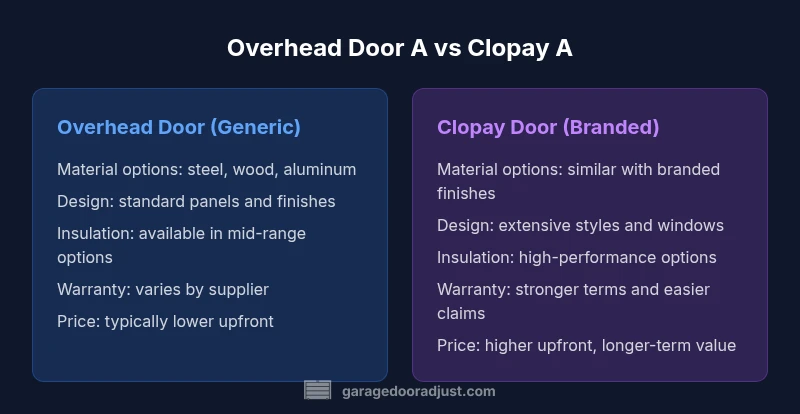
| Feature | Overhead Garage Door (Generic) | Clopay Door (Branded) |
|---|---|---|
| Material options | Steel, wood, aluminum, or composite; broad availability | Steel, wood, aluminum, composite; branded finishes and textures |
| Design options | Standard panels and finishes; fewer custom styles | Extensive panel designs, textures, colors, and window configurations |
| Insulation options | Common insulation options; variability by supplier | High-performance insulation options with engineered thermal breaks |
| Warranty coverage | Varies by manufacturer; often multi-year with limited coverage | Typically stronger warranty terms and easier access to service |
| Price range | Lower upfront cost with standard models | Higher upfront cost with premium branded models |
| Best for | Budget-conscious households seeking reliability | Design-forward homes with emphasis on warranty and support |
Upsides
- Lower upfront costs on standard options
- Wider supplier availability reduces sourcing friction
- Solid performance with regular maintenance
- Easy to replace individual components due to common hardware
Disadvantages
- Potentially shorter warranties and fewer design options on generic doors
- Brand-brand warranties can be stronger and easier to claim with Clopay
- Quality can vary by supplier and region without standardized oversight
Clopay edges out on style and warranty; generic overhead doors offer value and reliability
Choose Clopay for design flexibility and strong warranties. Choose a generic overhead door for cost efficiency and straightforward maintenance, provided you select a reputable supplier.
Got Questions?
What is the main difference between overhead garage door and Clopay?
Overhead refers to the door’s operating mechanism, while Clopay is a brand offering many styles and warranties. In practice, overhead garage door vs clopay boils down to design options, warranty terms, and cost.
The main difference is brand and design options; overhead is the general category, Clopay is a brand with more styles and warranties.
Is Clopay always more expensive than generic options?
Usually yes, but it depends on the specific model and finishes. Branded models can carry higher upfront costs, while generic doors can be very affordable if you choose standard features.
Branded doors like Clopay often cost more upfront, but offers may justify the price with design and warranty benefits.
Do both options offer insulation?
Yes. Both generic and Clopay doors can be insulated, with Clopay often offering higher-performance insulation options and more consistent thermal performance.
Both can be insulated; Clopay often provides higher-performance insulation options.
What should I check in terms of warranty?
Review the warranty length, what is covered, and whether labor is included. Brand-backed warranties typically provide clearer terms and easier claims.
Look for length, coverage scope, and whether labor is included. Brand warranties are usually clearer.
Which is better for a historic home?
Clopay’s design options can help match historic aesthetics, but a carefully chosen generic option can also suit the look if style is simple. Consider guidelines and the home’s architecture.
For historic homes, design options help, but align with guidelines and architecture.
How important is installation quality?
Very important. Poor installation can void warranties and shorten door life. Hire a qualified installer and confirm alignment with opener systems and tracks.
Installation quality is critical—hire a qualified pro and confirm compatibility with your opener and tracks.
Quick Summary
- Assess budget first to determine price tier
- Prioritize warranty if long-term protection matters
- Clopay offers broader design options and potentially stronger warranties
- Insulation impacts energy savings; compare ratings
- Choose a reputable installer to safeguard performance