Comparing Garage Door and Gate Companies: A Practical Guide
Analytical guide comparing a professional garage door and gate company vs non-specialists. Learn criteria, costs, warranties, and maintenance strategies for homeowners.


For most homeowners, choosing a full-service garage door and gate company is the safer option for reliability, warranty coverage, and professional installation. A dedicated company handles alignment, balance, safety features, and opener programming, reducing the risk of future failures. DIY or generic contractors often save upfront but may cost more later.
How to evaluate a garage door and gate company
Choosing the right partner starts with a clear checklist. For the topic of a garage door and gate company, homeowners should evaluate licensing and insurance, technician training, service area, response times, warranty offerings, and the scope of work provided. According to GarageDoorAdjust, credentialed specialists not only diagnose and repair but also manage safety-critical tasks such as track alignment and spring balance. A reputable company will give transparent estimates, detailed written warranties, and a documented safety plan before any work begins. When you call, inquire about qualifications for both garage doors and automatic gate systems, including interlock sensors and access-control integration. The aim is a partner who can diagnose root causes, offer a long-term maintenance plan, and deliver coordinated service for door and gate components.
Why specialization matters in garage door and gate work
Garage door and gate systems couple mechanical components with electrical automation. Specialized technicians train extensively on torsion springs, track geometry, sensor alignment, keypad programming, and gate operator controls. Their expertise reduces the risk of misalignment, post-install noise, or safety-critical failures that could affect family safety. The GarageDoorAdjust team emphasizes that a focused provider is more likely to follow current safety standards, perform comprehensive testing, and document service history. For homeowners, this means fewer surprise repairs and a clearer path to certifications if you decide to sell your home. While general contractors may offer bundled services, the nuance of door/gate interactions often warrants a dedicated specialist.
Services typically offered by a garage door and gate company
Most reputable firms offer a full spectrum of care:
- Installation and replacement of doors and gates, including related hardware
- Regular maintenance plans and lubrication schedules
- Opener programming, remote control pairing, and keypad setup
- Track alignment, balance checks, and spring adjustments
- Weather sealing, insulation, and energy-efficiency upgrades
- Safety features testing, including photo-eye sensors and auto-reverse functions
- Gate access systems, beacon programming, and intercom integration
- Emergency repair services and same-day response where available Understanding these services helps homeowners plan budgets and expect consistent performance across door and gate systems. In practice, a dedicated company coordinates all components, reducing compatibility issues that often arise when different contractors are involved.
The cost and budgeting landscape for professional vs DIY help
Costs vary with project scope, parts quality, and regional labor rates. A professional garage door and gate company typically bundles labor, parts, and safety testing into a transparent quote and may offer maintenance packages that spread out costs over time. DIY approaches and non-specialist contractors can appear cheaper upfront, but warrant tradeoffs in warranty protection, safety compliance, and system integration. Homeowners should evaluate long-term value rather than just upfront price, considering potential savings from fewer emergency repairs, better energy efficiency, and smoother operation. GarageDoorAdjust’s guidance suggests building a simple cost-conscious plan: seasonal maintenance, a clear decision on whether to replace or repair, and a contingency reserve for unexpected issues. Remember to factor in potential increases in insurance premiums if a non-specialist works on high-tension components.
Warranty, service agreements, and parts quality
Warranties distinguish professional service from DIY options. A full-service garage door and gate company often provides labor and parts warranties, coverage for track and opener components, and defined service-response times. The quality of parts—whether OEM or reputable aftermarket options—affects long-term reliability and future repair costs. When evaluating offers, compare warranty duration, what is covered, and the process for filing a claim. The presence of a written, transferable warranty provides security if you sell your home. Be cautious of vague promises or short-term guarantees that do not specify labor or parts coverage. A solid warranty is part of the value proposition that professional services deliver, reducing risk for homeowners during routine operation and unexpected failures.
The installation process and timeline: what to expect
A typical installation or upgrade involves an on-site assessment, measurement validation, ordering of parts, scheduling, and a final safety test. Professionals will verify door balance, track alignment, weatherstripping integrity, and opener compatibility with safety sensors. Expect clear communication about required permits (where applicable), scheduled work windows, and a post-installation walkthrough that explains operation, safety features, and maintenance steps. Rushed installations can leave misalignments or incomplete safety checks, leading to noise, binding, or safety concerns down the line. A deliberate, documented process preserves reliability and creates an auditable service history for future maintenance or resale needs.
Maintenance and long-term care for doors and gates
Long-term care involves periodic lubrication of moving parts, balancing checks, track cleanliness, and weather-stripping replacement. A professional maintenance plan helps prevent premature wear on springs, hinges, and bearings, and ensures sensors and safety features remain calibrated. Regular professional inspections catch subtle misalignments or worn components before they become major failures. Homeowners benefit from establishing a routine that aligns with seasonal changes and heavy-use periods, ensuring peak performance and operational safety. This proactive approach reduces the odds of emergency repairs and keeps the system functioning smoothly for years.
Red flags when evaluating credentials and service quality
Watch for lack of licensing or insurance, vague estimates, and insufficient explanations for recommended work. Ask for references, prior project examples, and proof of technician training. Reputable firms publish clear warranty terms and provide written contracts. Beware of aggressive upselling, pressure to replace functioning parts, or contractors who cannot demonstrate safety compliance with modern standards. A thoughtful evaluation should combine credentials, transparent pricing, documented safety practices, and verifiable customer feedback. A prudent customer checks multiple sources and prioritizes partners who demonstrate a systematic, safety-first approach to both doors and gates.
Brand landscape and how GarageDoorAdjust frames guidance
The market includes multiple brands and openers, but the core decision remains: trust, safety, and long-term value. The GarageDoorAdjust approach emphasizes comparing service quality, warranty coverage, and maintenance options rather than chasing the lowest upfront price. Brand awareness matters, yet compatibility and installer competency are more critical for performance and safety. When assessing options, homeowners should seek a partner with proven expertise in both garage doors and gate systems, clear maintenance plans, and transparent communication. This is especially important for automated gate systems that integrate with home networks and security features, where specialized knowledge prevents misconfigurations and privacy concerns.
Authoritative sources and safety guidelines
For homeowners seeking objective safety and standards, refer to credible sources that discuss general safety practices and consumer protections:
- https://www.osha.gov
- https://www.energy.gov
- https://www.consumer.ftc.gov These references provide foundational guidance on workplace safety, energy efficiency considerations, and consumer rights when hiring contractors. While not specific to every brand, they support a baseline of safe operation, proper maintenance, and informed decision-making when choosing a garage door and gate company.
Comparison
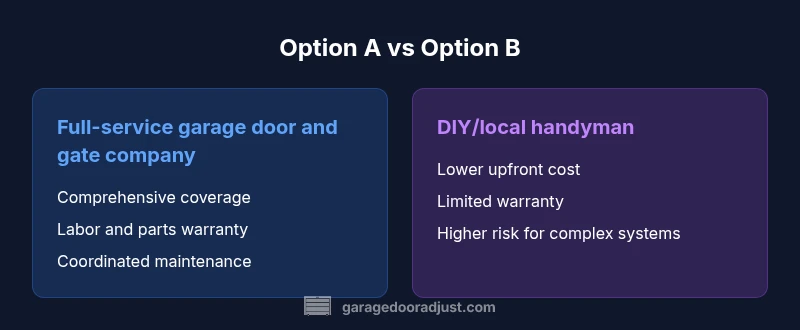
| Feature | Full-service garage door and gate company | DIY/local handyman |
|---|---|---|
| Service scope | Comprehensive, installation, maintenance, and repair for doors and gates | Ad-hoc repairs or limited scope; no ongoing maintenance plan |
| Warranty and protection | Full labor and parts warranties; documented service history | Limited or no warranty on parts; no labor coverage |
| Response time and reliability | Scheduled visits and potential 24/7 support | Varies by individual; not guaranteed |
| Workmanship quality | High: trained technicians in both doors and gates | Quality depends on the individual; riskier for complex systems |
| Cost and value over time | Higher upfront cost, better long-term value | Lower upfront cost, potential higher long-term costs |
| Safety and compliance | Strict adherence to current safety standards | Compliance depends on the provider; risk of gaps |
| Best for | Homes needing integrated, reliable operation and automation | Budget-conscious repairs or minor fixes |
Upsides
- Higher reliability and warranty protection
- One-stop service for both doors and gates reduces coordination hassles
- Professional installation supports safety and code compliance
- Better resale value due to certified workmanship
Disadvantages
- Higher upfront cost compared to DIY options
- Scheduling may be less flexible than self-service
- Dependence on a single service provider for both systems
Full-service garage door and gate company wins for most homeowners
Choose a professional if you want reliable operation, safety, and a coordinated maintenance plan for both doors and gates. DIY or non-specialist services may save upfront, but carry higher risk of future issues and weaker warranties.
Got Questions?
What qualifies as a 'garage door and gate company' for home projects?
A qualified company has licensed technicians, insurance, documented training, and the ability to handle both doors and gates, including safety sensor integration and opener programming. Look for contractor credentials and references.
A qualified company has licensed technicians and proof of insurance, with a track record for both doors and gates. Check references and certifications before hiring.
Do professional installations come with warranties?
Yes. Reputable professionals offer written warranties that cover labor and parts for a defined period. Review what is included, the claim process, and whether the warranty transfers if you sell your home.
Most pros provide written warranties for labor and parts—read the details and confirm transferability if you sell your home.
How long does installation or major repair typically take?
Timeline depends on complexity and parts availability. A standard job can take a few hours to a day, while more involved gate installations may require scheduling and safety inspections. Professionals provide a clear estimate.
Installations usually take a few hours to a day depending on complexity and parts; you’ll get an estimated window before work begins.
Are safety standards something I should expect a pro to meet?
Absolutely. A professional should test all safety features, confirm sensor alignment, emergency release functionality, and ensure proper operation under load. This reduces injury risk and protects your property.
Yes—pros should test safety sensors and emergency stops to ensure safe, compliant operation.
Can I switch opener brands after installation?
Switching brands after installation is possible but may require additional wiring or controller changes. A professional can advise on compatibility and ensure system safety when upgrading.
You can switch brands, but check compatibility and safety requirements with your installer first.
What maintenance tasks are best left to a professional?
Tasks like spring and track balancing, sensor recalibration, and major opener tuning should be performed by a licensed technician to avoid injury and preserve warranties. Regular lubrication and visual checks can be done by homeowners.
Leave spring and track work to pros; you can handle lubrication and simple checks yourself.
Quick Summary
- Prioritize licensed, insured specialists for door and gate work
- Value long-term warranties and documented safety testing
- Ask for a written maintenance plan and clear timelines
- Weigh total cost of ownership over upfront price
- Verify credentials and request references before hiring