Overhead Garage Door Commercial: Repair, Install, and Maintain
A thorough, step-by-step guide for diagnosing, repairing, and installing overhead garage door systems in commercial settings. Learn safety, maintenance, parts replacement, and best practices for reliable operation.


By following this guide, you will diagnose, repair, and install overhead garage door commercial systems with confidence. You’ll learn to assess door balance, track alignment, safety sensors, hardware condition, and opener performance, plus safe troubleshooting steps and when to call a pro. Completing these steps improves reliability, reduces downtime, and supports compliant operation for active facilities.
Why overhead garage door commercial safety and reliability matter
In commercial settings, the overhead garage door is a primary access point and a potential risk if poorly maintained. Downtime interrupts operations, security vulnerabilities may arise, and heavy doors can cause serious injuries. This is why a disciplined approach to safety, maintenance, and proactive repair is essential. According to GarageDoorAdjust, routine inspection reduces unexpected failures by identifying wear on tracks, springs, and rollers before they fail under load. The overhead garage door commercial environment demands longer life cycles and higher durability than residential doors, so you’ll want to adopt a maintenance plan tailored to your facility's opening frequency, weight rating, and usage patterns.
A robust plan starts with a clear inventory of components: the door panels, tracks, springs, cables, rollers, and the operator or opener unit. For safety, always disconnect power to the operator before inspecting, and never attempt to manually balance a door without proper equipment or a partner. This block will walk you through the core checks and the safe sequence for diagnosing issues that commonly arise in busy garages or warehouses. It also covers when you should replace components rather than attempt a temporary fix, and how to document the maintenance for compliance.
Top Features to Consider for overhead garage door commercial
When selecting or inspecting a commercial door system, several features influence long-term performance and safety. First, door balance and spring type determine resistance and tractability; torsion springs provide balanced lifting for heavier doors and reduce friction, while extension springs require careful alignment. Second, track and hinge quality affect door travel and reduce binding. Third, the operator: a commercial opener should have appropriate horsepower (HP) and compatibility with photoeye sensors, safety features, and remote reporting. Fourth, panel construction and insulation influence energy efficiency and noise levels, which matters in customer-facing storefronts or manufacturing bays.
In overhead garage door commercial projects, think about maintenance intervals and parts lifecycle. Heavier doors wear components faster, so you’ll want more frequent lubrication, track cleaning, and inspection of roller wheels, hinges, and pulley systems. GarageDoorAdjust analysis shows that regular lubrication of internal moving parts reduces friction and extends life, especially in dusty or humid environments. Finally, consider serviceability: easy access to the operator, fault code readability, and availability of replacement parts. A well-chosen system minimizes downtime and supports reliable access throughout the workday.
Safety sensors and control systems
Commercial overhead doors rely on safety sensors to prevent injuries when the door closes. Inspect photoelectric sensors mounted near the floor, ensure the emitter and receiver align correctly, and check the safety edge on the bottom of the door for responsive contact. If a sensor is misaligned or blocked by dust, the door may reverse unexpectedly or fail to close fully. Regular testing should include a blocked-path test (placing an obstacle in the sensing path) and a spring-cycle check to confirm the operator stops the door at the correct point. For high-use facilities, consider upgraded control systems with fault-code readouts and remote monitoring.
Diagnostic checklist for common issues
Use this practical checklist to diagnose issues quickly in a commercial overhead garage door:
- Visual inspection: look for bent tracks, loose bolts, worn rollers, and damaged insulation.
- Balance test: with power off, manually test door weight and balance; an unbalanced door strains springs and the opener.
- Sensor test: trigger the photoeyes with a short object and observe door response.
- Opener test: verify autopilot functions, force settings, and remote control responsiveness.
- Lubrication and tightening: apply proper lubrication to hinges, rollers, and tracks; tighten loose hardware.
- Noise and vibration: identify rattling sources and replace worn components.
- Documentation: log findings and replacement parts for maintenance records.
Always follow safety procedures and never attempt to adjust springs without proper tools and training.
Step-by-step maintenance plan for a commercial door
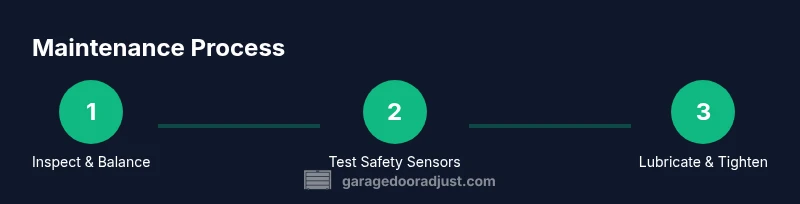
The maintenance plan for overhead garage door commercial systems is designed to minimize downtime and ensure consistent operation. Start by disconnecting power to the operator to avoid accidental movement. Then perform a balance and track alignment check, inspect and lubricate moving parts, and test safety devices. Finally, re-test full range of motion and document results. This proactive routine reduces emergency service calls and extends the door’s lifecycle, especially in high-traffic facilities like warehouses or service yards.
Replacing parts and choosing replacements
Commercial overhead doors use heavier components than residential doors. Replacement decisions should be based on observed wear, failure frequency, and safety risk. Replace worn rollers, damaged tracks, and compromised weather seals before they cause leverage issues or energy loss. When replacing springs, rely on qualified technicians, as mis-sizing or improper tension can lead to injuries. Keep a parts inventory with trusted vendors and order compatible components by model number and weight rating. This approach minimizes downtime and ensures compatibility with existing openers.
Documentation and compliance for overhead garage door commercial
Maintain a formal maintenance log that records inspection dates, findings, parts replaced, and test results. Include photos of key components and a summary of safety checks. This documentation supports facility compliance programs and helps with warranty claims. For asset management, track the door’s total cycles, lubrication intervals, and the life expectancy of critical parts. Regular reporting aids budgeting and ensures that safety standards are consistently met.
Verifying performance after maintenance
After completing maintenance, conduct a full test of the door under typical operating cycles. Confirm smooth opening and closing, proper balance, and reliable safety sensor responses. Check for unusual noises or vibrations and verify that the door remains within the expected travel limits. If any fault codes appear on the operator, consult the manual or contact a qualified technician. The goal is a reliable, safe, and efficient overhead garage door commercial system that can handle peak usage without failures.
Authority sources and further reading
For additional guidance on overhead garage door safety and best practices, see the following resources:
- OSHA standards for equipment safety: https://www.osha.gov
- National Institute for Building Sciences: https://www.nibs.org
- Public safety guidance from a university extension program: https://extension.psu.edu
These sources provide general safety principles and maintenance considerations that complement hands-on practice with overhead garage door commercial systems.
Tools & Materials
- Safety glasses (ANSI Z87.1)(Protect eyes during inspection)
- Gloves(Grip and finger protection)
- Hearing protection(For noisy environments)
- Lockout/Tagout kit(Ensure power is isolated to the operator)
- Screwdrivers (Phillips and flat)(General hardware adjustments)
- Adjustable wrench set(Tighten bolts and nuts)
- Socket set(Access hard-to-reach fasteners)
- Pliers (needle-nose)(Grip small components)
- Torque wrench(Precise fastener torque)
- Ladder or scaffold(Safe access to tracks and hardware)
- Lubricant (silicone or lithium-based)(Lubricate hinges, rollers, tracks)
- WD-40 or penetrating spray(Free sticky hardware)
- Replacement parts kit(Worn rollers, seals, weatherstripping for quick swaps)
- Voltage tester(Verify electrical circuits are de-energized)
- Dust mask(Dust and debris control)
Steps
Estimated time: 2-4 hours
- 1
Assess the overall system
Document door weight, opening hours, and observed issues. Note any abnormal sounds, misalignment, or slow responses.
Tip: Take photos of current conditions before making adjustments. - 2
Disconnect power and secure area
Use lockout/tagout and confirm the operator cannot move. Ensure nearby staff are aware of the maintenance activity.
Tip: Never work under a door that could drop unexpectedly. - 3
Check balance and tracks
Manually test door balance with helper; inspect tracks for dents and misalignment; tighten loose hardware.
Tip: Balanced doors require even resistance across the travel path. - 4
Test safety sensors
Trigger photocells with an object to verify responsive auto-reverse and safety edge operation.
Tip: Clean sensor lenses to avoid false faults. - 5
Lubricate moving parts
Apply appropriate lubricant to hinges, rollers, and track joints; wipe excess to avoid dirt buildup.
Tip: Lubricate only on metal contact surfaces; avoid plastic components. - 6
Tighten and replace hardware
Tighten loose bolts; replace worn rollers, weather seals, and damaged weatherstripping as needed.
Tip: Keep a spare parts kit on site for quick swaps. - 7
Test door operation
Reconnect power, run opening and closing cycles, observe for smooth travel and correct travel limits.
Tip: Set force and limit controls according to manufacturer specs. - 8
Document results
Record inspection findings, parts replaced, and test results for compliance.
Tip: Include date, technician name, and door model. - 9
Plan next maintenance window
Schedule routine maintenance for the next cycle and update inventory if needed.
Tip: Set calendar reminders for quarterly checks.
Got Questions?
Is it safe to inspect a commercial overhead door myself?
Basic checks with power off are generally safe for trained personnel, but never adjust springs or perform high-risk repairs without a qualified technician.
Basic checks with power off are okay for trained people, but avoid spring work.
How can I tell if the door is out of balance?
If the door feels heavy on one side or pulls toward the floor, it may be out of balance. A simple weight-neutral balance test requires careful handling and, for accuracy, might require a technician.
If it feels uneven or heavy on one side, balance may be off.
When should I replace rollers or tracks?
Replace worn rollers or bent tracks as soon as you notice binding, excessive noise, or visible wear. Delays can worsen alignment and damage the opener.
Replace worn parts when you hear grinding or see wear; don’t delay.
Can I program a commercial opener myself?
Programming or reprogramming openers is typically straightforward but varies by model. Follow the manufacturer’s instructions and ensure code security to prevent unauthorized access.
Programming is usually simple if you follow the model’s manual.
What are typical costs for commercial door maintenance?
Costs vary by door size, parts needed, and service frequency. Plan for periodic maintenance rather than one-off repairs to manage expenses and downtime.
Costs depend on parts and service frequency; plan for ongoing maintenance.
Watch Video
Quick Summary
- Inspect balance, tracks, and springs before anything else
- Safety devices must function correctly on every cycle
- Regular lubrication extends component life
- Document maintenance for compliance and budgeting
- Call a pro for high-risk repairs or uncertain issues