Can You Put Two Garage Door Openers on the Same Circuit? A Safe Guide
Explore whether two garage door openers can share a circuit and learn safe, code-compliant ways to approach installation with guidance from GarageDoorAdjust.


Quick answer: In most cases, you should not install two garage door openers on a single circuit without planning. A single 15-amp circuit may handle one opener plus accessories, but adding a second opener risks overloading the circuit or nuisance trips. The safer path is to run dedicated circuits for each opener or hire a licensed electrician to size and install a shared, code-compliant solution.
Why this question matters
Homeowners frequently ask can you put two garage door openers on the same circuit, and the answer hinges on circuit capacity, safety, and local codes. The GarageDoorAdjust team has found that the garage outlet and opener load are typically designed for a single opener plus basic accessories. When you try to feed two openers from one 15- or 20-amp circuit, you risk nuisance trips, voltage drop, and overheating if the load exceeds the circuit’s rating. This is why planning with your exact opener models in mind matters. The goal is reliable operation without nuisance trips or fire hazards. If you’re seeing intermittent opener resets, unusual buzzing, or dimmed lights, those are red flags that merit stopping and re-evaluating the circuit.
In practical terms, the question isn’t just “can you put two garage door openers on the same circuit” once and for all. It’s about ensuring safety, code compliance, and long-term reliability for your home garage. GarageDoorAdjust guidance emphasizes starting with a load assessment, confirming panel capacity, and aligning with the manufacturer’s electrical requirements. This approach helps you avoid unexpected trips, nuisance behavior, or future repairs that disrupt daily use.
Safety-first overview
Safety comes first when modifying any part of your home’s electrical system. Two openers on one circuit increases the potential for overload during peak demand (e.g., multiple doors opening during a busy morning). The National Electrical Code (NEC) and many local amendments require protective devices such as AFCI/GFCI where applicable. Always verify that your planned setup supports the total continuous and intermittent load of both openers, plus any door accessories (lights, sensors, smart controls). The GarageDoorAdjust team strongly recommends using a licensed electrician to confirm all safety provisions before proceeding.
What counts as a ‘load’ for a garage door opener
A typical garage door opener draws a surge at startup and a smaller continuous load while running. Your exact numbers depend on the model and features (lighting, sensors, chain/belt drive, plus smart features). When calculating load, include the opener motors, travel accessories, and any connected devices that draw power on the same circuit. This section explains how to estimate load in simple terms and why a second opener often needs either a dedicated circuit or an appropriately sized shared circuit.
Can you put two garage door openers on the same circuit safely?
The core issue is whether your shared circuit can safely handle the sum of two openers’ loads, plus any startup surges. In many homes, sharing a circuit can introduce trip risks or voltage drops that impact performance. In rare cases, a properly sized shared circuit with AFCI/GFCI protection may be permissible, but it requires exact load calculations and adherence to code. Always treat this as a decision guided by professional guidance rather than a DIY experiment. The GarageDoorAdjust analysis emphasizes prioritizing safety and code compliance over convenience.
Safer alternatives and best practices
If you’re upgrading or adding openers, the most reliable path is to give each opener its own dedicated circuit when feasible. If that isn’t practical, work with a licensed electrician to size a shared circuit carefully, install the correct protective devices, and verify that the total load won’t trip the breaker under peak use. For many homeowners, installing new wiring and a separate 15- or 20-amp circuit for the second opener yields the simplest long-term reliability and compliance. In all cases, document the changes and keep wiring diagrams accessible for future maintenance.
Quick checks you can do before calling a pro
- Gather model numbers and electrical specifications from both openers’ manuals. - Check your current panel for available capacity and whether AFCI/GFCI protection is already present. - Observe the circuit’s behavior when opening both doors (any tripping, flicker, or slow response). - If in doubt, stop and consult a licensed electrician. These steps help you decide whether to pursue a dedicated-circuit approach or a professionally sized shared solution.
Tools & Materials
- Non-contact voltage tester(To verify power before touching wires)
- Voltage tester / multimeter(Check voltage, continuity, and load where appropriate)
- Wire nuts(Secure wire connections in junctions)
- Electrical tape(Insulate connections and protect splices)
- Appropriate circuit breaker (15- or 20-amp) and panel access(Ensure capacity and proper installation by a pro)
- Pliers, wire strippers, and screwdrivers(For stripping conductors and securing devices)
- Junction box (if required)(Provide protected space for any splices)
- Electrical permit (if required by your local jurisdiction)(Code-compliance may require permitting)
Steps
Estimated time: 60-180 minutes
- 1
Assess circuit load
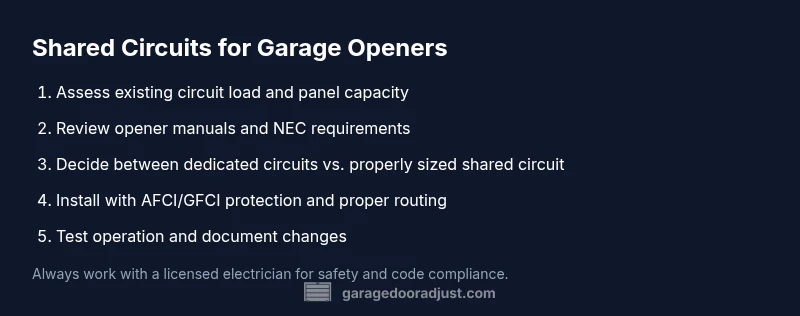
Identify the existing garage circuit rating and document the opener loads. Check the panel labeling and the manuals for each opener to estimate startup surges and continuous draw. Confirm whether the combined load would exceed the circuit’s rating at any time.
Tip: Use a simple load calculator or consult a pro to confirm safe combined load. - 2
Review manuals and manufacturer guidance
Read each opener’s electrical requirements and any notes about sharing a circuit. Some models specify dedicated circuits only, while others may allow sharing under certain conditions. This step reduces the risk of misinterpretation.
Tip: Document any model-specific guidance for future reference. - 3
Check code requirements
Consult your local electrical code requirements or the NEC guidelines relevant to garages, AFCI/GFCI protection, and shared circuits. Codes can vary by jurisdiction and current adoption date, which affects what’s permitted in your home.
Tip: If you’re unsure, assume “no” to DIY sharing and plan for professional sizing. - 4
Plan the wiring approach
Decide whether to run a second dedicated circuit or organize a properly sized shared circuit with appropriate protective devices and safe routing. Prepare a rough routing plan and confirm panel space and wire routing paths.
Tip: Avoid routing through living spaces or areas with limited clearance. - 5
Shut off power and prepare space
Turn off the relevant breakers at the main panel and verify no voltage with a tester before touching any conductors. Arrange the workspace so you can safely access the panel and any wiring routes.
Tip: Lockout/tagout if available to prevent accidental re-energizing. - 6
Engage a licensed electrician for final installation
Share your plan, load calculations, and the existing panel setup with a licensed electrician. They should size the circuit, install the proper breaker(s), and verify AFCI/GFCI protection, wire routing, and code compliance.
Tip: A pro will also document the work for future maintenance and resale.
Got Questions?
Is it legal to run two garage door openers on the same circuit in residential wiring?
Local codes vary, but in many places the NEC requires protection and proper load calculation. A dedicated circuit for each opener is often the simplest path. Always consult a licensed electrician to confirm code compliance for your home.
Local codes vary, but a licensed electrician will confirm whether sharing is allowed and ensure all protections are in place.
What amperage circuit do I need for two openers?
Most openers draw modest loads, but startup surges matter. A single 15-amp circuit handling two openers typically requires professional assessment; a second dedicated circuit is common to avoid overloads.
Expect a professional to calculate the startup surge and total load to determine if a shared or dedicated circuit is needed.
Will sharing a circuit cause tripping?
Yes, if the combined load or surge exceeds the circuit rating. Proper sizing and protective devices mitigate this risk, but miscalculation is a common cause of nuisance trips.
Overloading a circuit can trip the breaker; load calculations and protection help prevent this.
Can I do this myself, or should I hire a pro?
Electrical work—especially circuit sizing and shared circuits—should be performed by a licensed electrician. DIY attempts can lead to code violations or dangerous conditions.
For safety and compliance, hire a licensed electrician to size and install the wiring.
What are safer alternatives if I want two openers?
Use two dedicated circuits, or have a pro size a properly protected shared circuit with AFCI/GFCI and verified load capacity. Keep documentation for future maintenance.
Two dedicated circuits are the simplest and safest option; a pro can size a shared setup if needed.
Watch Video
Quick Summary
- Prioritize safety and code compliance over convenience
- Consider dedicated circuits for each opener whenever possible
- If sharing, use proper load calculations and AFCI/GFCI protection
- Hire a licensed electrician for sizing, installation, and permits