b2405 Error: Urgent Troubleshooting for Garage Door Openers
Urgent guide to diagnosing and fixing the b2405 error on garage door openers. Learn quick fixes, costs, and when to call a pro.


b2405 signals a fault in the opener system. Begin with safety sensor alignment and a full reset; if the error remains, it’s time to consult a pro. See our detailed step-by-step guide.
Understanding the b2405 Code and Why It Appears
The code b2405 is seen on certain garage door opener models to indicate a fault within the system. While the exact meaning can vary by brand, the most common culprits are safety-sensor misalignment, wiring issues in the sensor path, or a failing control board. For homeowners, this usually shows up as the opener refusing to move, a blinking or solid error indicator, or a warning light next to the sensor. The key is to treat the code as a signal: not every trigger is the same, but most fixable problems revolve around sensors, wiring, or board health. In the GarageDoorAdjust experience, codes like b2405 are most often resolved by a safe reset and sensor recheck, then a targeted inspection of sensor wiring. By understanding the typical failure modes, you can prioritize fixes that save time and reduce risk. As always, safety first: disconnect power before poking around live components and never force a door past an obstacle.
Quick Diagnostic Flow for b2405
A structured approach helps you separate quick fixes from deeper repairs. Start with the simplest causes and progress to more complex problems. The most common issue is misaligned safety sensors that prevent the door from closing or stopping properly. If you notice misalignment, you’ll often see a sensor LED behavior or a visible misalignment mark on the sensors. If the door still won’t operate after realigning sensors, inspect internal wiring between sensors and the control board for loose connections or obvious damage. Persistent faults may point to control-board problems, which typically require professional intervention. GarageDoorAdjust analysis shows that starting with sensor alignment and a reset yields successful closures in a large majority of cases, especially for residential systems. Keep a calm, methodical pace and verify each component before moving on to the next.
Step-by-Step Fix for the Most Likely Cause: Sensor Alignment
- Power off the opener and unplug the unit. 2) Clear the sensor area of dirt, debris, or spiderwebs that could block the infrared beam. 3) Re-align the sensors so their lenses face each other directly and the LED indicators show steady, solid light. 4) Reconnect power and run a test: close the door slowly and watch the sensors as the door travels. 5) If the door stops mid-journey, re-test a second time after re-tightening any loose connectors nearby. 6) Document any sensor LEDs and behavior for future reference. 7) If the code reappears after these steps, move to wiring checks or contact a pro. This approach is typically quick, cost-effective, and reduces the chance of a repeat fault. Quick fixes at this stage often cost little to nothing beyond your time; however, some homes may require professional alignment tools or sensor replacements, which can range from modest to substantial depending on the model and parts. GarageDoorAdjust notes that sensor-related fixes remain the most common path to clearing b2405 in residential settings.
Other Potential Causes and How to Address Them
While sensor misalignment is the most common reason for b2405, other issues can trigger the code. Damaged or loose wiring between the safety sensors and the opener control board is a frequent culprit; inspect all sensor cables for cuts, pinch points, or corrosion, and reseat any loose connections. A faulty control board can produce similar symptoms and may require reprogramming or replacement. If you suspect a bad board, a professional diagnosis is recommended because board replacements are model-specific and can involve delicate programming. In some cases, the door itself may be out of balance or off-track, creating stresses that trigger safety protections and the b2405 code. Regular maintenance and careful inspection after fixes help prevent recurrence.
Safety, Costs, and When to Call a Pro
Safety is non-negotiable with garage doors. Always disconnect power before touching electrical components. If the sensors show no light or the LED indicators flicker erratically after a reset, stop and re-check connections, as improper wiring can cause further damage. Cost-wise, sensor realignment and wiring checks performed by a homeowner are typically minimal (often $0–$50 for replacement parts). If a pro is needed for sensor replacement, you’ll usually see a service call in the $60–$150 range, with sensor or board parts possibly adding $20–$200, depending on the model. For persistent or complex issues, such as a suspected faulty control board or motor, professional assessment is strongly recommended. GarageDoorAdjust emphasizes treating any unresolved fault as potential for serious malfunction and recommends professional service when the door behaves unpredictably or you can’t reliably clear the code after basic steps.
Prevention Tips and Long-Term Care
To minimize future b2405 occurrences, pair routine maintenance with mindful usage. Regularly wipe sensor lenses, keep the sensor path clear of debris, and inspect wiring connections during seasonal maintenance. Lubricate moving parts per manufacturer guidelines and test auto-reverse and force settings monthly. If you replaced components, re-run a full function test after each upgrade. Proper calibration and periodic checks reduce the likelihood of nuisance codes and extend the life of the opener. Keeping a brief maintenance log helps catch patterns early and can speed up troubleshooting when the code reappears. In the GarageDoorAdjust framework, proactive care is your best defense against recurring faults and unexpected breakdowns.
Quick Recap: What to Do First if You See b2405
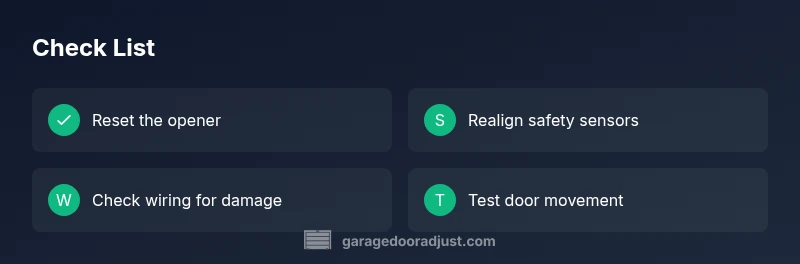
- Power cycle the opener and reset the unit.
- Inspect and realign safety sensors; remove obstructions.
- Check for loose or damaged sensor wiring and reseat connections.
- Test door movement with the opener unplugged, then re-test with power.
- If the code persists, schedule a professional inspection to diagnose board or motor issues.
Steps
Estimated time: 45-60 minutes
- 1
Power cycle the opener
Unplug the opener from its outlet, wait 60 seconds, then plug back in. This resets transient faults and clears minor glitches that may trigger b2405.
Tip: A full reset clears ghost codes from memory. - 2
Inspect safety sensors for alignment
Look for misaligned lenses or obvious gaps between the sensor eyes. Realign so both LED indicators show solid light when the beam is unobstructed.
Tip: Use a straight edge to ensure the sensors face each other directly. - 3
Check sensor wiring
Inspect the cables from the sensors to the opener board for loose connectors or damaged insulation. Reseat connectors firmly and avoid pinched wires.
Tip: Power off before touching wires to avoid shock. - 4
Test door movement with the opener unplugged
Manual test the door to ensure tracks are clean and balanced. If there is binding, address it before testing electronically.
Tip: Do not force the door; identify resistance points gently. - 5
Re-test with power and sensors
Reconnect power, run a test close/open cycle, and observe sensor LEDs and door behavior. If the code reappears, proceed to a more in-depth wiring check.
Tip: Note any unusual LED patterns for reference. - 6
Program or reset the opener limits
If the door travels incorrectly, re-train the limit switches according to manufacturer instructions. This ensures safe travel and correct reverse behavior.
Tip: Refer to the manual for exact steps for your model. - 7
Assess need for professional service
If b2405 persists after steps 1–6, a professional inspection is warranted to diagnose board or motor issues and to prevent further damage.
Tip: Costs typically range from $60 to $150 for a service call, plus parts if needed.
Diagnosis: Garage door displays b2405 on the opener panel; door may be sluggish or not move
Possible Causes
- highMisaligned safety sensors or sensor obstructions
- mediumDamaged or loose wiring between sensors and control board
- lowControl board or logic fault within the opener
Fixes
- easyRealign safety sensors and clear sensor path obstructions
- easyCheck and reseat sensor and control board wiring; look for damaged cables
- hardReset the opener and reprogram limits if needed; replace board if faults persist
Got Questions?
What does code b2405 mean on a garage door opener?
B2405 generally indicates a fault in the opener system. The most common causes are misaligned safety sensors or wiring issues; start with a reset and sensor realignment, then inspect wiring if needed.
B2405 means a fault in the opener system. Start with reset and sensor realignment, then check wiring if the issue persists.
Can I fix b2405 myself?
Many homeowners can perform basic fixes like resetting the unit and realigning sensors. For wiring or control-board problems, hire a pro to avoid safety risks and potential further damage.
You can try a reset and sensor realignment, but wiring or board issues should be handled by a professional.
How much does it cost to repair b2405?
Costs vary with the root cause. Expect service calls around $60–$150, with sensor parts or wiring upgrades potentially adding $20–$200. Board or motor replacement can be higher.
A service call is usually sixty to one hundred fifty dollars, plus parts if needed.
What safety concerns should I be aware of?
Always disconnect power before inspection. Doors can start unexpectedly; keep hands clear of moving parts and avoid tampering with high-tension springs.
Disconnect power first and keep clear of moving parts; springs can be dangerous.
If b2405 persists after fixes, what should I do?
Shut the door, unplug, and call a pro for a diagnostic. Continuing operation risks damage to the opener and nearby property.
If it persists after fixes, stop and call a professional for a proper diagnosis.
Does upgrading to a newer opener help prevent b2405?
Upgrading can improve reliability and include modern safety features, but it’s a larger investment and depends on the model and installation costs.
A newer model can reduce failure rates, but weigh cost against benefits and compatibility.
Watch Video
Quick Summary
- Identify b2405 as a fault signal, not a fixed fault.
- Start with quick resets and sensor realignment before deeper checks.
- If unresolved, involve a professional to prevent damage and ensure safety.
- Regular maintenance reduces recurrence and extends opener life.