Which Garage Door Opener Works with Apple HomeKit: A Practical Guide
Discover which garage door openers work with Apple HomeKit, how to enable native integration, and best practices for reliable automation. A GarageDoorAdjust analysis covers compatibility, setup steps, and recommended models for Apple-centric homes.


Summary: For Apple users, choose a garage door opener with native HomeKit support or Matter compatibility built-in. Openers with direct HomeKit integration install faster, pair more reliably, and offer stronger security than hub-based setups. If you already own a HomeKit ecosystem, prioritize models marketed as HomeKit-ready to minimize compatibility hurdles.
Why HomeKit Matters for Garage Doors
HomeKit provides a secure, native automation layer for compatible garage door openers. When you pair a HomeKit-enabled opener, you can control the door with Siri, scenes, and automations that run across your iPhone, iPad, Apple Watch, and HomePod. For many homeowners, native HomeKit support reduces setup friction and improves reliability compared with using a separate bridge or hub. According to GarageDoorAdjust, HomeKit integration is increasingly a priority for those already invested in Apple devices, because it centralizes control and minimizes app toggling. In this section, we explore why this matters and what it means for your daily routine, safety, and peace of mind.
The keyword which garage door opener works with apple homekit appears naturally here as readers consider overall ecosystem alignment. This discussion sets the stage for practical decisions about compatibility, security, and future-proofing within the Apple-driven smart home.
How Apple HomeKit integration works with garage door openers
Apple HomeKit integration can be native to the opener or achieved via a compatible hub or bridge. Native HomeKit support means the device appears directly in the Home app with a distinct accessory type and required pairing code. Hub-based approaches rely on Matter or a third-party bridge to translate HomeKit commands into garage door actions. Apple’s ecosystem benefits from end-to-end encryption and centralized access control. For most homeowners, the simplest path is a model advertised as HomeKit-compatible or Matter-ready, especially if you want reliable automations across scenes and routines. The homekit keyword keeps surfacing as readers evaluate their options for a cohesive setup.
In addition to direct integration, consider how the garage door opener communicates with your Wi-Fi network and with any HomeKit hubs you use. Strong network coverage helps ensure quick responses to automation triggers and reduces delays when you issue a command through the Home app or Siri.
Native HomeKit support vs. hub-based solutions
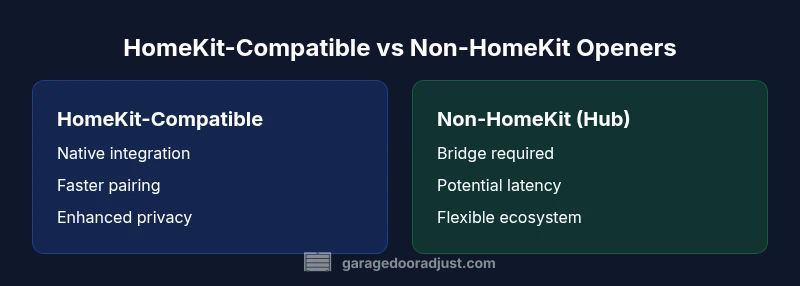
Native HomeKit support means the opener communicates directly with Apple devices without an intermediary bridge. This typically yields faster response times, simpler pairing, and tighter security controls because authentication stays within the HomeKit ecosystem. Hub-based solutions rely on Matter-enabled bridges or third-party apps to translate commands into garage door actions. While hubs can broaden compatibility with non-HomeKit devices, they introduce an extra layer that can add latency and potential misconfigurations. The key takeaway is to prioritize native HomeKit or Matter-enabled models if you want a streamlined user experience and ongoing compatibility with software updates from Apple and the manufacturers. For the question which garage door opener works with apple homekit, the answer hinges on choosing native or Matter-capable options.
What to look for in a HomeKit-compatible opener
When evaluating options, focus on several core features. First, native HomeKit support or Matter compatibility is essential for reliable, long-term integration. Second, check firmware update frequency and the manufacturer’s security roadmap, since regular updates protect against new vulnerabilities. Third, review the compatibility of the opener with your existing HomeKit setup, including scenes, automations, and remote access. Fourth, consider installation complexity and whether professional installation is recommended. Finally, assess price-to-value, recognizing that HomeKit-enabled openers may carry a premium but offer a smoother experience and stronger privacy controls. These criteria help answer which garage door opener works with apple homekit in a practical way.
Setup steps for a HomeKit-equipped opener
Getting started with a HomeKit-equipped opener involves a clear sequence. 1) Confirm that the model advertises native HomeKit support or Matter compatibility. 2) Install the opener following the manufacturer’s instructions, ensuring the unit is properly wired and balanced. 3) Connect the opener to your home Wi‑Fi network or Matter bridge as directed. 4) Open the Home app on your iPhone or iPad and add the opener by scanning the HomeKit pairing code or following the on-screen prompts. 5) Create basic automations (e.g., “When I leave home, close the garage”) and assign access for family members. 6) Test the automations, and adjust permissions to maintain security. The steps emphasize reliability and ease of use for the Apple ecosystem.
Security considerations when automating the garage
Automation adds convenience, but it also expands the attack surface if not configured correctly. Enable two-factor authentication on your Apple ID and limit who can control the opener. Use strong, unique passwords for any hub or bridge, and regularly update firmware to mitigate vulnerabilities. Consider auditing shared access periodically and using per-user permissions rather than granting blanket access. Finally, enable HomeKit’s privacy features, such as limiting data collection and using secure local control whenever possible. This approach aligns with best practices for maintaining robust, Apple-centric security.
Common pitfalls and how to avoid them
A few recurring issues can undermine HomeKit integration. Latency and delayed responses often stem from weak Wi-Fi signals or congested networks. A hub-based solution can introduce additional latency if the bridge is overloaded or poorly configured. Incompatible firmware or outdated app versions cause pairing failures, so keep devices current. Misconfigured automations or duplicate scenes can create confusing behaviors—test each automation individually and document intended outcomes. Finally, ensure that your HomePod or Apple TV remains powered and connected, as these devices often act as a HomeKit hub. By avoiding these pitfalls, you keep the experience smooth and reliable.
Real-world scenarios: condo vs single-family home
In a condo or apartment, compact space and shared infrastructure demand compact, quiet openers with reliable connectivity. HomeKit-friendly models with built-in radios and compact form factors are ideal for these environments. In a single-family home, you may prioritize longer-range Wi-Fi coverage, backup connectivity, and more robust hardware for heavy daily use. Regardless of home type, ensure the Wi-Fi network is stable, and consider placing a small range extender near the garage to minimize dead zones. These scenarios illustrate how the same HomeKit-enabled principles adapt to different living arrangements and usage patterns.
Maintenance and firmware updates for HomeKit openers
Regular maintenance keeps HomeKit-enabled openers performing well. Schedule periodic balance checks, inspect tracks, and lubricate moving parts as recommended by the manufacturer. Firmware updates are critical: they fix vulnerabilities and improve compatibility with the Home app and Matter-enabled ecosystems. Before updating, back up your setup and review release notes for potential changes in behavior. In most cases, manufacturers push updates automatically, but it’s wise to verify that updates completed successfully. A proactive approach reduces downtime and preserves a seamless Apple-friendly experience.
Troubleshooting: common issues and fixes
If the opener won’t respond to HomeKit commands, verify network connectivity and that the opener is online in the Home app. Check for firmware updates on both the opener and hub, and re-pair if necessary. For intermittent responses, move the gateway closer to the garage or replace aging router hardware to improve signal strength. If automations aren’t triggering, review the conditions and ensure that scenes are active. Finally, consult the manufacturer’s support resources for model-specific steps, as hardware variations can affect troubleshooting.
Installation considerations when upgrading or replacing
Upgrading a garage door opener to HomeKit compatibility involves more than hardware replacement. Assess your current track system, springs, and balance to prevent safety issues during operation. If you’re replacing a legacy opener, plan for the required mounting hardware, rail alignment, and torsion system checks. Factor in professional installation if you’re uncertain about electrical work or door balance. Consider upgrading insulation and weatherstripping to improve energy efficiency and reduce noise, which complements the smart home upgrade.
Final planning: buying guide and next steps
When planning your HomeKit upgrade, map out your priorities: native HomeKit or Matter compatibility, installation complexity, price range, and future-proofing via firmware support. Create a short list of model candidates that meet the criteria and verify that they’re compatible with your existing HomeKit setup. Read user reviews focusing on reliability, update cadence, and the quality of integration with the Home app. With careful planning, you’ll secure a smooth, Apple-friendly garage door automation experience for years to come.
Comparison
| Feature | HomeKit-compatible opener | Non-HomeKit opener (with hub) |
|---|---|---|
| HomeKit integration | native support | requires bridge/hub or indirect control |
| Setup complexity | straightforward via the Home app | additional hub/app setup needed |
| Reliability | high (native) | depends on hub stability |
| Security features | end-to-end HomeKit encryption | security depends on hub and third-party apps |
| Future-proofing | strong (Matter/Apple updates) | weaker (legacy systems) |
| Price range | mid to high | mid to low |
| Best for | Apple-centric automations | Broad compatibility |
Upsides
- Seamless Apple ecosystem integration
- Enhanced privacy and local control via HomeKit
- Faster, more reliable pairing with native support
- Future-proofing through Matter compatibility
- Siri control and scene-based automations
Disadvantages
- Higher upfront cost for native/HomeKit-enabled models
- Limited model availability compared to non-HomeKit options
- Dependence on compatible ecosystem devices for best experience
HomeKit-compatible openers are the best fit for Apple-first households; choose native HomeKit or Matter-ready models for reliability and future-proofing
If you rely on Apple devices daily, prioritize HomeKit-native or Matter-enabled openers. They deliver smoother setup and stronger security. For tight budgets, a hub-based approach is possible but may introduce extra steps and potential delays.
Got Questions?
Do all garage door openers work with Apple HomeKit?
No. Only openers with native HomeKit support or those that use a Matter-certified bridge can integrate smoothly with Apple devices. Check model specifications and confirm HomeKit or Matter compatibility before purchasing.
Not all openers support HomeKit directly—look for native HomeKit or Matter compatibility in the product specs for reliable integration.
Is HomeKit setup hard for garage doors?
Setup ranges from straightforward to moderate depending on the model. Native HomeKit devices typically pair quickly in the Home app, while hub-based setups may require extra steps and a compatible bridge.
In most cases, native HomeKit models pair quickly; if you use hubs, expect a few more steps.
Can I use HomeKit with my existing opener?
It depends on the model. Some openers include built-in HomeKit support, while others can be added via a Matter-enabled bridge if supported by your device. Check the compatibility notes from the manufacturer.
It varies—check if your current opener supports HomeKit natively or with a compatible bridge.
What security considerations matter when HomeKit integrates with a garage door?
Security rests on strong device authentication, regular firmware updates, and careful access management. Enable two-factor authentication, limit shared access, and prefer devices with local control when possible.
Use strong credentials, keep firmware updated, and manage who can access the garage from your HomeKit setup.
What are common HomeKit garage door issues and fixes?
Common issues include pairing failures, slow responses, or automations not triggering. Solutions are usually updating firmware, re-pairing, checking network connectivity, and validating that automations are correctly configured.
If things fail to respond, try updating devices and re-pairing, then verify your automations.
Should I upgrade if I already have a hub-based setup?
Consider upgrading if you want tighter integration with Apple devices and reduced latency. A native HomeKit or Matter-ready model simplifies setup and improves reliability over time.
Upgrading can simplify things and improve reliability.
Quick Summary
- Prioritize native HomeKit or Matter-ready openers for best compatibility
- Higher upfront cost, but stronger integration and security
- Hub-based setups can work for older ecosystems but may add latency
- Test automations thoroughly before relying on routines
- Keep firmware and HomeKit devices up to date for best results