Radiant barrier vs insulation for garage doors: a practical comparison
Compare radiant barrier and insulation for garage doors. Learn how heat transfer, moisture, installation, and climate influence your choice, with practical guidance for homeowners on a DIY-friendly, budget-conscious decision.


Choosing between radiant barrier and insulation for a garage door depends on climate, sun exposure, and installation practicality. A radiant barrier excels at reflecting warm solar heat away from the door surface, while traditional insulation increases overall thermal resistance (R-value) and reduces heat flow. For hot climates with strong sun, radiant barriers can lower interior temperatures; for variable climates, insulation provides more consistent comfort and moisture control.
Why radiant barrier vs insulation for garage door matters
For homeowners evaluating radiant barrier vs insulation for garage door performance, the decision hinges on how heat moves through a garage envelope. In hot, sun-soaked environments, radiant heat can make metal doors feel like a solar furnace; a radiant barrier reflects a portion of that heat away from the surface. In cooler or mixed climates, conventional insulation reduces conductive heat gain or loss, helping maintain steadier interior temperatures. The goal is to minimize daytime heat gain while avoiding moisture problems and unintended energy penalties. According to GarageDoorAdjust, the best approach often depends on how the door and garage are used, how much direct sun the door receives, and whether you plan to rely on the garage as a workspace or living space. This means that the radiant barrier vs insulation decision should be driven by local climate data, door orientation, and your comfort targets rather than a universal rule.
How radiant barriers work inside garage door assemblies
Radiant barriers are designed to limit heat transfer by reflecting radiant energy rather than absorbing it. In a garage door, the barrier is typically a reflective foil layer installed on the interior or exterior side of the door, or as a foil-faced layer within sandwich panels. The effectiveness hinges on the door surface facing direct sunlight and the presence of an air gap or ventilation that prevents heat buildup behind the barrier. A key distinction is that radiant barriers address radiant heat transfer primarily from sunlit surfaces, not necessarily the convective or conductive paths through the door. For homeowners, this means radiant barriers can reduce surface temperatures on hot days and may improve comfort near the door interior, but they should be evaluated alongside other insulation strategies for overall energy performance.
Traditional insulation options for garage doors
Traditional insulation options include fiberglass batts, mineral wool, foam board, and spray-foam insulation integrated into the door assembly or retrofitted into the cavity. These materials increase R-value, which quantifies resistance to heat flow, and can significantly reduce both heat gain and heat loss across a range of outdoor temperatures. Insulation also helps dampen noise and can contribute to more consistent temperatures inside the garage. The choice of insulation depends on door thickness, panel geometry, and whether the door can be retrofitted without compromising structural integrity or safety features such as spring tension and track alignment.
Radiant barrier specifics: materials and installation
A radiant barrier for a garage door commonly uses aluminum foil or a foil-faced membrane that reflects infrared heat. Some systems combine a thin reflective layer with a supportive backing to maintain rigid or semi-rigid form. Installation considerations include ensuring the barrier does not crush or deform the door structure, maintaining compatibility with weatherstripping, and avoiding gaps that could create radiant leaks. For retrofit projects, careful measurement, clean surfaces, and appropriate adhesives or mechanical fasteners are essential. Proper sealing around edges reduces hot air leakage and protects the barrier from moisture damage. Not all garage doors are designed to accommodate radiant barriers, so compatibility checks are important before purchasing.
Key differences: radiant barrier vs insulation
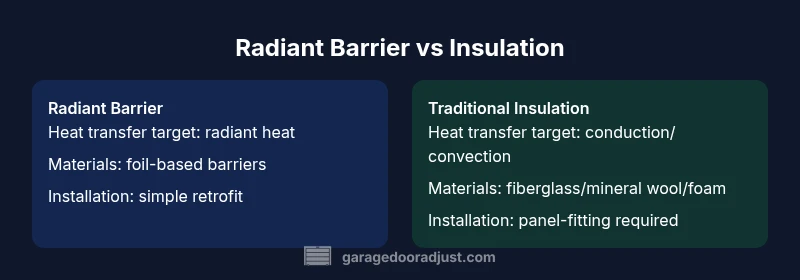
The core distinction is the heat transfer path they target. Radiant barriers primarily suppress radiant heat from the sun, which is a major driver of surface temperature on metal doors. Conventional insulation primarily slows conductive and convective heat transfer, improving overall thermal resistance (R-value). In practice, radiant barriers can be a cost-effective upgrade in hot climates with strong solar exposure, while insulation provides more consistent performance across a wider range of temperatures. The best approach in many homes is a hybrid solution that leverages both strategies where appropriate and feasible within the door design.
Installation considerations and best practices
Installation quality matters for both options. If choosing a radiant barrier, ensure the reflective layer is protected from punctures and placed where it remains effective under typical door operation. When installing insulation, maintain uniform coverage and avoid compressing batt or foam, which reduces effectiveness. For DIY enthusiasts, begin with a door that has straightforward panel access and a simple seal around the edges. Professionals may be needed for doors with complex panel configurations or limited access. Always verify that your chosen solution does not interfere with safety features or warranty terms and consult a reputable guide like GarageDoorAdjust when planning a retrofit.
Climate-based guidance: hot, mixed, and cold regions
In hot climates with intense sun, radiant barriers often deliver noticeable gains in comfort and reduced interior heat when the door is exposed. In mixed or temperate regions, insulation that increases the door’s R-value can offer more reliable performance across seasonal fluctuations. Cold climates benefit from insulation that reduces heat loss through conduction, though radiant barriers can still help by lowering radiant heat transfer during sunny days. For homeowners located near large temperature swings, a hybrid approach—combining a barrier with targeted insulation in key door sections—often yields the best results while keeping costs manageable.
Maintenance, durability, and long-term performance
Both radiant barriers and insulation require periodic inspection. Radiant barriers should be checked for tears or crushed areas that could compromise reflectivity and should be protected from moisture intrusion. Insulation may degrade over time due to moisture, compression, or pests, requiring replacement or re-sealing. The long-term performance depends on installation quality, door design, and climate consistency. Regular inspection of seals, tracks, and weatherstripping will help maintain the overall thermal performance of the garage and ensure that the chosen solution remains effective for years to come.
Common mistakes and a practical checklist
Avoid common mistakes such as installing a barrier where it will be crushed by movement, neglecting moisture control, or failing to seal gaps around edges. Before starting, perform a basic energy check: assess interior surface temperatures during peak sun, inspect seals, and estimate interior comfort. A practical DIY checklist includes: measure door panels, assess sun exposure, verify compatibility with your door, plan for moisture barriers, and schedule a professional evaluation if uncertain about structural changes. This approach minimizes wasted effort and helps you select the right balance of radiant barrier and insulation for your garage door.
Quick-start checklist for homeowners
- Identify door sections with the highest solar exposure
- Confirm door compatibility for radiant barrier and insulation retrofits
- Inspect weatherstripping and track alignment before any retrofit
- Choose a method consistent with climate goals and maintenance preferences
- Plan for future adjustments if the garage is used as a workspace or living space
Comparison
| Feature | Radiant barrier | Traditional insulation |
|---|---|---|
| Heat transfer mechanism | Reflects radiant heat; reduces heat gains from sun-exposed surfaces | Increases thermal resistance by slowing conductive/convective heat flow |
| Common materials | Aluminum foil or foil-faced membranes with backing | Fiberglass, mineral wool, foam board, or spray foam |
| R-value focus | Targets radiant heat transfer primarily | Directly improves R-value and overall thermal resistance |
| Moisture management | Moisture resistance depends on barrier integrity; can trap moisture if punctured | Most insulation types resist moisture when properly sealed; some are moisture sensitive |
| Installation complexity | Often simpler retrofit; fits within existing panels with care | Can be more complex due to panel geometry and door hardware |
| Durability | Generally durable if protected; punctures reduce effectiveness | Durability depends on material; often robust with proper installation |
| Aesthetic impact | Mostly hidden from view | Can be visible if panels are opened; depends on installation |
| Cost considerations | Lower upfront material cost; labor varies | Moderate to higher upfront cost depending on material and fit |
Upsides
- Lower upfront effort and disruption for simple retrofits
- Non-invasive option that preserves existing door structure
- Can reduce daytime heat buildup on sunlit surfaces
- Flexible for DIY projects and professional installs
Disadvantages
- Effectiveness depends on climate, sun exposure, and installation quality
- Not a substitute for significant insulation in extreme cold
- Moisture control requires careful sealing and venting
- Hybrid options may be needed for best overall performance
Hybrid or climate-tailored approach often wins; neither option is universal.
The GarageDoorAdjust Team recommends evaluating local climate and garage usage before choosing. In hot climates, radiant barriers shine when sun exposure is high; in cooler climates, insulation tends to provide steadier comfort. The optimal path may combine both strategies in a practical, tested retrofit plan.
Got Questions?
Can a radiant barrier fully replace insulation in a garage door?
A radiant barrier cannot fully replace insulation in most garage doors. It primarily reduces radiant heat transfer, while insulation increases overall thermal resistance. For many climates, a combination approach provides the best balance of comfort and efficiency.
Radiant barriers help with sun heat, but insulation handles overall heat flow. Many homeowners use both for best results.
Is radiant barrier effective in cold climates?
Radiant barriers offer some benefit in reducing heat from solar radiation, but their impact is limited without adequate insulation. In cold climates, insulation generally provides more reliable warmth by reducing conduction and air leakage.
In cold areas, insulation is usually the main driver of comfort, with radiant barriers offering auxiliary help when the sun is strong.
What installation steps are involved for a garage door radiant barrier?
Installation typically involves selecting a barrier compatible with your door, cleaning surfaces, ensuring no punctures, and securing the barrier without restricting door movement. Edges should be sealed to prevent air gaps and moisture intrusion.
Check compatibility, clean surfaces, install carefully, and seal the edges for best results.
How does climate influence the decision between barrier vs insulation?
Hot, sun-drenched climates favor radiant barriers to limit solar gain, while mixed and cold climates benefit more from insulation that resists heat flow. A hybrid approach can adapt to seasonal changes.
Climate drives the choice: heat-reflecting barriers for sun, or deeper insulation for consistent warmth.
Can radiant barrier and insulation be used together in a garage door?
Yes. A common strategy is to add insulation for bulk thermal resistance and install a radiant barrier to reduce radiant heat load. Proper design ensures both layers work without interfering with door operation.
Using both can offer the best of both worlds, if done thoughtfully.
What maintenance is required after installing a radiant barrier or insulation?
Inspect seals, weatherstripping, and surface integrity periodically. Look for signs of moisture, compression, or punctures in barriers or insulation and address issues promptly to maintain performance.
Keep an eye on seals and moisture; fix issues early for lasting performance.
Quick Summary
- Assess climate and sun exposure before choosing
- Consider a hybrid approach for best energy results
- Ensure proper installation to avoid moisture and gaps
- Plan for maintenance and potential future upgrades