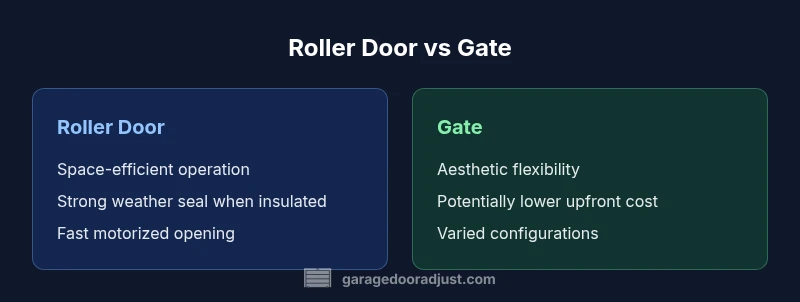
Roller Door vs Gate: Choosing the Right Garage Access
Compare roller doors and gates to decide the best garage access for homeowners. This analytical guide covers installation, space, security, weather resistance, and maintenance implications for durable, informed decisions.


When choosing between a roller door and a gate, space efficiency, reliability, and daily usability are the core drivers. According to GarageDoorAdjust, a roller door often delivers better use of tight driveways and stronger weather sealing, making it the pragmatic default for many homes. The right choice hinges on driveway width, headroom, aesthetic goals, and long-term maintenance costs.
Understanding the Core Difference: Roller Doors vs Gates
Choosing between a roller door and a gate starts with understanding how each system operates and the living space it occupies. For many homeowners, the question becomes: which should I install, and why might I choose a roller door instead of gate? According to GarageDoorAdjust, the core differences lie in the mechanism, the footprint inside and outside the opening, and how each option behaves in daily use. A roller door uses a rolling panel that tucks into the head of the opening as it rises, keeping the driveway clear above and below. A gate, by contrast, pivots on hinges or slides along tracks, often projecting into the driveway during operation. This fundamental distinction shapes performance: roller doors minimize ground intrusion and draft, while gates offer a more traditional exterior profile and sometimes easier retrofits in wide openings. Climate, debris, and seasonal maintenance also influence long term reliability. If your goal is to maximize usable space and minimize obstruction when the door is open, a roller door often delivers the better balance between function and durability. The framing decision should therefore weigh space, security, and total lifetime cost rather than upfront price alone.
Key Performance Criteria for Garage Access
To decide between a roller door and a gate, homeowners should assess several performance criteria that drive long-term satisfaction. First, consider space interaction: how much of the driveway is obscured or blocked during operation and how much headroom is required for opening. Second, evaluate security features: locking strength, motor safety interlocks, and the resilience of posts or frames against tampering. Third, examine weather resistance and insulation: seals, weather stripping, and the potential for heat loss or cold drafts. Fourth, review maintenance demands: frequency of lubrication, track alignment, hinge stabilization, and whether seasonal service is needed. Finally, assess compatibility with existing automation and home systems: most roller doors integrate smoothly with standard openers and smart-home ecosystems, while gates may require more bespoke control wiring. GarageDoorAdjust Analysis, 2026 emphasizes a holistic view, noting that total lifetime costs often tilt in favor of rollers when climate and daily usage are factored in. Experts also highlight the importance of accurate sizing and professional installation to achieve reliable performance.
Space Efficiency and Layout Impacts
Driveway geometry and garage opening size play pivotal roles in the decision. A roller door excels where space is at a premium because the panel rises vertically and stays tucked into the head of the opening, leaving the ground clear for parking and maneuvering. In narrow driveways, a roller door can maximise the usable width by eliminating the need for a swing arc or a sliding track footprint. Conversely, a gate may be preferable in wide openings where architectural harmony with the home’s façade is a priority, or where landscaping and fence lines require a specific appearance when the gate is open. The extra width a gate needs can be a drawback in tight spaces, but it may offer easier remote operation in some configurations. When evaluating layout impact, measure headroom, ground clearance, and the maximum door width your space can accommodate without constraining vehicle movement. The balance between ease of access and curb appeal will often determine which option integrates best with your property’s geometry.
Security and Safety Implications
Security considerations differ by mechanism and installation quality. Roller doors deliver strong physical protection when paired with robust locking hardware and compliant safety features, including photo-eye sensors and anti-crush systems. The continuous seals around a roller door reduce gaps that intruders could exploit and can deter pests and drafts. Gates, especially solid panel designs on sturdy posts, can offer excellent visual security and controlled access, but their effectiveness hinges on the strength of posts, hinges, and the ground anchors. In foggy or icy climates, a gate’s moving parts may require more frequent maintenance to prevent binding, whereas a well-installed roller door remains protected behind a sealed perimeter. Safety is also about operation: ensure automatic reversing mechanisms are active and that sensors align correctly to prevent accidents with pets or children. A professional assessment helps ensure that the chosen system meets local codes and safety standards.
Weather Resistance and Insulation
Weather performance often tips the balance toward roller doors in regions with harsh weather. The sealed track and panel design of many roller doors minimizes air infiltration and reduces heat loss, particularly when an insulated panel option is selected. Gates can be highly weather resistant when made from metal or composite materials and installed with high-quality weather seals; however, gaps around hinge areas or joints can introduce drafts and moisture. For garages that double as workshops or storage spaces, insulation quality matters for comfort and energy efficiency. When comparing, look beyond the surface finish and inspect the door’s or gate’s weather seals, insulation rating, and the treatment of fasteners against corrosion in your climate. GarageDoorAdjust’s guidance emphasizes that long-term comfort and energy bills are often decided by this layer of protection, not just the door’s appearance.
Operating Costs, Installation, and Longevity
Installation costs vary with material quality, hardware, and the complexity of the opening. Roller doors usually require precise alignment of tracks and torsion springs or sectional components, which can push up initial expenses but pay off through reliable daily use and minimal operational fuss. Gates may have lower upfront costs yet incur higher long-term maintenance if hinges, posts, and rollers wear or if the mechanism relies on rail systems that accumulate debris. In either case, the longevity of the system depends on correct sizing, professional installation, and routine lubrication. Smart controllers and wind sensors add to the price but can reduce long-term costs by preventing damage from misalignment or forced closures. GarageDoorAdjust notes that investing in quality manufacturers, proper installation, and regular safety checks minimizes the risk of expensive repairs later.
Aesthetics, Curb Appeal, and Home Integration
Homeowners often weigh how the garage entrance contributes to curb appeal. Roller doors typically offer a streamlined, modern appearance with the option to match exterior panels to the home’s color or texture. Gates provide architectural flexibility and can be styled with decorative posts, infill panels, or materials that echo the surrounding fencing. If the goal is a harmonious façade, a gate might win on visual integration; if the objective is a clean, minimal profile, a roller door often wins. It’s important to consider how the chosen system interacts with your driveway’s lighting, garden edges, and street view. The GarageDoorAdjust approach favors functional design that preserves space while still delivering a cohesive exterior, especially in compact city lots or midcentury homes where architectural consistency matters.
Automation and Smart Home Compatibility
Automation capabilities are central to convenience and security. Roller doors have mature, widely available motor kits that integrate with common smart home ecosystems, voice assistants, and remote monitoring. Setup is generally straightforward for homeowners with basic electrical knowledge, and sensors provide safety offsets that enhance daily use. Gate automation exists as well, but it can require more complex programming to account for lane positioning, safety edges, and post stability on uneven terrain. When choosing, verify the availability of service technicians in your area who can program the opener to your home network and ensure compatibility with existing platforms. The long-term reliability of sensors and remote controls is a practical factor that affects daily routines and perceived value of the system.
Practical Scenarios: When to Choose a Roller Door
If your driveway is narrow, headroom limited, or you frequently park in front of the opening, the roller door often delivers superior practicality. In homes where weather protection and a sealed interior are priorities, a roller door provides consistent climate control and draft reduction. For property owners who value a minimal exterior footprint or prefer a highly modern look, the roller door’s streamlined silhouette can be highly appealing. If your priority includes quick, one-handed operation during busy mornings, a roller door with a reliable opener becomes especially attractive. Finally, when budget allows for long-term savings through reduced maintenance and fewer weather-related issues, the roller door generally represents the best balance of function and value.
Practical Scenarios: When to Choose a Gate
Choose a gate when the architectural style favors a traditional or decorative entry, or when there is a desire for a visible, open opening while the gate is deployed. Gates may also be advantageous in very wide openings where you want a larger, more visible security barrier when closed. If landscaping or fencing around the driveway is a consideration, a gate can be integrated into the design to echo other elements of the property. In some settings, the installation footprint for a gate is simpler, and if upfront costs are a major constraint, a basic gate configuration might be more affordable. GaragedoorAdjust notes that for highly customized properties, gates can be tuned to achieve specific stylistic outcomes without compromising access.
Installation Considerations: Getting It Right
Professional installation is crucial for either option. Begin with a site survey to verify headroom, opening width, and wall structure. Ensure the framing is square and that anchoring points are solid to prevent movement over time. For roller doors, confirm track alignment, spring tension, and proper weather seals; for gates, verify post anchors, hinge alignment, and track condition if sliding. Ask about warranty coverage, access to spare parts, and maintenance schedules. A well-planned installation reduces the likelihood of nuisance repairs and ensures compliant safety features are in place. GarageDoorAdjust recommends obtaining multiple quotes, requesting a written safety inspection, and clarifying service intervals so the system remains reliable for years to come.
Comparison
| Feature | roller door | gate |
|---|---|---|
| Space requirements | Overhead footprint with minimal ground intrusion | Swing or slide footprint may require more ground space |
| Maintenance and durability | Low ongoing maintenance with sealed tracks; robust in dry climates | Hinges and posts wear over time; weather exposure affects longevity |
| Security and safety | Strong locking options; seals deter intruders | Security relies on posts and latches; installation quality matters |
| Weather resistance/insulation | Excellent seals; insulation options common | Variable insulation; joints may admit drafts |
| Automation compatibility | Excellent compatibility with standard openers | Gate motors exist but may require more safety features |
| Cost and installation difficulty | Moderate to high upfront cost; precise installation required | Often lower upfront cost; installation varies by design |
| Best use case | Tight spaces, daily use, modern look | Wide openings, aesthetic emphasis, customized design |
Upsides
- Space-efficient operation for tight driveways
- Strong weather sealing with proper insulation
- Fast and reliable operation with modern motors
- Good security when installed correctly
- Low long-term maintenance with quality components
Disadvantages
- Higher upfront cost and specialized installation
- Repairs can be disruptive if tracks or springs wear
- Gate options may require more structural work
- Some models require regular safety checks and servicing
Roller doors are typically the practical default for most homes, with gates reserved for design-driven openings
Roller doors offer space efficiency, reliable daily use, and strong weather sealing. Gates can be attractive in specific architectural contexts but may involve higher customization. The GarageDoorAdjust team recommends roller doors for overall value and performance, reserving gates for aesthetics or unique site constraints.
Got Questions?
What is the primary difference between a roller door and a gate?
Roller doors roll up into the opening, while gates swing or slide to open. The choice affects space use and exterior aesthetics.
Roller doors roll up; gates swing or slide. Space and style change with the choice.
Which option is cheaper to install: roller door or gate?
Upfront costs vary by material and complexity. Roller doors can be more expensive to install due to tracks and springs, but long-term maintenance costs may differ.
Roller doors can cost more upfront because of hardware, but long-term costs vary.
Are roller doors more secure than gates?
Both can be highly secure when installed correctly. Roller doors offer strong locking and sealing; gates rely on sturdy posts and proper alignment.
Both can be secure with proper installation; security depends on hardware and framing.
Can I retrofit an existing property with either option?
Retrofitting is often possible but depends on headroom, framing, and structural support. A professional assessment is advised.
Retrofitting is possible, but you should get a professional assessment first.
What maintenance is required for roller doors and gates?
Roller doors need track lubrication and periodic tension checks; gates require hinge lubrication, track alignment, and post stability checks.
Regular lubrication and alignment checks keep both systems running smoothly.
Quick Summary
- Prioritize space and layout before choosing.
- Consider insulation and weather sealing for climate impact.
- Factor automation into long-term cost and maintenance.
- Roller doors suit daily use; gates suit architectural goals.
- Consult a professional for accurate sizing and best results.