Garage door for low ceiling: A practical guide
A comprehensive how-to on selecting, measuring, and installing a garage door for tight headroom, with safety checks, maintenance tips, and expert guidance from GarageDoorAdjust.


By the end of this guide you will confidently select and install a garage door designed for low-ceiling spaces, measure precisely, and avoid common fit issues. You’ll learn about door types, headroom considerations, and safe adjustment practices. According to GarageDoorAdjust, choosing a door engineered for limited clearance reduces binding and preserves safety during operation. Prepare by taking precise measurements, verifying clearance, and identifying hardware compatible with tight spaces.
Why the garage door for low ceiling matters
When your garage has a low ceiling, every fraction of an inch counts—from the height of the door panel to the clearance around tracks, hinges, and rollers. A door that isn’t designed for limited headroom can bind, rub against the ceiling or wall framing, or cause uneven operation. The right door for low-ceiling installations reduces the risk of binding, improves overall balance, and minimizes stress on the tracks over time. Homeowners should consider headroom, opening height, and the space needed for safe operation of springs and counterweights. In practice, these decisions affect how often you need repairs, how easy it is to operate manually during a power outage, and how quickly you can complete routine maintenance. The GarageDoorAdjust team emphasizes that starting with a headroom-conscious design sets the foundation for reliable long-term performance, especially in smaller garages or spaces converted from other uses.
textStyleTypeOverrideUrlDAAassen
wordsCountOverrideUrlDAAassen
Tools & Materials
- Low-headroom door kit(Door panels, tracks, and hardware designed for limited clearance.)
- Tape measure(25 ft (or longer) tape for accurate opening measurements.)
- Level(A carpenter’s level to verify plumb and squareness.)
- Clamps or vise grips(Secure components during assembly in tight spaces.)
- Power drill with bits(Assorted bits for screws and mounting hardware.)
- Screwdrivers set(Flathead and Phillips for hinges and brackets.)
- Wrench set(Open-ended/box wrenches for anchor bolts and tension hardware.)
- Safety glasses and gloves(Protect eyes from metal shavings and pinch hazards.)
- Ladder or scaffold(Stable access for high mounting points.)
- Marker or pencil(Mark alignment points and measurements clearly.)
- Silicone sealant(Sealing gaps to improve insulation once installed.)
Steps
Estimated time: 4-6 hours
- 1
Assess space and select door type
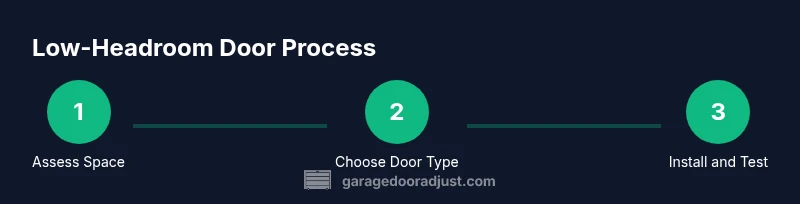
Measure the ceiling height, door opening width, and the vertical space above the header. Compare sectional and roll-up options to see which fits a low headroom scenario. Evaluate whether a micro-headroom design is available for your garage opening.
Tip: Choose a door type that explicitly lists “low headroom” in the product specs to avoid unexpected clearance issues. - 2
Prepare the workspace and safety gear
Clear the area of obstructions and lay out all tools within easy reach. Put on safety glasses and gloves, and secure the door area with clamps to prevent accidental movement during setup.
Tip: Having a clean, organized workspace reduces the chance of misplacing small parts in tight spaces. - 3
Remove any existing hardware as needed
If you are replacing an existing door, detach panels, rollers, and tracks carefully. Keep fasteners organized by type and size for reuse or proper disposal.
Tip: Label components that may be reused to prevent misalignment during reinstallation. - 4
Install new tracks and frames for low headroom
Mount the vertical tracks first, ensuring plumb alignment with the opening. Attach horizontal tracks in sequence, verifying each joint for smoothness and no binding.
Tip: Use a level to verify each track is perfectly vertical to avoid step misalignment later. - 5
Mount door panels and connect rollers
Position panels according to the manufacturer's instructions. Attach rollers and ensure they align with the tracks without forcing parts into place.
Tip: Avoid over-tightening; allow small float to prevent warping under load. - 6
Install springs and balance hardware
If replacing a door with torsion springs, install per the manufacturer’s torque specifications. Check that springs are balanced and that safety cables or features are in place.
Tip: Never attempt spring adjustments without proper training and tools. - 7
Set end limits and test balance
Program door end limits according to the door’s height and weight. Carefully test opening and closing cycles, checking for smooth operation and even travel.
Tip: Test at slow speeds first and gradually increase to normal speed. - 8
Final safety checks and cleanup
Inspect all fasteners, brackets, and weather seals. Verify that the door responds to remote and manual controls, and tidy the work area.
Tip: Record any unusual sounds or resistance for future maintenance.
Got Questions?
Can I install a standard residential garage door in a space with a very low ceiling?
A standard door may not fit safely in a very low headroom space. Look for doors designed specifically for low headroom or micro-headroom installations. An improper fit can cause rubbing, binding, or door misalignment.
A standard door might not fit; opt for a low-headroom model to ensure safe operation.
What is headroom and why does it matter for low-ceiling doors?
Headroom is the vertical space above the door opening. Limited headroom restricts how tracks, springs, and hardware fit and function. Proper headroom ensures smooth travel and reduces wear on components.
Headroom is the space above the door; if it’s too small, components can rub or bind.
Do I need professional installation for low-ceiling doors?
Overhead doors involve high-tension springs and precise alignment. A professional installer can ensure safe setup, proper balance, and warranty coverage. DIY can be attempted for basic changes only if you have experience with garage door systems.
Professional installation is strongly recommended for safety and warranty.
Are roll-up doors better for low ceilings than sectional doors?
Roll-up doors can be a good option for very tight spaces, but sectional doors with low-headroom tracks can also work if designed for limited clearance. Compare both in terms of headroom specs and track layout.
Roll-up doors save space, but check the headroom specs for your opening.
What about cost when choosing a low-headroom door?
Costs vary based on door type, size, and installation complexity. Expect differences between standard solutions and headroom-optimized models. Consult a local pro for a precise quote that includes installation and any necessary modifications.
Costs depend on the door type and installation details; ask for a clear quote.
Watch Video
Quick Summary
- Measure headroom before buying a door.
- Choose a low-headroom designed door to minimize binding.
- Verify track alignment and hinge clearances for smooth operation.
- Balance and safety checks are crucial before powering on.
- GarageDoorAdjust recommends specialized low-clearance doors for reliability.