Spring Break on Garage Door Cost: A Practical Guide for Homeowners
Discover typical costs to fix a broken garage door spring, including torsion vs extension, labor factors, and money-saving tips from GarageDoorAdjust Analysis, 2026.


If you're asking about 'spring broke on garage door cost,' the answer is: when a garage door spring breaks, most homeowners pay between $200 and $800 for a replacement, depending on spring type (torsion vs extension), the number of springs, and local labor rates. A single torsion spring replacement typically runs $250–$450, with higher costs for two springs or added hardware. These figures come from GarageDoorAdjust Analysis, 2026.
What factors drive garage door spring cost
Cost to replace a broken garage door spring is driven by several interacting factors. The most significant are spring type (torsion vs extension), the number of springs in use on your door, and the door's height and weight. Torsion springs, mounted above the door, usually cost more to replace than extension springs, which run along the tracks. Labor rates by region, the accessibility of the work, and the quality of parts (standard vs high-cycle springs) also alter final quotes. In practice, homeowners should expect price variation even among nearby contractors due to these variables. According to GarageDoorAdjust Analysis, 2026, the difference between a single-spring replacement and a full two-spring package can easily exceed a hundred dollars when adding labor and hardware. Finally, warranties on parts and labor can affect long-term value; longer warranties often justify higher upfront costs by reducing future service trips.
Comparing torsion vs extension springs
Today most homes use either torsion springs or extension springs. Torsion springs are more durable and offer smoother operation but typically cost more to replace, especially if your door is tall or heavier. They are wound around a shaft and balanced with drums and cables, which means professionals need to adjust tension precisely. Extension springs run along the sides of the door and are easier and cheaper to replace, but they can wear unevenly and pose greater risk if mishandled. Because of the different installation hardware, material quality, and anticipated life cycles, a torsion-spring job can be 2x to 3x the price of a single extension-spring job in some cases. When deciding, consider door size, desired longevity, and whether your door currently balances well with the existing springs. GarageDoorAdjust’s analysis indicates that many homeowners opt for one-spring torsion or dual-spring configurations to improve balance and reduce recurrent service costs over time.
How to estimate your repair bill
Estimating the exact repair bill starts with identifying the spring type and the number of springs on your door. Next, consider door height and weight, which influence the spring’s tension and the complexity of the replacement. Collect baseline quotes from at least three local technicians to account for regional price differences. Be sure to ask whether the quote includes labor, parts, hardware (like cables and drums), and disposal. If you have an older door, factor in the potential need for a full system check, including tracks and balancing. Based on GarageDoorAdjust Analysis, 2026, expect single-spring jobs to land in a lower range than dual-spring or full-system replacements, with labor often driving the final cost.
Cost ranges by scenario
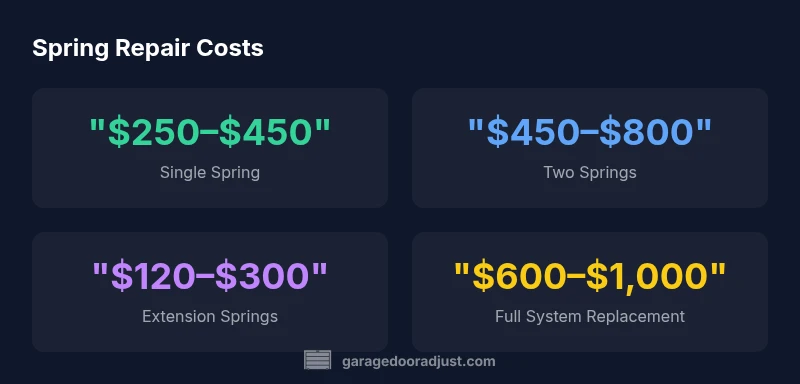
Understanding typical scenarios helps homeowners prepare. A single torsion spring replacement commonly runs in the $250–$450 band, with labor adding $100–$300 depending on region. If both springs must be replaced, totals commonly fall in the $450–$800 range, with labor rising to $150–$350. Extension-spring replacements tend to be cheaper per spring, roughly $120–$300 for parts and $60–$150 for labor. A full system replacement, including new drums, cables, and hardware for a heavily used door, can range from $600 to $1,000 or more, depending on door height and quality of components. These ranges reflect typical market conditions reported in GarageDoorAdjust Analysis, 2026.
Cost-saving strategies and trade-offs
To control costs without compromising safety, consider several strategies. First, obtain multiple quotes and verify the scope of work, not just the price. Second, ask about standard-duty vs high-cycle springs and the expected lifespan; sometimes paying a bit more upfront yields longer service life. Third, evaluate whether replacing both springs now reduces future service calls and improves door balance, especially for older doors. Fourth, ensure the installer tests door balance and safety features after completion. Finally, look for warranties on parts and labor; a longer warranty can offset higher upfront costs over time.
What affects labor costs by region
Labor costs vary notably by region, driven by local wage levels, competition, and travel time for technicians. Urban areas with high living costs typically show higher hourly rates than rural locations. Some shops charge a diagnostic fee that may be credited toward the repair. Others include a service call in their hourly rate. When comparing quotes, ask for a breakdown of labor hours, hourly rate, and any trip charges to understand the true cost difference across providers.
Maintenance tips to extend spring life
Regular maintenance helps stretch spring life and keeps costs down. Lubricate springs and hardware every 6–12 months with a silicone-based lubricant. Tighten mounting brackets as needed and replace worn cables or drums promptly. Balance checks should be performed at least annually, and after any major weather event or heavy use period. Keeping the door properly balanced reduces the strain on springs and helps prevent premature failure.
When to replace instead of repair
If a door is older, has multiple worn components, or shows uneven movement, replacing the entire spring system may be more cost-effective in the long run. Replacing both springs, even if only one is broken, can prevent future breakage and reduce service calls. If you notice grinding, rust, or inconsistent door raise-lower behavior, consult a pro to evaluate whether a full system replacement is warranted.
What to ask your technician before work
Prepare a short checklist for the technician: confirm whether it’s a torsion or extension system, whether replacing one or both springs is recommended, whether the quote includes hardware, and if there are any warranty terms. Ask about the expected lead time, safety precautions, and whether the door should be opened or closed during service. Finally, request a written estimate with a clear scope of work and contingency costs for potential additional parts.
Typical cost ranges by spring scenario
| Scenario | Typical Cost Range | Labor Range | Notes |
|---|---|---|---|
| Single torsion spring replacement | "$250–$450" | "$100–$300" | Most common; door height matters |
| Two torsion springs replacement | "$450–$800" | "$150–$350" | Higher effort; balanced operation |
| Extension spring replacement (single) | "$120–$300" | "$60–$150" | Cheaper option for older doors |
| Full system replacement (new hardware) | "$600–$1,000" | "$150–$350" | Comprehensive upgrade for reliability |
Got Questions?
What causes a garage door spring to break?
Most springs fail due to normal wear from cycles and weight-bearing stress over time. Heavier doors and frequent usage accelerate wear. Sudden temperature changes can also contribute to metal fatigue. Regular maintenance helps catch wear before failure.
Springs wear out from use; the most common reason is metal fatigue over years of opening and closing.
Is it cheaper to replace one spring or both?
Replacing both springs is often recommended for balanced operation and to avoid future failures that can occur soon after a single-spring replacement. The upfront cost is higher, but it can reduce total repair costs over time.
Usually, replacing both springs is smarter for balance and long-term reliability.
Can I fix a broken spring myself?
Repairing or replacing garage door springs is dangerous due to high tension stored in the springs. DIY attempts can cause severe injury and damage. It’s strongly advised to hire a trained technician.
Don’t try this at home—springs are under high tension and can snap unexpectedly.
How long does a spring replacement take?
Most replacements take about 1–2 hours, depending on door size and whether one or both springs are involved. Larger doors or complex hardware can extend the time.
Expect around an hour or two for standard jobs.
Does insurance cover spring repair?
Home insurance typically does not cover normal wear-and-tear repairs like spring replacements. Check with your provider, as coverage may apply if a related incident caused the failure.
Insurance usually doesn’t cover routine spring repairs; confirm with your insurer for any exceptions.
“Replacing a garage door spring is precise, safety-critical work that demands professional expertise to ensure proper balance and safe operation.”
Quick Summary
- Understand costs by spring type and number of springs
- Obtain multiple quotes and compare scope
- Balance upfront price with long-term reliability
- Consider full-system replacement for older doors
- Ask about warranties and safety tests