Fixing rjo20: Urgent Garage Door Error Guide
Learn how to diagnose and fix rjo20, the garage door error code. This urgent guide covers meaning, quick fixes, safety tips, and when to call GarageDoorAdjust for professional help in 2026.


rjo20 signals a safety or sensor fault in most garage door systems. According to GarageDoorAdjust, misaligned or blocked safety beams is the typical cause, though wiring or control-board issues can contribute. The quick fix starts with safe checks: clear obstructions, realign beams, and reset the opener. If the code persists, follow the diagnostic flow below.
What rjo20 Means for Your Garage Door System
rjo20 is a fault code emitted by many garage door opener safety circuits. It signals a fault in the safety or sensor loop, which prevents the door from operating normally until the issue is resolved. In general, this means the safety beams may not be detecting a safe opening, or the control logic has flagged a fault. The GarageDoorAdjust team notes that, in 2026, sensor-related faults are among the most common causes across brands. Prioritize diagnosing why the safety path is compromised before attempting to force the door to move. Addressing rjo20 quickly helps prevent further damage to the opener and reduces risk to people nearby.
If you see rjo20 on a display or app, don’t ignore it. This code often appears when a safety loop is interrupted or miscommunicates with the opener. Treat it as urgent and approach repairs methodically. While some homeowners can clear basic obstructions and realign beams, persistent faults should trigger a professional assessment to prevent reoccurrence.
Quick Safety Checks You Can Do (No Tools Needed)
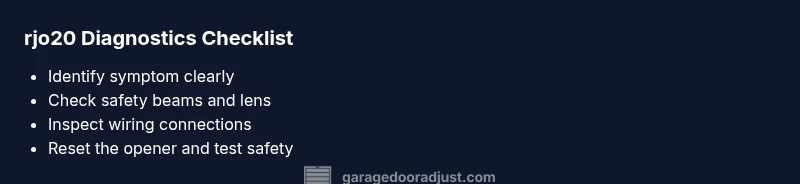
Start with simple, non-invasive checks that reduce risk and often resolve rjo20 quickly. Prioritize safety: unplug the opener before handling sensors, keep hands and clothing away from moving parts, and work on a dry surface. Then perform these quick checks:
- Inspect the safety beams at each side of the door opening and ensure they face each other directly. A slight tilt can trigger rjo20.
- Remove any loose objects, leaves, or dirt along the beam path that could obscure or reflect the signal.
- Clean each sensor lens with a soft, dry cloth to remove dust that can mimic a misalignment.
- Confirm the wiring connections at the sensors are snug and free of corrosion or wear.
- Reconnect power and perform a soft reset of the opener to clear stale fault memory.
- With the door closed, test the auto-reverse feature by briefly interrupting the beam during a close cycle.
Common Causes and How to Verify
Understanding the top culprits for rjo20 helps you triage quickly. Here are the most common causes and how to check them:
- Misaligned safety beams (high likelihood): Verify both beams are level and directly opposite each other. Small misalignments can trigger fault codes.
- Blocked beam path (high likelihood): Look for packages, tools, or dirt lodged between beams that could interrupt the signal.
- Dirty or damaged sensor lenses (medium likelihood): Clean with a lint-free cloth; inspect for cracks or condensation that could distort the signal.
- Wiring faults to sensors or control board (low likelihood): Check connectors at the sensors and the opener for loose pins or wear; look for frayed insulation.
- Firmware or control-board fault (low likelihood): Some models require firmware updates or reinitialization of learned settings. GarageDoorAdjust Analysis, 2026 indicates sensor-related faults are a frequent source of rjo20 across brands, underscoring the value of sensor health checks in the diagnostic flow.
When to Call a Professional
If basic checks do not clear rjo20, it is time to call a professional. A trained technician can safely access and test sensor wiring, verify power supply integrity, and perform advanced diagnostics without risking personal injury or further equipment damage. Pro support is particularly advisable if you notice arcing, burnt smells, or water intrusion around sensors, or if your model requires proprietary tools or calibration sequences. Expect professional repairs to include parts and labor estimates in a broad range, depending on the model and access.
Practical Tips to Prevent rjo20 Recurrence
Preventive measures reduce the chance of rjo20 returning between service visits. Implement these practical steps:
- Schedule monthly sensor inspections and beacon cleanings, especially after seasons with heavy dust or pollen.
- Keep the door path clear and avoid placing objects near the sensor area that could trigger misreads.
- Use a surge protector for the opener to stabilize power delivery and prevent sensor glitches during voltage spikes.
- Maintain a simple maintenance routine, including lubrication of moving parts and periodic testing of safety features.
- Document any adjustments with photos to help future diagnostics and keep a record for future service calls.
Steps
Estimated time: 25-40 minutes
- 1
Power cycle the opener
Unplug the unit or switch off the circuit breaker, wait 60 seconds, and plug back in. This resets some control logic that may trigger rjo20. After power restore, test the door using the wall control in a controlled manner.
Tip: Use the wall control or remote to avoid touching the door while it moves. - 2
Check safety beam alignment
Inspect both safety beams at the door edges and ensure they face each other directly. A slight tilt or misalignment can trigger rjo20. Secure brackets if needed.
Tip: Use a level to confirm a straight beam line and verify mounting screws are tight. - 3
Inspect for obstructions and clean lenses
Remove debris from the beam path and wipe sensor lenses with a soft, dry cloth. Dirt or obstructions degrade signal and can trigger faults.
Tip: Don’t use liquids on sensor lenses; avoid abrasive cleaners. - 4
Verify sensor wiring connections
With the power off, reseat sensor connectors and inspect for damaged insulation or loose pins at both the sensor and the opener.
Tip: Take a quick photo before unplugging to ensure correct reassembly. - 5
Reset the opener’s safety feature
Follow your model’s reset or learning sequence to clear fault memory and re-establish safe operation.
Tip: Consult the manual for model-specific steps to avoid misconfiguration. - 6
Test sensor function and auto-reverse
Close the door and briefly interrupt the beam to confirm auto-reverse works and that the safety system detects a break in the path.
Tip: If the door fails to reverse or remains blocked, stop and call a pro.
Diagnosis: Error code rjo20 appears on the opener display or app, door won't safely operate
Possible Causes
- highMisaligned safety beams
- highBlocked safety beam path by dust/obstruction
- mediumDirty or damaged sensor lenses
- lowWiring faults to sensors or control board
Fixes
- easyRealign safety beams until both sensors face each other within the recommended gap
- easyClear path between sensors and clean lenses with a soft, dry cloth
- mediumInspect and reconnect sensor wiring; check for damaged insulation
- easyReset or reprogram opener following manufacturer steps
Got Questions?
What does rjo20 mean on my garage door opener?
rjo20 is a safety/sensor fault code indicating an issue in the safety beam circuit or sensor path. It stops normal operation to protect people and property.
rjo20 is a safety sensor fault; the door won’t operate until the issue is fixed.
Can I fix rjo20 without a professional?
Some quick checks like realigning beams and cleaning sensor lenses can fix rjo20. If there’s no improvement, a professional diagnosis is recommended.
Yes, you can try simple beam realignment and cleaning, but call a pro if it stays.
How much does sensor repair cost?
Sensor-related repairs, including alignment or replacement, typically range from $50 to $200 depending on the model and access.
Sensor repairs usually cost between fifty and two hundred dollars, depending on parts and labor.
Is rjo20 dangerous?
The code indicates a safety fault; it isn’t usually an immediate danger, but it prevents operation until resolved. Treat it urgently.
It’s a safety fault, so address it quickly to prevent accidents.
What should I do after resetting the opener?
Reset as directed by the manufacturer, then test beam alignment and auto-reverse before returning to normal use.
Reset, then test the beams and the door’s safety features.
Watch Video
Quick Summary
- Check and realign safety beams first.
- Keep sensors clean and free of obstructions.
- Reset and test after each fix step.
- Call a professional if the fault persists.