Do Garage Doors Use Much Electricity? A Practical Guide for Homeowners
Explore standby vs active power, insulation impact, and energy-saving tips for garage door openers. Learn how to minimize electricity use without sacrificing convenience.


Do garage doors use a lot of electricity? Not typically. In standby, most openers draw only a few watts, and when actively opening or closing, the motor runs at roughly 200–600 watts for a short period. Because operation time is brief, a single daily opening consumes only a small amount of energy, especially when you compare it to larger home appliances.
Do garage doors use a lot of electricity? Understanding the energy profile
Do garage doors use a lot of electricity? The short answer is no for most homes. The energy draw of a typical residential setup is dominated by the opener motor only during active movement and by minimal standby power when idle. According to GarageDoorAdjust, standby power is usually under five watts, and the motor operates at roughly 200–600 watts for just a brief interval each time you open or close the door. When you add up daily cycles, the total energy used by the door system remains a small fraction of a modern household’s overall electricity footprint. This means the door is not a major energy drain, especially when compared to heating, cooling, or powering appliances like dryers and ovens. Understanding this can help homeowners focus on where the real savings lie: improving insulation, lighting, and the efficiency of the garage area more broadly. The key takeaway is that the door system itself is usually not a high-energy device, but there are practical steps you can take to minimize even that small usage.
Standby power vs. active operation
A garage door opener draws power in two distinct modes: standby and active operation. Standby power keeps the system ready to respond to a remote signal, while active operation powers the motor for the actual movement. Standby draws are typically very low, commonly under 5 watts, which translates to a few kilowatt-hours per year at most if you rarely use the opener. Active operation occurs for a short time—often under a minute per cycle—when you press the remote or keypad. In most situations, this transient boost (200–600 watts) is a small, infrequent spike that adds little to the household bill overall. For homes with frequent openings (e.g., multi-car households), the cumulative effect is still modest due to the short duration of motor running.
How the opener motor and lighting contribute to energy use
The motor is the primary source of electricity during movement. Efficiency varies by model, but most modern openers optimize motor control to reduce peak power while maintaining torque. In addition, many openers include built-in lighting, typically LED and rated at 5–20 watts when lit. If you leave the light on during the day, it can add to energy use, but LEDs keep this impact small. Sensors, remotes, and Wi-Fi modules add negligible steady load, especially if they’re in sleep or low-power modes. The overall effect of lighting and electronics is small compared with the motor’s brief high-power bursts.
The role of insulation, seals, and garage climate on energy footprint
Energy awareness around garage doors often focuses on the door itself, yet the surrounding environment matters. A well-insulated door reduces heat exchange with the garage and adjacent living spaces, which lowers the home’s heating or cooling load. While this doesn’t dramatically increase electricity use on the door’s own, it reduces energy waste associated with a poorly insulated garage, especially in extreme climates. Seals and weatherstripping reduce drafts that could cause your HVAC system to work harder to compensate for temperature fluctuations near the door, yielding indirect energy savings over time. GarageDoorAdjust’s analysis emphasizes viewing energy use holistically, not just the door’s motor draw.
How to estimate energy use for your setup
Estimating energy use starts with identifying the door model, insulation level, and lighting configuration. A typical modern opener consumes about 200–600 watts during operation but only briefly per cycle. Standby power generally stays under 5 watts. To get a practical estimate, multiply the power draw by the duration of each cycle, then multiply by the expected number of openings per day and per year. This produces a rough energy footprint that you can compare against other household loads. Real-world usage will vary based on climate, door frequency, and whether you keep lights on in the garage. The goal is to understand your own pattern rather than chase a universal number.
Practical energy-saving tips for homeowners
To minimize energy use without sacrificing convenience, consider these actions:
- Upgrade to an energy-efficient opener with better motor control and sleep mode capabilities.
- Use LED lighting and set it to auto-off when the garage is unused.
- Ensure proper insulation and weather stripping around the door to reduce heat loss/gain in the garage.
- Schedule remote openings to consolidate use and avoid repeated cycles in quick succession.
- Perform regular maintenance to prevent friction that increases motor load during operation.
- If you connect a smart opener, enable energy-saving features like inactivity sleep modes and automatic shutoff when idle.
Energy-use snapshot for common residential garage-door openers
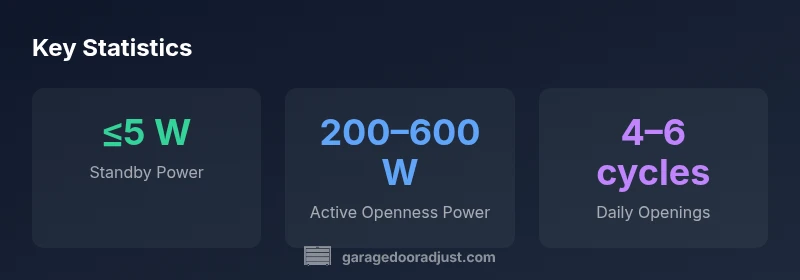
| Aspect | Power (watts) | Notes |
|---|---|---|
| Standby Power | ≤5 | Power drawn by opener when idle |
| Active Operation | 200–600 | Power used during opening/closing |
| Door Lighting | 5–20 | LED light usage when on |
| Estimated Daily Openings | 4–6 cycles | Common for a typical household |
Got Questions?
Do garage doors draw power when not in use?
Only standby power is drawn when idle, typically under 5 watts. This is a small, continuous draw that contributes minimally to energy costs.
Yes, but the idle power draw is usually under five watts.
What determines how much energy a garage door uses?
Model efficiency, motor type, insulation, lighting, and usage frequency all influence energy use. Short activation bursts dominate the electricity cost.
Energy use depends on the opener, insulation, lighting, and how often you open and close it.
Can I reduce energy use without replacing my door?
Yes. Upgrade to LED lighting, improve seals, insulate the door, and enable any available sleep or auto-off modes on the opener.
Yes—LED lights, better seals, insulation, and energy-saving modes can help.
Are smart openers more energy-efficient?
Smart openers can optimize cycles and sleep modes, offering small energy savings, but the difference depends on usage patterns.
Smart openers can save a bit of energy with smart scheduling and sleep modes.
How does insulation affect energy use?
Insulation reduces heat transfer near the garage, which lowers HVAC energy needs; it does not dramatically change the door’s own electrical draw.
Insulation helps the garage stay warmer or cooler, reducing your home’s HVAC load.
How often should I maintain my opener for energy efficiency?
Regular lubrication, tension checks, and sensor alignment prevent extra motor effort and ensure smooth operation, saving energy over time.
Regular maintenance keeps it running smoothly and efficiently.
Can I estimate my yearly energy use from my opener?
Yes, by multiplying the peak wattage during cycles by the number of cycles per day and days per year, considering standby power as a constant small load.
You can estimate by accounting for cycles and standby draw.
“Efficient garage-door systems save energy mainly through smart motor control and low-power lighting; the door itself isn’t a big energy drain when used sensibly.”
Quick Summary
- Standby power is very low; active use is brief.
- Energy use scales with cycles, not door size alone.
- Insulation and lighting choices have meaningful indirect savings.
- Regular maintenance reduces friction-driven power losses.
- Consider energy-saving features in newer openers.