Tilt Garage Door vs Sectional: An Analytical Comparison
A detailed, analytical comparison of tilt garage doors and sectional doors. Learn how headroom, insulation, installation, and maintenance influence value and long-term performance for homeowners. Practical guidance from GarageDoorAdjust.


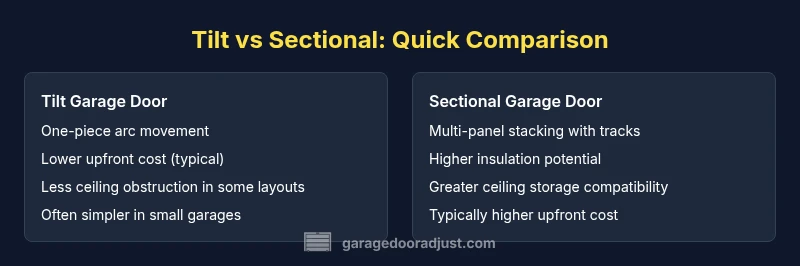
Tilt vs sectional doors: Sectional doors typically deliver better insulation, security, and ceiling clearance, while tilt doors often have lower upfront costs and simpler installation in very tight spaces. For most homes, sectional doors offer greater long-term value. See our detailed comparison chart for specifics.
Introduction to Tilt and Sectional Doors in Practical Terms
When homeowners start planning a garage door project, the core decision often comes down to two dominant designs: tilt garage doors and sectional doors. This quick framing incorporates the keyword and sets the stage for a deeper dive: tilt garage door vs sectional. According to GarageDoorAdjust, the choice hinges on headroom, insulation needs, and maintenance budgets, not just initial price. The GarageDoorAdjust Team emphasizes that the most reliable outcome comes from aligning door type with how a garage is used, climate exposure, and future upgrade plans. Throughout this guide, you will see explicit comparisons, practical scenarios, and plain-language guidance designed for homeowners who want a durable, cost-effective solution without guesswork.
How Tilt Garage Doors Work: Mechanics and Practicalities
Tilt doors are a classic one-piece design that pivots upward as a single unit, typically utilizing a torsion spring or balanced counterweight system. The mechanism is simpler than a multi-panel design, which can translate into faster installation in some garages and potentially lower upfront costs. However, tilt doors rely on a single curved surface that moves along a curved path, which can limit the height and width you can safely cover and might constrain insulation opportunities. The tilt design inherently reduces the amount of track space overhead, and in some layouts, this can be a decisive advantage when ceiling clearance is limited. When evaluating tilt door options, homeowners should weigh the reliability of the hinge assemblies and the availability of replacement components in their region.
How Sectional Doors Work: Panels, Tracks, and Modern Versatility
Sectional doors use multiple hinged panels that slide vertically along tracks and roll into the ceiling cavity of the garage. This design creates a clean, modular profile that can be customized with insulation, weather seals, and low-profile hardware. Sectional doors generally provide higher ceiling clearance for storage and better thermal performance because each panel can be sealed independently. Installation tends to involve more track alignment and hardware mounting, but modern sectional systems offer a wide range of panel finishes, panel thicknesses for energy efficiency, and smart integration options. For homeowners planning future upgrades, sectional doors often accommodate more upgrade paths without structural changes to the opening.
Space, Headroom, and Opening Geometry: Why It Matters
Headroom is the key variable that differentiates tilt and sectional doors in many homes. Tilt doors typically require less overhead space since the door moves in a single arc. Sectional doors need space above the opening to wind and stack panels as they rise, which means a garage with high lift or ample ceiling clearance can accommodate thicker insulation and heavier panels without compromising headroom. If your garage has limited vertical space or sloping ceilings, tilt doors can be an appealing fit. Conversely, if you want maximum free wall space and tall storage options, a sectional door often earns the recommendation. In any scenario, measure the opening height, ceiling height, and the available headroom before you decide, and consider how future renovations might alter those measurements.
Insulation and Thermal Performance: Energy Use and Comfort
Thermal performance varies with the construction quality of each door type. Sectional doors commonly offer superior insulation because the panels can be made with thicker cores and tighter seals, which reduces heat transfer and drafts. A sectional system with insulated skins creates a more complete thermal barrier, improving year round comfort and potentially lowering HVAC costs. Tilt doors, while sometimes adequate for milder climates or non-insulated models, typically have more surface area exposed to the wind and weather at the temperatures extremes. If energy efficiency is a high priority, you should push for sectional doors with high R-value panels and robust weather seals. The GarageDoorAdjust analysis underscores that insulation needs are climate dependent and should be matched to energy goals and comfort priorities.
Durability, Maintenance, and Long-Term Reliability
Durability depends on the door’s construction, hardware quality, and frequency of use. Sectional doors benefit from multi panel articulation that distributes stress and reduces the impact of wind loads, though they have more moving parts that can require maintenance over time. Tilt doors have fewer moving subassemblies but can be sensitive to hinge and spring wear since the single-piece surface bears the door’s weight through the arc. Routine maintenance—lubrication of hinges, checking weather seals, inspecting tracks and rollers—applies to both designs, but a sectional door’s heavier insulation and more complex track system may demand more periodic inspection. In general, homeowners who expect frequent use, larger openings, or harsher climates tend to favor sectional doors for longevity and predictable performance, a point echoed in GarageDoorAdjust’s practical recommendations.
Installation and Retrofit Considerations: What You Need to Know
Installation complexity varies by design. Tilt doors can sometimes be installed more quickly due to a simplified mechanism, especially in retrofits where existing frames align well with the single-panel geometry. Sectional doors require precise track mounting and panel alignment, which can extend installation time but pays off with improved opening height control and weather sealing. Retrofit options exist for both designs, but sectional doors often provide more options for upgrading to better insulation, stronger hardware, and smarter openers. If you are working within a tight schedule or a DIY-friendly project, weigh the availability of trained installers and the expected time to complete when choosing between tilt and sectional. The right installer can make a substantial difference in performance and life span.
Safety, Security, and Smart Features: Keeping Your Garage Weather-Ready
Both door types benefit from standard safety features like auto-reverse sensors and manual emergency release, but sectional doors often offer wider accessory ecosystems for smart openers, battery backups, and advanced weather seals. Tilt doors may present fewer channels for adding extraneous hardware, depending on the model, but modern tilt designs can still integrate remote access, security alerts, and robust weatherstripping. When evaluating safety and security, consider the door’s wind load ratings, impact resistance, and the availability of compatible smart features from trusted brands. GarageDoorAdjust notes that weather exposure and family safety priorities should guide the selection process, especially for homes with children or frequent garage usage.
Cost Considerations and Value Over Time: Balancing Upfront and Long-Term Costs
Cost is a central factor in tilt vs sectional decisions. Tilt doors often have lower upfront costs and quicker installation in straightforward openings, which can be attractive for budget-conscious homeowners. Sectional doors typically come with higher upfront costs due to the complexity of panels, tracks, and insulation; however, they tend to offer stronger thermal performance, improved durability, and longer service life, which translates into better long-term value. When estimating cost, shift focus from initial price alone to total cost of ownership, including maintenance, energy savings, and potential renovation needs for fit and function. GarageDoorAdjust’s insights emphasize that the best choice aligns with your climate, usage patterns, and financial timeline, rather than a single price point.
Real-World Scenarios: Choosing the Right Door for Your Home
Consider how you use your garage. If you store vehicles, tools, and seasonal items in a high-use space and you live in a climate with distinct seasons, a sectional door can reduce energy losses and improve comfort, which makes it a strong default choice. If your garage has very limited headroom or you need a cost-effective option for a lightly used space, a tilt door might serve well, especially if you can source replacement parts locally. Real-world installations show that the decision should reflect opening heights, ceiling storage plans, and the potential for future climate upgrades. Consulting a qualified installer who understands your local building codes will prevent common missteps and ensure compliant, safe operation.
Common Misconceptions and Myths: Clearing Up Confusion
One common myth is that all insulated sectional doors are far more expensive and not worth the investment. In reality, the energy savings over time can offset the initial premium, especially in climate zones with cold winters or hot summers. Another misconception is that tilt doors are always cheaper and simpler; while they can be upfront affordable, they may incur higher maintenance costs or limits on headroom that complicate future upgrades. A third myth is that all door types have identical safety features; in practice, modern sectional systems often offer richer safety and smart automation options. Finally, some homeowners assume installation difficulty is the same for every model; this varies with opening size, wall construction, and existing hardware. A thoughtful evaluation with a professional can dispel these myths and lead to a more informed choice.
Comparison
| Feature | Tilt Garage Door | Sectional Garage Door |
|---|---|---|
| Operation | One-piece arc movement | Multi-panel segments that rise and slide along tracks |
| Headroom/Ceiling Space | Low overhead requirement due to arc motion | Requires space above the opening to stack panels |
| Insulation and Thermal Performance | Typically less insulated (varies by model) | Typically higher insulation with insulated panels |
| Durability and Maintenance | Fewer moving parts but hinge/spring wear can be design-dependent | More moving parts; generally durable with regular maintenance |
| Installation Complexity | Often quicker installation for simple openings | More complex installation due to tracks and alignment |
| Upfront Cost and Value | Lower upfront cost in many cases | Higher upfront cost but typically better long-term value |
| Best For | Tight headroom, budget-conscious projects | Energy efficiency, durability, and storage flexibility |
Upsides
- Lower upfront cost for tilt doors in suitable openings
- Quicker installation in tight headroom scenarios
- Fewer exposed components can simplify some maintenance
- Versatile styling options in many sectional models
Disadvantages
- Lower insulation and energy efficiency with many tilt designs
- More complex maintenance in sectional door systems due to multiple panels
- Ceiling clutter potential when stacking panels in sectional configurations
- Higher upfront cost for sectional doors with premium materials
Sectional doors are the more versatile and energy-efficient choice for most homes.
Choose sectional for better insulation, durability, and ceiling clearance. Tilt is worth considering when you have very limited headroom or a tight budget, but it often trades long-term value for short-term savings.
Got Questions?
What is the main difference between tilt and sectional garage doors?
Tilt doors are a single-panel design that lifts in an arc, while sectional doors use multiple panels that slide up and into the garage ceiling. Sectional doors typically offer better insulation and headroom flexibility, whereas tilt doors can be simpler and cheaper upfront in certain layouts.
Tilt is a single panel that tilts up; sectional uses stacked panels that rise. Sectional generally handles insulation and space better.
Which door is cheaper upfront, tilt or sectional?
Tilt doors often have lower initial costs due to simpler hardware. However, the total cost depends on opening size, required insulation, and whether upgrading tracks or weather sealing is needed.
Tilt doors usually cost less at install, but overall price depends on your garage and insulation choices.
Which door is better for insulation and energy efficiency?
Sectional doors with insulated panels typically provide superior energy performance, helping reduce drafts and HVAC load in most climates.
Sectional doors usually insulate better, especially with insulated panels.
Can tilt doors be insulated or retrofitted for better efficiency?
Yes, some tilt models offer insulated skin options, but retrofitting insulation is often less effective than installing a properly insulated sectional door and may require professional adjustment.
Insulation is possible with some tilt models, but sectional might be easier to upgrade well.
Are tilt doors safer than sectional doors?
Both door types include standard safety features like auto-reverse and manual release. Sectional doors often have more mature safety and smart opener ecosystems, but proper installation is crucial for either type.
Both are safe when installed correctly; sectional doors usually have more advanced safety options.
How long do tilt and sectional doors typically last?
Lifespan depends on use, climate, and maintenance. Sectional doors often offer longer service life due to modular panels and stronger hardware, while tilt doors rely on the longevity of a single surface and hinge mechanisms.
Durability varies; sectional doors tend to last longer with proper maintenance.
Quick Summary
- Assess headroom before choosing door type
- Prioritize insulation for energy efficiency in colder climates
- Expect higher upfront costs with sectional doors but greater long-term value
- Plan for installation complexity and track alignment in sectional designs
- Consider future storage needs and potential upgrades when selecting a door type