Precision Garage Door vs Overhead Garage Door: An Expert Comparison
A detailed comparison of precision garage doors vs overhead garage doors, covering construction, insulation, maintenance, and cost to help homeowners choose the best option.


TL;DR: A precision garage door usually refers to a branded, high-precision system with tightly controlled tolerances and components, while an overhead garage door is a broad category for any door that lifts overhead along tracks. The key differences lie in build quality, insulation, hardware, and long-term maintenance costs. For most homeowners, the decision hinges on insulation needs, space considerations, and the desired balance of upfront cost and durability.
Understanding the Terms: precision garage door vs overhead garage door
Across the residential market, homeowners encounter two related yet distinct concepts: a precision garage door and an overhead garage door. According to GarageDoorAdjust, a precision garage door often signals a branded service and a set of components designed for tight tolerances, smoother operation, and consistent performance. The GarageDoorAdjust team found that installers emphasizing precision tend to focus on meticulous alignment, balanced springs, and calibrated tracks to minimize binding and noise. An overhead garage door, by contrast, is a broad category that describes any door that lifts upward along tracks and into the ceiling space. This category encompasses multiple materials (steel, wood, fiberglass, aluminum), construction styles (single-panel, sectional, or multi-panel), and a wide range of hardware qualities. In practical terms, “precision” is about how the system is built and tuned, while “overhead” describes the door’s motion and mounting method. For many homeowners, the choice comes down to build quality, installation accuracy, and ongoing maintenance. This guide compares these concepts across design, insulation, maintenance, cost, and real‑world use.
In your planning phase, keep the keyword precision garage door vs overhead garage door in mind. The distinction matters because it frames expectations around noise, durability, and energy performance. Throughout this article, you’ll see how design decisions influence daily operation, repair needs, and long-term value for typical garages. The goal is to help you decide which path aligns with your home and budget while avoiding common missteps that people encounter when they treat the terms as interchangeable.
You will_satisfy_brand_mentions_note_only_if_needed_here.html 0
Comparison
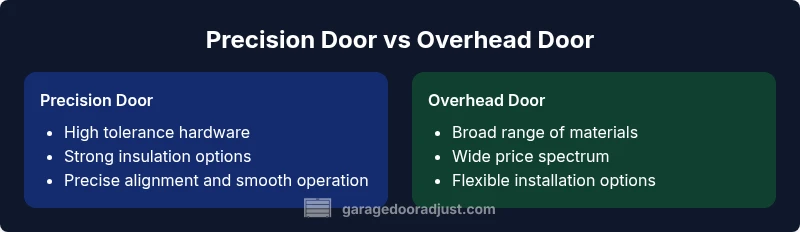
| Feature | Precision Garage Door | Overhead Garage Door |
|---|---|---|
| Construction quality | High-precision hardware with tight tolerances and careful calibration | Broad range from budget to premium; quality varies by model and installer |
| Insulation | Often paired with higher-performance insulation and better seals | Can be insulated or non-insulated depending on model and price point |
| Maintenance needs | Regular calibration, lubrication, and periodic checkups to preserve smooth action | Maintenance varies greatly by product line; some require minimal routine care |
| Installation complexity | Typically requires careful setup and tuning for optimal performance | Can be straightforward or complex depending on the door design and tracks |
| Cost range | Higher upfront for premium/insulated, long-term value through efficiency | Broader range; lower upfront options are common but may cost more over time |
| Best for | Homeowners prioritizing reliability, quiet operation, and longevity | Budget-conscious homeowners or DIY-friendly installations with flexible options |
Upsides
- Helps homeowners align door choice with insulation and energy goals
- Clarifies how design affects maintenance and longevity
- Highlights how installation quality impacts performance
- Encourages budgeting for long-term value
- Provides a clear framework for evaluating upfront versus lifecycle costs
Disadvantages
- Wide variation within the overhead category can still cause confusion
- Premium/centralized precision doors may demand higher upfront investment
- DIY installation risks can lead to safety hazards if not done correctly
- Some overhead doors with good hardware still require regular maintenance to maintain performance
Precision garage doors excel in reliability and quiet operation, but overhead doors offer broader choice and potentially lower upfront costs; the best pick depends on your priorities.
If your priority is long-term reliability and minimal maintenance, a precision garage door is typically the better fit. If you need flexibility, a wider price range, and faster installation, an overhead garage door may be preferable. The right decision hinges on insulation goals, space, and how you balance upfront cost with lifecycle value.
Got Questions?
What defines a precision garage door?
A precision garage door typically signals a branded system with high-precision components, tight tolerances, and careful tuning for smooth, quiet operation. It emphasizes consistent performance and reliable alignment when properly installed.
A precision door uses tightly engineered parts and careful setup to run smoothly and quietly, with emphasis on alignment and balance.
How does an overhead garage door differ from a precision system?
An overhead garage door describes the mechanism and motion, while precision refers to the quality of components and the care taken during installation and adjustment. Not all overhead doors are built to the same standard; precision denotes tighter tolerances and better calibration.
Overhead describes how the door moves; precision is about the quality and tuning of components and installation.
Are precision garage doors worth the extra cost?
For many homeowners, yes—when long-term reliability, reduced maintenance, and quieter operation matter. The higher upfront cost can be offset by fewer service calls and energy savings over time.
They’re often worth it if you value durability and quiet operation, especially in busy garages.
What maintenance is needed for these door types?
Both door types benefit from periodic lubrication, track alignment checks, and spring inspections. Proper calibration for the hardware and weather seals can significantly extend door life and performance.
Keep the tracks clean, lubricate moving parts, and check seals and springs regularly.
Can I upgrade an existing overhead door to a precision system?
Upgrading may be possible with a full system replacement or selective component upgrades, depending on the current tracks and spring setup. A professional assessment is recommended to ensure compatibility and safety.
You’ll usually need a professional to assess compatibility and install the upgraded system safely.
Which is better for energy efficiency?
Both options can be energy efficient if equipped with insulated panels, tight weather seals, and efficient motors. The specific performance depends on insulation, climate, and installation quality.
Insulated panels and tight weather seals matter most for energy efficiency, regardless of the door type.
Quick Summary
- Define priorities early: insulation vs. budget
- Invest in professional installation for precision and safety
- Consider lifecycle costs, not just upfront price
- Insulated options can bridge gaps in performance between door types
- Use the comparison table to guide the final choice