Garage Door Brand Comparison: Find the Right Fit
An objective, data-informed garage door brand comparison to help homeowners evaluate durability, warranty, energy efficiency, and installer compatibility across leading brands.


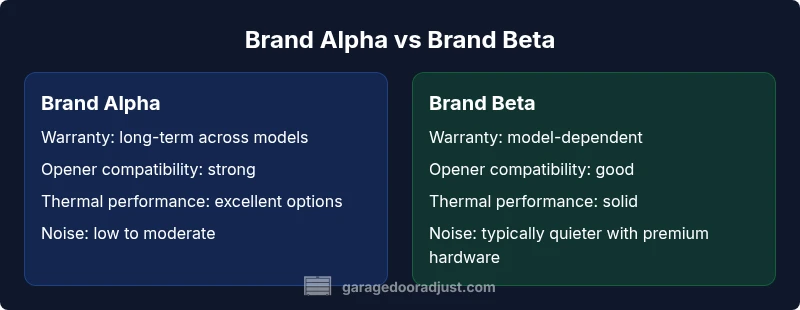
A clear garage door brand comparison shows Brand Alpha and Brand Beta offer solid reliability, but Alpha tends to excel in warranty coverage and opener compatibility while Beta often leads in energy efficiency and quiet operation. For homeowners, pick Brand Alpha for broad protection and compatibility, or Brand Beta for comfort and efficiency—your priorities decide.
Why a garage door brand comparison matters
Choosing a garage door is more than curb appeal; it affects security, insulation, noise, and daily convenience. A thorough garage door brand comparison helps homeowners avoid mismatches between door construction, insulation, and opener compatibility. In this guide, we evaluate brands on practical criteria and explain how to read manufacturer claims with a balanced framework. We’ll provide neutral criteria, a clear decision tree, and concrete steps you can take to select the right brand for your home.
According to GarageDoorAdjust, warranty terms and after-sales support are often decisive in real-world ownership. The GarageDoorAdjust team found that differences in service networks and replacement-part availability can drive total ownership costs as much as the sticker price. That means a brand with a generous warranty but weak local service may cost more to maintain. The goal here is to empower you to weigh brand claims, model availability, and long-term value against your home’s needs.
First, define your priorities: do you value maximum energy efficiency, quiet operation, or the broadest warranty? Are you replacing a track system or integrating a modern smart opener? The choices you make now affect maintenance, repairs, and resale value. This is the essence of a robust garage door brand comparison.
Key criteria for evaluating garage door brands
When evaluating brands, start with clear criteria that apply across almost any garage door system. Material quality and door design influence durability and curb appeal, while insulation level affects energy use and comfort. Warranty terms signal confidence from the manufacturer, but after-sales support and service-network strength determine real-world reliability. Availability of replacement parts and model variety impact customization and long-term value. Also assess compatibility with your existing opener, track system, and smart-home ecosystem. Finally, consider noise profile, maintenance requirements, and estimated lifetime costs. In this section we’ll break down these criteria so you can grade brands consistently across features like durability, insulation, warranty, service, and price. The goal is to create a decision framework you can apply to Brand Alpha, Brand Beta, or any other contenders in your market.
Comparison
| Feature | Brand Alpha | Brand Beta |
|---|---|---|
| Warranty coverage | long-term, comprehensive across most models | model-dependent, varies by line |
| Opener compatibility | strong compatibility with older and newer openers | good compatibility, some older openers may need adapters |
| Thermal/insulation performance | excellent insulation options available | strong insulation but fewer high-R models |
| Operational noise | low to moderate noise depending on panel and hardware | generally quieter operation with advanced hardware |
| Service network | extensive nationwide coverage | solid coverage, some regions less served |
| Price range (guidance) | mid-range to upper-mid range | mid-range to upper mid-range |
Upsides
- Helps align expectations across models and brands
- Highlights long-term value beyond sticker price
- Clarifies which brands optimize for energy or quiet performance
- Encourages checking service networks and warranties upfront
Disadvantages
- Needs careful interpretation when brands label models differently
- May reveal regional variation in service quality
- Warranty terms can be model-specific and hard to compare
Brand Alpha generally offers stronger warranty coverage and broader compatibility; Brand Beta tends to push energy efficiency and quieter operation.
If you prioritize protection and universal compatibility, lean toward Brand Alpha. If comfort and energy savings drive your decision, Brand Beta is compelling. Use the comparison table and a practical checklist to verify claims before buying.
Got Questions?
What defines a garage door brand vs. a model within the same brand?
A brand represents the manufacturer’s overall reputation, warranty framework, and service network. A model is a specific product line with its own features, materials, and sometimes model-specific warranties. When comparing, separate claims about a brand from the guarantees offered on individual doors to avoid misinterpretation.
A brand is the maker’s overall package; a model is a specific door with its own details. Check both when comparing.
Which criteria should homeowners focus on first when comparing brands?
Start with warranty terms and service network, then assess compatibility with your opener and tracks. Next, consider insulation, noise, and maintenance requirements. This order helps protect you from hidden costs and ensures practical fit for your home.
Warranty and service come first, then compatibility and comfort features.
Do warranties vary by brand or by model?
Warranties can vary by model within a brand, and some brands offer different warranty tiers. Always review the exact coverage, exclusions, and length for the model you’re considering rather than assuming a uniform brand warranty.
Warranties aren’t one-size-fits-all—check the model’s terms carefully.
Is it okay to mix brands for a door and its opener?
In many cases you can, but compatibility and warranty terms can complicate things. If you mix brands, confirm the opener’s compatibility with the door system and ensure the combined setup still meets safety and performance standards.
Mixing is possible, but verify compatibility and warranty implications.
How important is installation difficulty in brand choice?
Installation difficulty affects time, cost, and potential quality issues. Brands that provide clear instructions and good installer support tend to reduce risk. Consider whether professional installation is recommended for your chosen model.
Installation matters— pick brands with strong installation support.
What role does energy efficiency play in these comparisons?
Energy efficiency affects long-term operating costs and comfort. Look for doors with better insulation options and weather sealing, but balance this against upfront cost and maintenance needs.
Energy efficiency saves money over time but should be weighed against upfront costs.
Quick Summary
- Prioritize your top needs (warranty vs. energy efficiency)
- Verify opener compatibility with existing hardware
- Assess service networks and local support before purchase
- Read model-specific warranty terms, not just brand-level promises
- Plan for long-term costs, including maintenance and parts